
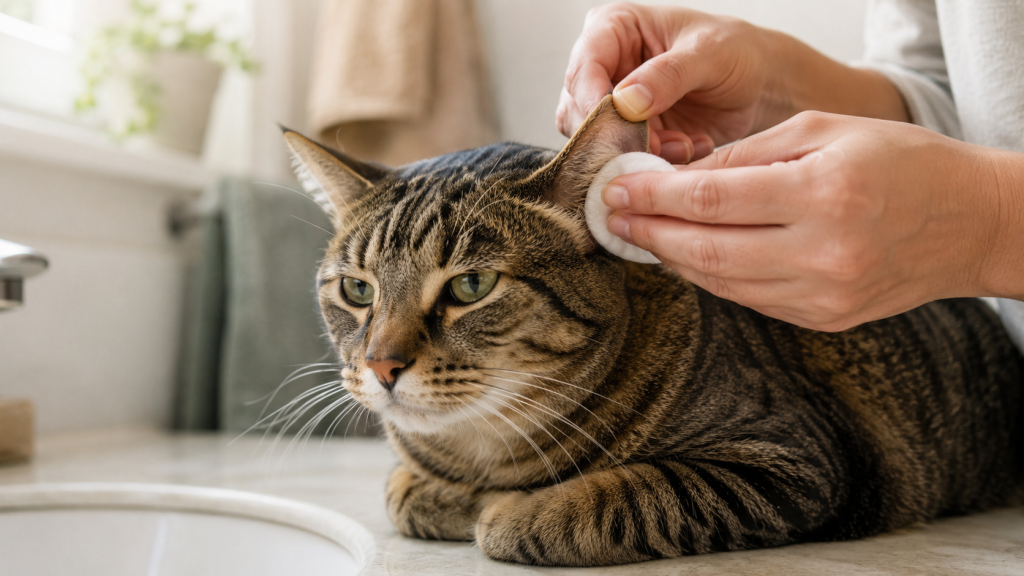
You notice dark wax in your cat’s ear, or maybe one ear suddenly looks dirtier than usual. It is easy to wonder whether you should clean it, treat it, or leave it alone.
The safest answer is simple: most cats with healthy ears do not need routine ear cleaning. Check the ears regularly, but clean only when there is mild debris and the ear looks comfortable.
For me, the safer way to think about it is this: checking is normal care. Cleaning is selective care. Treating is veterinary care.
Check Often and Clean Only When Needed
Most cats do not need their ears cleaned on a weekly or monthly schedule. A healthy cat ear can have a small or moderate amount of wax, and even dark brown waxy debris is not automatically a problem if your cat seems comfortable.
What matters is the whole picture. Color alone does not diagnose ear mites, yeast, infection, or anything else. Odor, redness, swelling, pain, scratching, head shaking, discharge, or debris that comes back quickly matters much more.
Gentle home cleaning may be reasonable when the ears are only mildly dirty, your cat is calm, there is no bad smell, no redness, no swelling, no injury, and no sign of pain. If any of those signs are present, skip cleaning and call your veterinarian instead.
What Normal and Concerning Cat Ears Can Look Like
The goal is not to make your cat’s ears look spotless. The goal is to know what is normal for your cat, then notice when something changes.
| What you notice | Safer interpretation |
|---|---|
| Small or moderate wax, cat acts comfortable | Often not urgent. Monitor, or clean gently only if needed. |
| Dark wax but no smell, pain, redness, or scratching | Not automatically mites. Color alone is not a diagnosis. |
| Bad odor, redness, swelling, pain, heavy discharge, or injury | Do not clean at home first. A veterinary exam is safer. |
| Head shaking, scratching, flattened ears, recurring debris | Possible ear disease, mites, yeast, infection, allergy, or another cause. Call a vet. |
| Head tilt, loss of balance, circling, falling, abnormal eye movement, hearing loss, facial droop, drooling, trouble eating, nausea, or vomiting | Prompt veterinary help. These can point beyond simple dirty ears. |
A one-sided problem that keeps returning also deserves attention. Persistent blockage in one ear can be more than wax, including foreign material, chronic inflammation, polyps, tumors, or middle or inner ear disease.
When Not to Clean Your Cat’s Ears at Home
Do not clean at home if the ear looks painful, inflamed, injured, smelly, swollen, or infected. Cleaning through pain can make things worse and can delay the exam your cat actually needs.
This matters because you cannot reliably know at home whether the eardrum is intact. Some cleaners can irritate the middle or inner ear if the eardrum is damaged, and vigorous cleaning of an already infected ear can create more trouble.
This is where I would stop guessing and call a vet if you see:
- Bad odor from one or both ears
- Redness, swelling, scabs, crusting, or injury
- Thick, wet, gooey, or increasing discharge
- Frequent scratching or head shaking
- Clear pain when the ear is touched
- Debris that returns quickly after cleaning
- One ear repeatedly looking worse than the other
- Head tilt, balance problems, circling, falling, rolling, odd eye movement, hearing change, facial droop, drooling, trouble chewing, trouble eating, nausea, or vomiting
Heavy debris is not a reason to flush harder. It is a reason to get the ear checked.
What to Use and What to Avoid
Use a cat-safe, veterinarian-approved ear cleaner. That is the conservative choice because cat ears are sensitive, and irritated canals can react badly to harsh or inappropriate liquids.
For wiping, use cotton balls, gauze, or a finger wrapped in gauze. Keep wiping to the ear flap and the part of the canal you can safely reach with that wrapped finger.
Do not put cotton swabs into the ear canal. They can push debris deeper, traumatize the canal, or damage the eardrum.
Also avoid household ear-cleaning experiments. Hydrogen peroxide, alcohol, vinegar, baby oil, and other DIY liquids should not be used unless your veterinarian specifically directs you. Suspected mites or infection need diagnosis and proper treatment, not kitchen-cabinet trial and error.
How to Clean Your Cat’s Ears Step by Step
Only do this when the ear is mildly dirty and your cat is not painful, distressed, or showing red flags.
- Set up calmly. Choose a quiet moment. Have your cleaner, cotton or gauze, and treats ready before you start. If needed, use a loose towel wrap, not forceful restraint.
- Position your cat gently. Many cats do better facing away from you. Keep the session short. If your cat is tense from the start, pause.
- Lift the ear flap. Hold the flap gently so you can see the ear opening. Do not poke inside to inspect deeply.
- Apply the ear cleaner. Use enough cleaner to wet or fill the ear canal, following the product directions. Do not touch the bottle tip to the ear.
- Massage the base of the ear. Massage gently for about 30 seconds. The point is to move cleaner through the canal and loosen debris, not to scrub.
- Let your cat shake. Shaking helps move loosened material outward. Give your cat space and keep your face back.
- Wipe only what you can safely reach. Use cotton or gauze to wipe the ear flap and accessible outer canal. Go no deeper than a finger wrapped in cotton or gauze can comfortably reach.
- Stop before it becomes a fight. Reward your cat. If the ear still looks very dirty, smells bad, seems painful, or your cat resists hard, stop and call a vet.
Do not keep repeating the process until the ear looks perfectly clean. Over-cleaning can irritate the canal and may contribute to ear problems.
Why This Method Works
A cat’s ear canal has a deeper horizontal section where debris can sit. You cannot safely scrape that area clean at home.
The cleaner loosens debris. The massage helps the liquid move through the canal. The head shake brings loosened material outward. Your job is only to wipe what has come within safe reach.
Think outward movement, not inward digging. That one idea prevents most owner mistakes.
What If You See Black Stuff in Your Cat’s Ear?
Black debris is not a diagnosis. It can be normal waxy material, but it can also appear with ear mites, yeast, infection, or other ear disease.
Ear mites are often linked with dark, gooey, sometimes foul-smelling buildup. Cats may scratch, shake their heads, flatten their ears, or have inflammation. Mites are contagious between cats through close contact and are more common in outdoor cats, especially cats that mix or fight with other cats.
Still, you should not try to identify mites by sight at home. A veterinarian may need to examine the ear with an otoscope or look at debris under a microscope. Treatment depends on the cause, and cleaning alone does not treat mites, yeast, bacteria, allergy, polyps, or middle-ear disease.
In a multi-cat home, I would be especially cautious about guessing. If one cat truly has mites, close-contact cats may also need veterinary guidance.
How Often Should You Clean a Cat’s Ears?
There is no universal schedule. Many cats never need ear cleaning.
Clean only when there is a reason, such as mild debris in an otherwise comfortable ear, or when your veterinarian has given you a specific plan. Some cats prone to wax buildup or ear disease may need individualized care, but that schedule should come from a vet.
If debris returns quickly after cleaning, do not simply clean more often. Recurring debris is a clue. It may mean the ear needs diagnosis, not more wiping.
If Your Cat Fights Ear Cleaning
Stop if your cat seems painful, panicked, or defensive. Resistance can be fear, but it can also be pain.
Short, calm handling is safer than overpowering your cat. Try a loose towel wrap, treats, and minimal handling. If your cat repeatedly escapes, hisses, bites, or seems distressed, let the clinic show you the process or handle the cleaning.
Forcing the issue can make future ear care harder. It can also hide the more important message: this ear may hurt.
If Your Cat Is Already on Ear Medication
Do not improvise cleaning around prescribed ear medication. Many treatment plans involve cleaning before applying drops, but not always in the same way or on the same timing.
Ask your veterinarian whether to clean first, whether to wait between cleaner and medication, and how often to clean. Some cleansers can weaken or interfere with medications, so the prescription instructions matter.
If the ear is infected or very painful, your cat may need professional cleaning, testing, or rechecks. Home cleaning is support care, not the treatment plan by itself.
Indoor, Outdoor, Older, and Special-Case Cats
Outdoor cats and cats with close contact with other cats have more opportunity for ear mites. Indoor cats are not automatically protected from dirty ears, mites, infection, or grooming-related buildup.
Older cats, cats with unusual ear anatomy, cats with prior ear disease, and cats that no longer groom well may need a more tailored plan. I would not put these cats on a generic cleaning schedule without veterinary input.
The best routine is simple: look regularly, learn your cat’s normal, clean gently only when appropriate, and act quickly when the pattern changes.
What to Remember
Cleaning a cat’s ears is not a routine chore for every cat. Most healthy cats need regular checking, not regular cleaning.
When cleaning is appropriate, use a vet-approved cat ear cleaner, massage gently, let your cat shake, and wipe only the visible, reachable areas. No cotton swabs in the canal. No peroxide, alcohol, vinegar, baby oil, or DIY remedies.
If there is odor, pain, redness, swelling, heavy discharge, head shaking, scratching, balance changes, or recurring debris, stop cleaning and call your veterinarian. Dirty-looking ears are sometimes just wax, but they can also be your cat’s way of showing that something deeper is going on.
References
- VCA Hospitals: Instructions for Ear Cleaning in Cats – ear-cleaning steps, safe wiping limits, product cautions, cotton swab warning, frequency guidance.
- PetMD: How to Clean Your Cat’s Ears – when gentle home cleaning may be appropriate, when not to clean, black debris context.
- VCA Hospitals: Inner Ear Infection in Cats – eardrum caution, risks of vigorous cleaning in infected ears, serious inner-ear signs.
- Cornell Feline Health Center: Ear Mites – mite signs, contagious spread, diagnosis, treatment needing veterinary direction.
- MSD Veterinary Manual: Otitis Externa in Cats – ear disease signs, possible causes, caution against irritating home remedies.
- Cornell Feline Health Center: Feline Ear Disorders – routine ear observation, signs that need veterinary attention, age and ear-anatomy context.