Finding urine on a wall, curtain, sofa, door, or pair of shoes feels personal. It also makes the house smell bad fast, so it is completely understandable to want one clear fix.
The safest way to stop a cat from spraying is to treat the spray mark as a clue. Your cat may be communicating stress, sexual motivation, conflict with another cat, outdoor-cat pressure, a litter-area problem, or pain that needs veterinary care.
I would not start with punishment. I would start with one question: is this true spraying, ordinary peeing outside the box, or a possible urinary warning sign?
The short answer is to stop the reason, not just the stain
To stop cat spraying, rule out medical trouble first, then reduce the trigger that makes your cat feel the need to mark. Cleaning helps, but it rarely solves spraying on its own.
- Check for urgent urinary signs. Straining, crying, blood, repeated trips, or little to no urine means calling a vet or emergency vet.
- Book a vet visit for new, persistent, or unexplained urine outside the box. Spraying can overlap with urinary disease, pain, arthritis, constipation, or other health issues.
- Confirm whether it is spraying. Spraying is often a small amount of urine on a vertical or socially meaningful surface, but marking can happen on horizontal surfaces too.
- Talk to your vet about spay or neuter surgery if your cat is intact. It helps many cats, especially intact males, but it is not a guaranteed cure.
- Map the pattern. Location, timing, surface, household changes, outdoor cats, and intercat tension usually matter.
- Clean with an enzymatic cleaner. Avoid ammonia-based cleaners because they can smell urine-like to cats.
- Reduce stress and conflict. Spread litter boxes, food, water, resting spots, hiding areas, and scratching options through the home.
- Do not punish. Fear and anxiety can make marking worse.
Is your cat spraying or peeing outside the box?
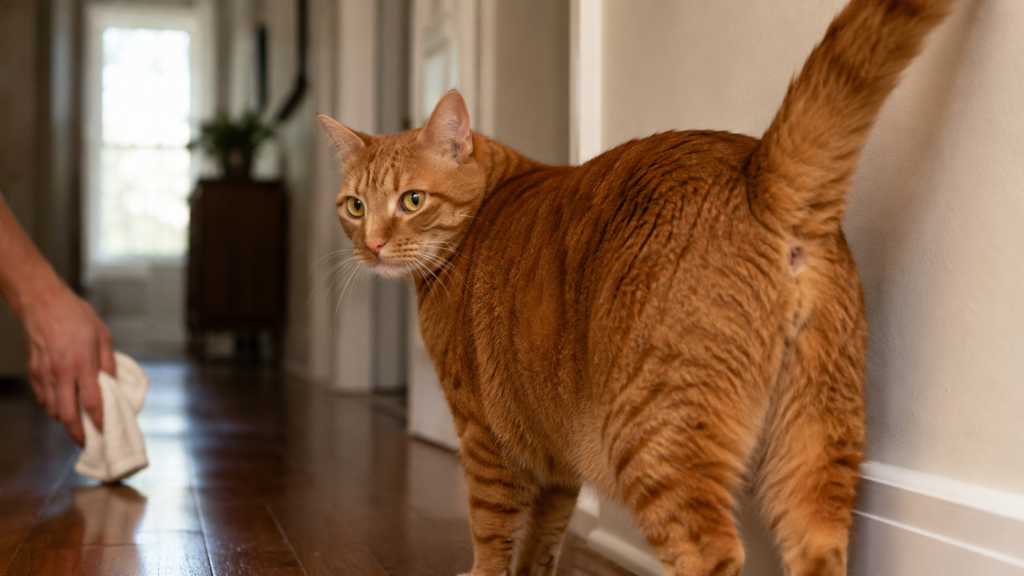
Spraying usually means urine marking, not full bladder emptying. A spraying cat often stands, lifts the tail, may quiver the tail, and leaves a small amount of urine on a wall, door, furniture, curtain, bag, bed, or other meaningful spot.
There is no perfect wall-versus-floor rule, though. Urine marking can happen on horizontal surfaces too. If you are unsure, treat the situation as possibly medical until your vet helps you sort it out.
| What you see | More like spraying or marking | More like toileting outside the box |
|---|---|---|
| Amount | Usually small | Often a full pee |
| Posture | Standing, tail up, tail may quiver | Squatting to empty the bladder |
| Surface | Often vertical, but not always | Often horizontal |
| Location | Doors, windows, furniture, bags, laundry, beds, new objects, travel paths | Carpet, floor, bathmat, bedding, or another chosen toilet area |
| Litter box use | Cat may still use the box normally | Cat may avoid the box or use it inconsistently |
This distinction matters because the fix changes. A cat marking near a window may be reacting to outdoor cats. A cat peeing large amounts beside the box may be dealing with pain, box access trouble, substrate preference, or another health or litter-area problem.
When spraying is a vet issue first
Any new, persistent, or unexplained urination outside the litter box deserves a veterinary check. That includes urine marking. I know that can feel frustrating when you just want the smell gone, but guessing wrong can miss pain or urinary disease.
Call a veterinarian promptly if your cat is urinating outside the box and you do not know why. A vet may recommend a physical exam and urine testing. Urinary pain, increased frequency, incontinence, systemic illness, arthritis, constipation, gastrointestinal disease, and learned litter aversion can all overlap with marking.
Get urgent veterinary care if you see repeated trips to the litter box, straining, crying while trying to urinate, blood in the urine, frequent genital licking, lethargy, vomiting, or little to no urine. A cat with a urethral obstruction may pass little or no urine and can become critically ill in less than 24–48 hours. A male cat who cannot pass urine is not a home behavior project.
I would also be more cautious with older cats, overweight cats, cats with limited mobility, and cats who suddenly change their bathroom habits. Arthritis or pain can make a box too hard to enter, too far away, or too risky if another cat blocks the path.
Why cats spray
Cats spray to communicate with scent, not to punish you. Urine can carry information about presence, reproductive status, and emotional state. For the cat, adding scent to a spot can make the area feel more familiar or safer.
Common triggers include sexual motivation, stress, anxiety, outdoor cats, new smells, new furniture, household changes, conflict with other cats, and pressure around resources. Indoor cats can still feel territorial pressure if they see, hear, or smell neighborhood cats through windows, doors, or vents.
This is why I do not like the revenge explanation. It makes the owner angry and makes the cat less safe. A better question is: what changed in the cat’s world, or what need is not being met?
Neutering helps, but it is not the whole answer
Both male and female cats can spray, but spraying is most common in intact males. Spaying or neutering can reduce the motivation to mark and can change urine odor, so it is worth discussing with your vet if your cat is not fixed.
Still, neutering is not magic. About 10% of neutered males and about 4–5% of spayed females may continue to mark. If your neutered cat sprays, look for stress, outdoor-cat triggers, intercat tension, pain, or resource problems instead of assuming the behavior is simply hormonal.
Make a spray map before you change everything
The best spray plan starts with a simple log. You are looking for a pattern, not trying to prove your cat is bad.
- Where is the urine?
- Is it a small spray or a full puddle?
- Did the cat stand, squat, lift the tail, or quiver the tail?
- What time of day does it happen?
- Is the spot near a window, door, cat flap, hallway, bed, laundry, bag, or new object?
- Have there been guests, schedule changes, remodeling, new furniture, new pets, or a missing person or pet?
- Could outdoor cats be visible or leaving scent nearby?
- In a multi-cat home, which cat is actually involved?
In multi-cat homes, do not assume the culprit is the cat you suspect most. More than one cat may be marking. Video of a frequently marked spot can be very helpful, and all suspected cats may need veterinary assessment if urine issues are ongoing.
A diary also helps you notice progress. Going from several sprays a day to a couple per week is not finished, but it is real improvement.
Clean the urine, then change the message
Use an enzymatic pet-odor cleaner on sprayed areas. These cleaners are designed to break down urine odor rather than just cover it. Avoid ammonia-based cleaners because urine contains ammonia, and that smell may draw a cat back to the same spot.
Cleaning is necessary, but it can also remove the scent message your cat was trying to leave. If the reason for spraying is still there, your cat may come back and refresh the mark.
If your cat repeatedly marks one or two places, clean first, then change the function of the area. Some cats are less likely to mark near feeding, resting, playing, or scratching spots. A small feeding station, cozy bed, scratcher, or regular play session in that area may help after medical causes and major stressors are addressed.
For stubborn, repeated marking, ask your vet or a veterinary behavior professional about harm-reduction options, such as a washable spraying station or vertical litter setup. The goal may first be to move the urine to a controlled surface while you work on the deeper trigger.
Block outdoor-cat triggers
If spraying happens near windows, doors, glass sliders, cat flaps, or exterior walls, outdoor cats should be high on your suspect list. Your indoor cat may be reacting to sight, sound, or scent from neighborhood cats.
Try limiting close-up views with blinds, opaque window film, or closing off a room at problem times. Keep windows closed if outdoor scent seems to drift in. If outside cats gather near windows, humane deterrents such as motion-activated sprinklers may help move them away.
This is environmental management, not punishment. Your cat is not being dramatic. From a cat’s point of view, an unfamiliar cat outside the core living area can be a real social threat.
Reduce tension in multi-cat homes
Intercat tension can be subtle. Cats do not need to fight loudly for one cat to feel unsafe. Staring, blocking doorways, guarding food, chasing, hiding, tail twitching, time-sharing rooms, or preventing access to the litter box can all matter.
I would not frame this as dominance. The practical goal is to lower threat and resource pressure. Give each cat or social group enough space to eat, drink, rest, hide, scratch, and toilet without crossing another cat’s path.
For litter boxes, a good starting point is one box per cat plus one extra. Spread them out. Side-by-side boxes often function like one resource, so they may not solve blocking or tension. Put boxes where the cat actually spends time, not only in a remote basement or busy laundry room.
Useful box details matter. Many cats prefer unscented, fine-textured litter around one to two inches deep. Scoop daily, and clean boxes regularly. Large cats need larger boxes. Kittens, elderly cats, and cats with joint pain may need low-sided boxes. Many cats prefer uncovered boxes, especially if they feel trapped or ambushed.
Give your cat acceptable ways to mark
Spraying is one kind of scent marking, but cats also mark by rubbing their face and body, scratching, and using familiar resting spots. You do not need to erase every cat scent from the home. You need to clean urine while preserving safe, acceptable scent routines.
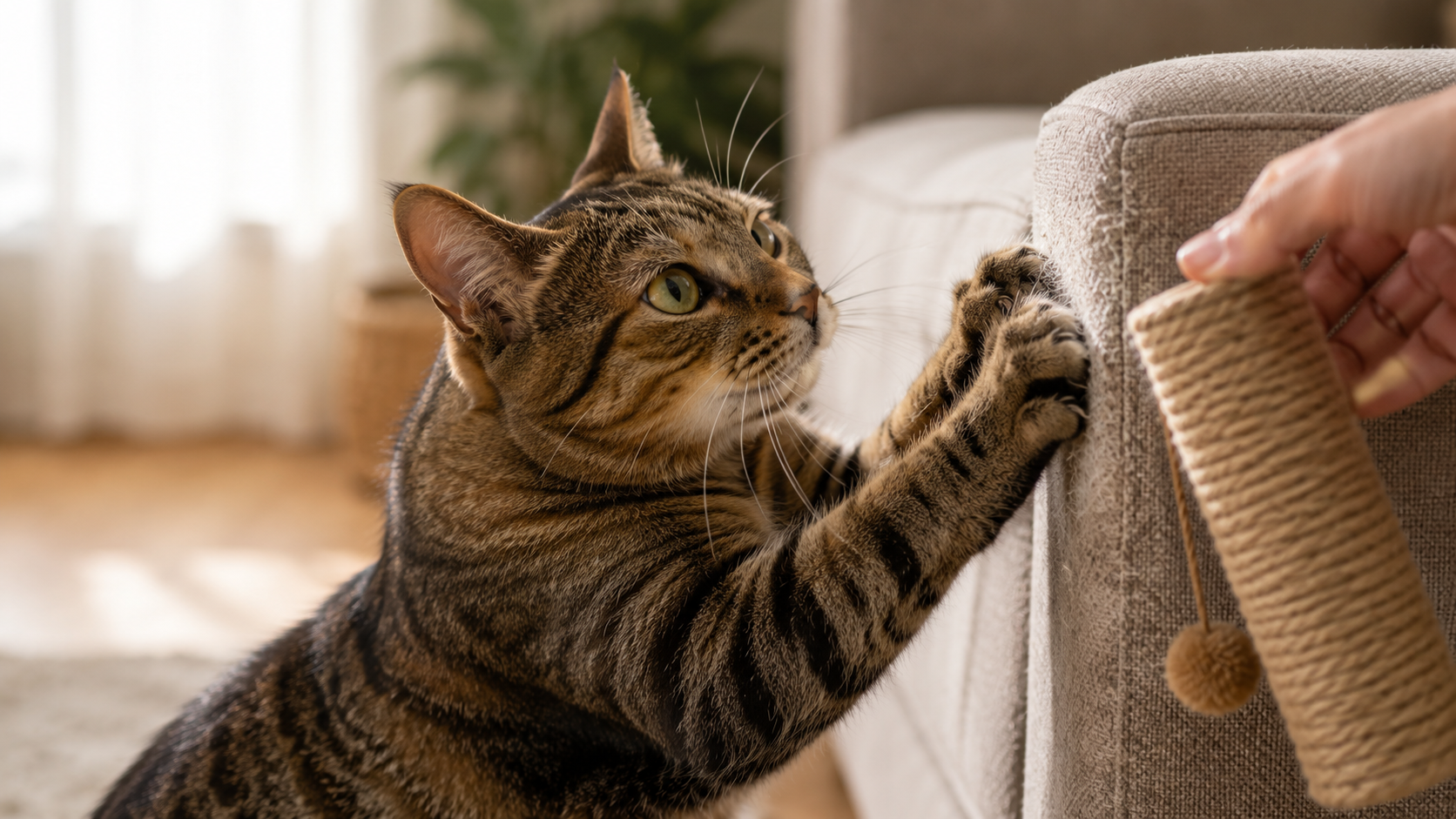
Add scratching posts, rubbing surfaces, perches, hiding spots, and comfortable beds in the areas your cat uses most. Keep routines predictable when you can. Introduce new furniture, cleaners, litter, and household changes gradually when possible.
After a spraying episode, it is tempting to wash every blanket, scrub every surface, and add strong fragrances. I would be careful with that. Clean urine thoroughly, but do not make the entire home smell unfamiliar overnight.
Use pheromones as support, not a guaranteed cure
Synthetic feline pheromone products may help some cats feel calmer and may reduce urine marking in some situations. They are best treated as support, not as the whole plan.
A diffuser or spray is more likely to help when you are also addressing the trigger: outdoor cats, intercat tension, poor litter-box access, new smells, or household stress. Pheromones do not replace a vet visit if your cat has pain, blood, straining, or sudden urinary changes.
Medication can help some cats when spraying is linked to anxiety or chronic stress, but this belongs with a veterinarian, veterinary behaviorist, or qualified behavior professional. Do not give human medication, leftover medication, supplements, or sedatives as a spraying fix.
What not to do
Punishment is one of the biggest mistakes with spraying. Do not rub your cat’s nose in urine, yell, throw things, spray water, or chase the cat from the area. Fear can increase anxiety, and anxiety can increase marking.
Do not rely on perfume, bleach smell, strong deodorizers, vinegar, essential oils, or ammonia cleaners as the solution. Covering the odor is not the same as removing the urine message, and strong scent changes can make some cats feel less secure.
Do not make diet the main answer unless your vet has found a urinary reason. Veterinary urinary diets may have a role in specific urinary conditions, but food is not a general cure for spraying. Avoid urinary supplements or acidifiers unless your vet specifically recommends them.
When to get more help
Get veterinary or behavior help if spraying is new, frequent, spreading to many areas, linked with aggression, happening in a multi-cat home where you cannot identify the cat, or continuing after basic changes. I would also stop guessing if the cat seems anxious, painful, older, or suddenly different in any way.
A good plan may include medical testing, neutering if appropriate, environmental changes, litter-area changes, pheromone support, behavior modification, and, in some cases, veterinary medication. The right mix depends on your cat, your home, and the pattern of marking.
What to remember
Stopping a cat from spraying usually means working backward from the stain. Is this urgent urinary trouble? Is it true marking? What surface, smell, cat, window, routine, or conflict is involved?
Start with safety: call a vet for new, persistent, painful, bloody, or difficult urination. Then clean with an enzymatic cleaner, reduce triggers, spread resources, improve litter access, protect predictable routines, and avoid punishment.
Most cats are not being spiteful. They are telling you something with scent. Your job is to find the reason, lower the pressure, and protect your home while you do it.
References
- PubMed: Feline Urine Spraying Review — urine spraying as feline behavior, contributing factors, and management concepts.
- MSD Veterinary Manual: Behavior Problems of Cats — marking versus toileting, stress-related marking, treatment principles, and punishment warning.
- VCA Hospitals: Cat Marking and Spraying — neutering effect, common triggers, cleaning limits, and changing marked-area function.
- Today’s Veterinary Practice: Diagnosis and Management of Feline Urine Marking — medical rule-out, trigger mapping, multi-cat assessment, and treatment approach.
- Cornell Feline Health Center: Feline Lower Urinary Tract Disease — urinary red flags, obstruction risk, and stress-related urinary disease context.
- Royal Canin Academy: House-Soiling in Cats — medical and behavioral differentials, litter-box setup, arthritis considerations, and non-revenge framing.
- CatVets: Setting Up for Success — feline environmental needs, resource distribution, predictability, and scent-sensitive home setup.
- ASPCA: Urine Marking in Cats — outdoor-cat triggers, enzymatic cleaning, litter-box management, pheromone support, and no-punishment advice.