You may suspect fleas before you ever see one. Your cat might be scratching more than usual, licking the same spot again and again, losing fur near the tail, or leaving tiny black specks on bedding. That is usually the confusing part. With cats, fleas are not always obvious.
A cat can have fleas, or have a strong reaction to flea bites, even if you never catch a live flea crawling through the coat. Cats groom so thoroughly that they may remove the evidence before you find it. Some cats are also highly sensitive to flea saliva, so one or two bites can cause more itching than you would expect.
The safest way to think about it is this: you are not trying to diagnose your cat at home. You are looking for clues. Live fleas, flea dirt, certain itching patterns, tiny scabs, hair loss, household exposure, and signs in other pets can all make fleas more likely.
The clearest signs your cat may have fleas
The strongest signs of fleas are live fleas, flea dirt, repeated scratching or licking, small scabs, and hair loss from overgrooming. You do not need to find every sign. Even one convincing clue, especially flea dirt or a live flea, is enough to take the possibility seriously.
Live fleas are small, dark, fast-moving insects. They may be easier to see in thinner-furred areas or when you part the coat close to the skin. Common places to check include the base of the tail, neck, shoulders, belly, groin, armpits, and between the legs. Fleas and flea debris are often hidden near the skin, not sitting neatly on top of the fur.
Flea dirt is often the more useful clue. It looks like tiny black or dark-brown specks, almost like ground pepper. It is not ordinary dirt. Flea dirt is flea waste made from digested blood, which is why it can leave a reddish-brown stain when wet.
Behavior matters too. A cat with fleas may scratch, bite at the skin, chew at the legs, lick one area repeatedly, or groom so much that the fur starts to thin. Some cats develop tiny scabs, especially around the head, neck, back, or tail base. Others look mostly normal until you notice barbered fur, broken hairs, or irritated skin.
How to check your cat for fleas at home
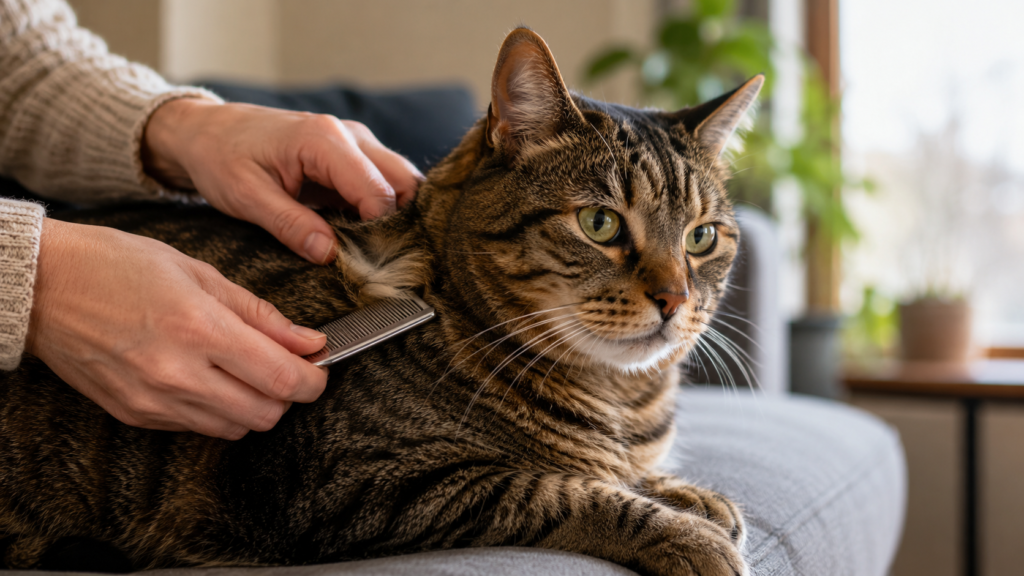
The best home check is to use a fine-toothed flea comb over a white surface. Put your cat on a white towel, white sheet, or piece of white paper if your cat will tolerate it. Then comb slowly through the coat, especially near the tail base, neck, shoulders, belly, and groin.
After each pass, look closely at the comb. You are looking for moving fleas, black specks, or reddish-brown debris. Fleas can move quickly, so do not rely only on a quick glance at your cat’s fur. The comb gives you a better chance of catching evidence close to the skin.
If you find black specks, place them on a damp white tissue or paper towel. Flea dirt often turns reddish-brown when it gets wet because it contains digested blood. This wet paper test is one of the simplest ways to separate flea dirt from ordinary dust.
I would still be careful with absolute certainty here. A reddish smear is a strong clue when it comes from pepper-like debris in the coat, but scabs or dried blood from irritated skin can sometimes confuse the picture. If your cat has sores, crusts, or bleeding skin, stop guessing and ask a veterinarian to check what is actually going on.
Why you may not see fleas even when fleas are the problem
Not seeing fleas does not rule them out. This is one of the biggest mistakes owners make with cats.
Cats are excellent groomers. If a flea bites, your cat may lick, chew, or swallow it before you ever see it. A very itchy cat may also groom so aggressively that the coat looks clean while the skin underneath is irritated.
This becomes even trickier with flea allergy dermatitis, which means an allergic skin reaction to flea saliva. In a sensitive cat, a small number of flea bites can trigger intense itching, scabs, or hair loss. The cat may look far more uncomfortable than the number of visible fleas would suggest.
That is why the question is not only, “Can I see fleas?” A better question is, “Do the signs fit flea exposure?” Flea dirt, itching near the tail base or neck, small scabs, hair thinning, other pets with fleas, or fleas in bedding can all matter.
Flea dirt is the clue many owners miss
Flea dirt is one of the most practical signs to look for because live fleas are easy to miss. It often appears as tiny black dots close to the skin or in places your cat sleeps.
You may notice it when petting your cat, brushing the coat, or cleaning a favorite blanket. On light-colored cats or white bedding, it may be easier to spot. On dark cats, you may need a comb and a white surface.
The wet paper test is worth doing because regular dirt usually stays dark or grayish. Flea dirt often dissolves into a rusty red or reddish-brown mark. That color change happens because the specks contain digested blood.
Do not only check the top of your cat’s back. Flea dirt can collect around the base of the tail, neck, shoulders, belly, groin, armpits, and between the legs. These areas are easy to miss if you only stroke the coat in the usual direction.
Scratching is not the only flea symptom in cats
Some cats scratch a lot when they have fleas, but others show it through licking, chewing, or overgrooming. That is why flea signs in cats can be easy to misread.
A cat may repeatedly lick the belly, chew at the legs, bite near the tail, or groom until the fur becomes thin. You may not see the grooming happen. You may only notice the result, such as bald patches, short broken hairs, or rough-looking fur.
Tiny scabs are another important clue. Some cats with flea-related skin irritation develop many small crusty bumps, often felt more easily than seen. These may be around the head, neck, back, or tail area. They do not prove fleas by themselves, but they are suspicious when they appear with itchiness, flea dirt, or possible flea exposure.
Normal grooming is usually calm, spread across the body, and not causing damage. Concerning grooming is repetitive, intense, focused on one area, or linked with hair loss, scabs, red skin, or broken skin.
What flea allergy can look like
Flea allergy dermatitis can make a flea problem look worse than expected. It is a reaction to flea saliva, not just irritation from insects crawling on the skin.
A cat with flea allergy may scratch, lick, chew, lose hair, or develop small scabs. The signs may appear around the neck, head, back, tail base, groin, belly, or thighs. Some cats show overgrooming more than obvious scratching.
This is where many owners get stuck. They think, “I only saw one flea, so it cannot be causing all this.” But for a sensitive cat, even limited flea exposure may be enough to trigger a bigger skin reaction.
I would be more cautious if a cat has repeated scabs, hair loss, or intense grooming even after you do not see live fleas. At that point, the question is not just whether fleas are present. The question is whether your cat’s skin needs veterinary attention and whether another skin problem is also involved.
How to tell normal grooming from a flea problem
Normal grooming keeps the coat clean. It should not leave bald patches, scabs, raw skin, or repeated broken hairs.
A cat may scratch briefly after waking up or groom after eating. That alone is not unusual. What becomes more concerning is a new pattern, especially if your cat keeps returning to the same spot.
Watch for repeated chewing near the tail base, sudden licking of the belly or legs, scratching around the neck, or grooming that interrupts rest. Also look for visible coat changes. Flea-related irritation may show up as thinning fur, rough patches, small scabs, or irritated skin.
If your cat is grooming more but the skin looks normal, you can still check for flea dirt and monitor closely. If the skin is sore, bleeding, swollen, crusted, or losing fur, I would not treat it as “just grooming.”
Can indoor cats get fleas?
Indoor cats can get fleas. Indoor life lowers some exposure risks, but it does not make fleas impossible.
Fleas can enter a home on other pets, especially dogs or cats that go outside. They may also hitchhike on clothing, used furniture, blankets, carriers, or items that have been in an infested environment. In multi-pet homes, one untreated animal can keep exposing the others.
Indoor environments can also protect fleas from weather. Carpets, rugs, bedding, soft furniture, and cracks in floors can hold immature flea stages. That is why a cat may keep showing signs even if you only found one flea on the body.
For an indoor-only cat, I would look carefully at the whole household. Has a dog been scratching? Did a visiting pet come over? Did you bring in secondhand furniture or blankets? Is your cat sleeping in one place that has black specks or debris? These clues can matter as much as the cat’s coat.
Check your cat’s bedding and favorite spots
Your cat’s favorite sleeping spots can give you extra evidence. Look at bedding, blankets, cat trees, sofa cushions, rugs, and carriers.
You may find black specks, tiny insects, or irritated skin flakes where your cat rests. Flea dirt on bedding can be easier to see than flea dirt on the cat, especially if your cat has dark fur or grooms heavily.
This does not mean you need to panic-clean the entire house before you know what is happening. It means the environment is part of the evidence. Fleas do not spend their whole life as adult insects on your cat. Eggs and immature stages can be in the home, which is one reason flea problems can seem to disappear and then come back.
If you find flea dirt on your cat and debris in bedding, the case becomes stronger. If you find nothing but your cat has ongoing itch, scabs, or hair loss, that still deserves attention because fleas are not the only possible cause.
When fleas become more than a nuisance
Fleas are not just annoying. They feed on blood, and a heavy infestation can be dangerous, especially for kittens.
Kittens, seniors, and cats with health problems deserve extra caution. A small kitten does not have much blood volume to spare. Heavy flea burdens can contribute to anemia, which means the body does not have enough healthy red blood cells to carry oxygen properly.
Warning signs include weakness, unusual tiredness, pale gums, poor appetite, or a very heavy flea burden. If a kitten has fleas and seems unwell, I would treat that as a prompt veterinary situation, not a normal grooming issue.
Fleas can also be linked with tapeworms. Cats may swallow infected fleas while grooming. One sign owners may notice is small rice-like segments near the anus, stuck in fur, or in fresh stool. If you see that, contact a veterinarian rather than trying to handle it with guesswork.
When to contact a veterinarian
Contact a veterinarian if your cat has ongoing itching, hair loss, scabs, bleeding skin, sores, swelling, weakness, pale gums, poor appetite, or signs that keep coming back. You should also call sooner for kittens, elderly cats, cats with existing health problems, or cats that seem uncomfortable or unwell.
A vet visit is also the safer choice if you cannot find fleas but your cat’s skin looks irritated. Many skin problems can resemble each other. Fleas, mites, allergies, bacterial infection, yeast overgrowth, and other conditions can all cause itching or skin changes.
This is where I would stop trying to prove fleas at home. Your home checks can help you explain what you found, but they do not replace an exam when the skin is damaged or the cat is distressed.
If your cat has a reaction after a flea or tick product, such as wobbliness, tremors, seizures, vomiting, diarrhea, excessive drooling, poor appetite, or sudden weakness, contact a veterinarian promptly. Product reactions are not something to troubleshoot casually.
Do not use dog flea products on cats
Never use a flea product made for dogs on a cat unless your veterinarian specifically tells you it is safe for that cat. Some dog flea products contain ingredients that can be dangerous or even fatal to cats.
This is one of the most important safety points in any flea article. Cats are not small dogs. A product that is acceptable for a dog may be unsafe for a cat, and even contact with a recently treated dog can be a concern with certain products.
Read labels carefully. Use only cat-appropriate products, follow the label, and check with your veterinarian if your cat is young, old, sick, pregnant, nursing, underweight, or has a history of reactions.
I would also avoid home remedies, essential oils, or improvised treatments. The research report supports careful checking and veterinary-guided flea control, not experimenting with unverified cures.
What owners often misunderstand about fleas
The first misunderstanding is that you must see live fleas to have a flea problem. With cats, that is not reliable. Grooming can remove fleas, and flea allergy can cause strong signs from limited bites.
The second misunderstanding is that indoor cats cannot get fleas. They can. Other pets, people, household items, and indoor soft furnishings can all play a role.
The third misunderstanding is that itching always means fleas. Fleas are common, but they are not the only cause. If there is no flea dirt, no live fleas, no household clue, and the skin problem continues, a vet needs to consider other causes.
The fourth misunderstanding is that one treatment automatically solves the whole problem. Flea issues often involve the cat, other pets, and the environment. If only one piece is addressed, the signs may continue or return.
What to do if you suspect fleas
Start by checking your cat carefully with a flea comb. Focus on the base of the tail, neck, shoulders, belly, groin, armpits, and between the legs. Comb over a white towel or paper so any debris is easier to see.
Test black specks on damp white tissue. If they turn reddish-brown, flea dirt becomes more likely. Check your cat’s bedding, favorite resting spots, and other pets for similar signs.
Then decide how urgent the situation is. A comfortable adult cat with a small amount of flea dirt needs safe, cat-appropriate flea control and environmental attention. A kitten, weak cat, pale-gummed cat, heavily infested cat, or cat with sores, bleeding, hair loss, or repeated skin problems should be seen by a veterinarian.
The point is not to handle everything alone. The point is to gather the right clues so you can act sooner and explain the situation clearly if you call your vet.
Final thoughts
The best way to tell if your cat has fleas is to look for a pattern, not just one obvious insect. Live fleas, flea dirt, reddish-brown staining on damp paper, itching, overgrooming, small scabs, hair loss, bedding debris, and exposure to other pets all matter.
A clean-looking coat does not fully rule out fleas, especially in cats that groom heavily or react strongly to flea bites. At the same time, itching and hair loss should not be blamed on fleas forever without checking for other skin problems.
If your cat is a kitten, seems weak, has pale gums, has sores or bleeding skin, reacts badly after a flea product, or keeps itching despite your checks, call a veterinarian. Fleas are common, but your cat’s skin still deserves a careful answer.
References
- Cornell Feline Health Center: Fleas
- Cornell Feline Health Center: Fleas, A Source of Torment for Your Cat
- MSD Veterinary Manual: Flea Allergy Dermatitis in Dogs and Cats
- Merck Veterinary Manual: Diagnosis of Skin Diseases in Small Animals
- VCA Animal Hospitals: Flea Allergy Dermatitis in Cats
- Companion Animal Parasite Council: Fleas
- CDC: About Dog or Cat Tapeworm Infection
- U.S. FDA: Flea and Tick Products for Pets