You’re sitting on the couch, your cat settles into your lap, and that familiar rumble starts. It’s one of the most recognizable sounds in the animal world, and most of us assume it simply means a happy cat. But if you’ve ever heard your cat purr at the vet’s office, or while hiding under the bed after a scare, you’ve probably wondered whether that assumption holds up.
The question of how cats purr turns out to be more interesting than you’d expect. Scientists have been studying it for decades, and the answer has shifted recently. And the question of why cats purr is even more layered, because that same low rumble can mean contentment, hunger, bonding, stress, or even pain.
I want to cover both here. I’ll explain the physical mechanism behind the purr, including what newer research has changed about older explanations. Then I’ll walk through the different contexts where cats purr and what to look for so you can tell the difference between a relaxed purr and one that deserves closer attention.
The Physical Mechanism: How the Purr Is Made
A cat’s purr is produced in the larynx (the voice box). As air moves through the larynx during breathing, structures in the vocal folds vibrate at a low frequency, typically around 20 to 30 Hz. That vibration creates the steady, rumbling sound you feel against your hand or hear from across the room.
One thing that makes purring unusual among cat vocalizations is that it happens during both inhaling and exhaling. A meow, by contrast, is mainly produced on the exhale. This continuous quality is why a purr sounds so steady and uninterrupted, almost like a small motor running. It’s not a separate engine inside the chest, though. It’s a voice-box sound shaped by the rhythm of breathing.
What Scientists Used to Think
For a long time, the standard explanation went like this: the brain sends rapid, repetitive neural signals to the muscles in the larynx, causing them to twitch open and closed very quickly. That repeated contraction and relaxation of the laryngeal muscles was thought to be what created the vibration.
That explanation isn’t wrong, exactly. It’s part of the picture. But research published in 2023 in Current Biology suggests it may not be the full story.
What the 2023 Research Found
Researchers examining the larynges of domestic cats found a specialized pad-like structure embedded in the vocal folds. This tissue appears to help the cat’s relatively short vocal cords produce unusually low-frequency sounds without needing constant, rapid muscle contractions or continuous neural input from the brain.
In simpler terms: part of the purr may be sustained passively, once airflow and the right vocal-fold conditions are in place. The vocal folds themselves may be physically built to vibrate at purr frequencies without the brain actively driving every cycle.
I think the most honest way to put it is this: current evidence suggests purring is produced in the larynx through airflow and specialized vocal-fold tissue, but the full mechanism in a living, relaxed, breathing cat is still not completely settled. The 2023 study used excised larynges from cats that had been euthanized for terminal illness (with owner consent), and warm air was pushed through them to simulate sound. That’s valuable data, but it’s not the same as observing natural purring in a living cat with an intact nervous system, breathing rhythm, and emotional state.
Several experts quoted in coverage by Smithsonian and WIRED have noted exactly this caution. So if you read elsewhere that “scientists have finally solved the mystery of purring,” that’s an overstatement. They’ve likely found an important piece of the puzzle.
Why Do Cats Purr? It’s Not Just Happiness
This is where the real practical value is for cat owners. Purring is not a single-meaning signal. The same sound can appear in very different emotional and physical contexts, and the cat’s body language is what tells you which one you’re dealing with.
Comfort and Social Bonding
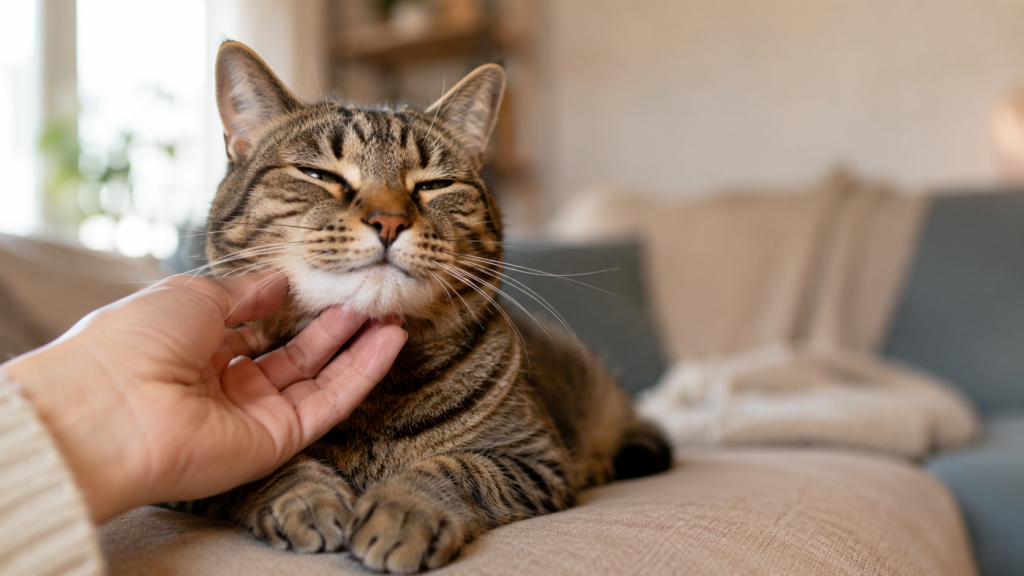
The most common context is the one you’d expect. A relaxed cat, curled up near you with soft eyes, loose muscles, and a still or gently swaying tail, is very likely purring from comfort. This kind of purring often comes with kneading, rubbing, or choosing to be in close contact with you.
The roots of this go back to early life. Kittens are born blind and deaf, so they rely heavily on touch, smell, and vibration. Mother cats purr to communicate safety and guide nursing, and kittens purr back. That makes purring a close-contact communication tool from birth. It’s one reason why adult cats so often purr during petting or grooming. The behavior is connected to reassurance and trust in a way that goes deeper than just “feeling good.”
The “Feed Me” Purr
If your cat’s purr around mealtime sounds more urgent or harder to ignore than the lazy lap purr, you’re not imagining things. A 2009 study published in Current Biology found that cats produce a distinct “solicitation purr” when seeking food. Listeners rated these purrs as more urgent and less pleasant than non-solicitation purrs, even when played at the same volume.
The key difference was a higher-frequency voiced component embedded within the low rumble, somewhat like a cry or whine layered into the purr. Humans appear to be naturally sensitive to this acoustic shift, which may explain why a hungry cat’s purr can feel so insistent.
I wouldn’t describe this as cats being manipulative, though that framing gets a lot of clicks. It’s more accurate to say that some cats appear able to produce a more urgent-sounding purr in certain contexts, and we respond to it. That’s communication, not scheming.
Stress, Fear, and Pain
This is the part many cat owners don’t realize. Cats may purr when they are distressed, frightened, or in pain. The purr in these cases may serve a self-soothing function, similar to how a person might hum or rock when anxious.
This is important because it means a purring cat is not automatically a comfortable cat. If your cat is purring while also hiding, refusing food, breathing strangely, or behaving unlike their normal self, that purr is not reassurance. It may actually be a sign that something is wrong.
How to Read a Purr
A purr tells you something, but the rest of the cat tells you what it probably means. This is the most useful thing I can offer on this topic.
Signs of a Comfortable Purr
- Half-closed or soft eyes
- Loose, relaxed body
- Still tail, or slow gentle movement
- Ears forward or in a neutral position
- Kneading, rubbing, or choosing close contact
- Normal breathing
This is the purr most of us know. It usually appears when a cat feels safe, is being petted in a way they enjoy, or is settling in near someone they trust. There’s nothing to worry about here.
Signs That a Purr May Be Concerning
- Crouching or hunched posture
- Ears flattened or rotated sideways
- Dilated pupils
- Tail tucked close to the body
- Hiding or withdrawing from contact
- Growling, hissing, or flinching when touched
- Reduced grooming
- Reluctance to jump or move normally
- Loss of appetite
- Changes in litter box habits
When purring appears alongside any of these signs, the context has shifted. The cat is not relaxed. They may be using the purr to self-comfort, but the underlying cause could be pain, illness, anxiety, or injury.
What makes this tricky is that cats are very good at masking discomfort. A purring cat that’s also subtly hunching, squinting, or avoiding the litter box can look “fine” to someone who isn’t watching closely. The key is knowing your cat’s baseline: how they usually act, move, eat, groom, and sleep. Changes from that baseline matter more than the purr itself.
Quiet Cats, Loud Cats, and Changes Over Time
Some cats purr loudly and often. Others barely purr at all, or only purr faintly. Neither extreme is a problem on its own. Cats vary in vocal behavior just like people do.
What’s worth watching is sudden change. A cat that stops purring when they normally would, or starts purring constantly in unusual situations, is telling you something has shifted. Older cats sometimes become more vocal as they age, which can be related to anxiety, declining vision or hearing, or cognitive changes. If a senior cat’s purring patterns change noticeably alongside appetite loss, confusion, mobility problems, or personality shifts, a vet visit is a good idea.
What About the “Purring Heals” Claim?
You’ll see this one a lot: the idea that purring vibrations heal bones, repair tissue, or provide medical-level recovery benefits. The kernel of truth is that cat purrs often fall in a low-frequency range (roughly 25 to 150 Hz), and there is some bioacoustic research exploring whether vibrations at these frequencies might have effects on tissue and bone.
But I’d be cautious with how far you take that. It’s reasonable to say purring may have self-soothing or even minor physiological benefits, and that researchers have proposed a recovery-related function. It is not reasonable to say that purring “heals bones” or replaces medical care. A cat that purrs while injured or ill still needs a veterinarian. The purr may offer some comfort, but it’s not a treatment plan.
Why Purring Can Mask Breathing Problems
Because purring changes the rhythm and sound of breathing, it can make it harder to notice respiratory problems. You can’t accurately count a cat’s resting breaths while they’re purring, and abnormal breathing sounds may be partially masked.
This matters because some owners hear purring, assume the cat is comfortable, and may not recognize breathing distress until it becomes severe. Purring does not cancel out breathing red flags.
When Breathing Becomes an Emergency
Cats should not pant or breathe with their mouths open like dogs. If your cat is doing any of the following, treat it as a medical emergency regardless of whether they’re purring:
- Open-mouth breathing or panting
- Blue, gray, or unusually dark gums
- Rapid, shallow breathing
- Exaggerated chest or belly movement with each breath
- Stretched-neck posture or lowered head while breathing
- Inability to settle or lie down comfortably
- Collapse
These signs indicate significant respiratory distress and can precede respiratory failure. This is where I’d stop guessing and go straight to an emergency veterinarian. A panting cat is not a relaxed cat, even if they’re purring at the same time.
A Quick Note on Big Cats
Domestic cats aren’t the only felids that purr. Some wild cats also produce purr-like vocalizations. However, some big cats, like lions and tigers, make sounds that resemble purring but aren’t considered true purring in the way domestic cats purr. This is an interesting piece of biology, but it’s mostly trivia for owners trying to understand their own cat at home.
Putting It Together
Cats purr by producing low-frequency vibrations in the larynx as they breathe. Recent research suggests specialized tissue in the vocal folds may allow the cat’s voice box to generate these sounds more passively than scientists previously thought, though the complete mechanism in living cats is still being studied.
The meaning of a purr depends on context. A relaxed cat purring on your lap is likely content. A kitten purring during nursing is communicating with its mother. A cat purring at the food bowl may be producing a more urgent solicitation purr. And a cat purring while hiding, refusing food, or showing signs of pain may be self-soothing through distress.
The practical skill isn’t just hearing the purr. It’s reading the rest of the cat: their posture, eyes, ears, appetite, mobility, grooming habits, and any deviation from what’s normal for them. When those things look off, the purr isn’t telling you everything is fine. When they look right, it probably is.
References
- ScienceDaily — 2023 purring mechanism research — covers the vocal fold pad discovery and updated laryngeal mechanism.
- Library of Congress — Why and How Do Cats Purr? — general overview of purring mechanism and felid comparisons.
- Smithsonian Magazine — How Do Cats Purr? — contextualizes the 2023 research with expert caution.
- Humane World for Animals — Understanding Cat Behavior — body language interpretation, vocal behavior changes, and mood signals.
- AAHA — 5 Reasons Why Your Cat Purrs — kitten bonding, purring during distress, and frequency range discussion.
- Current Biology — Solicitation Purring Study (2009) — acoustic analysis of food-seeking purrs vs. non-solicitation purrs.
- Cornell Feline Health Center — Dyspnea — signs of respiratory distress in cats.