
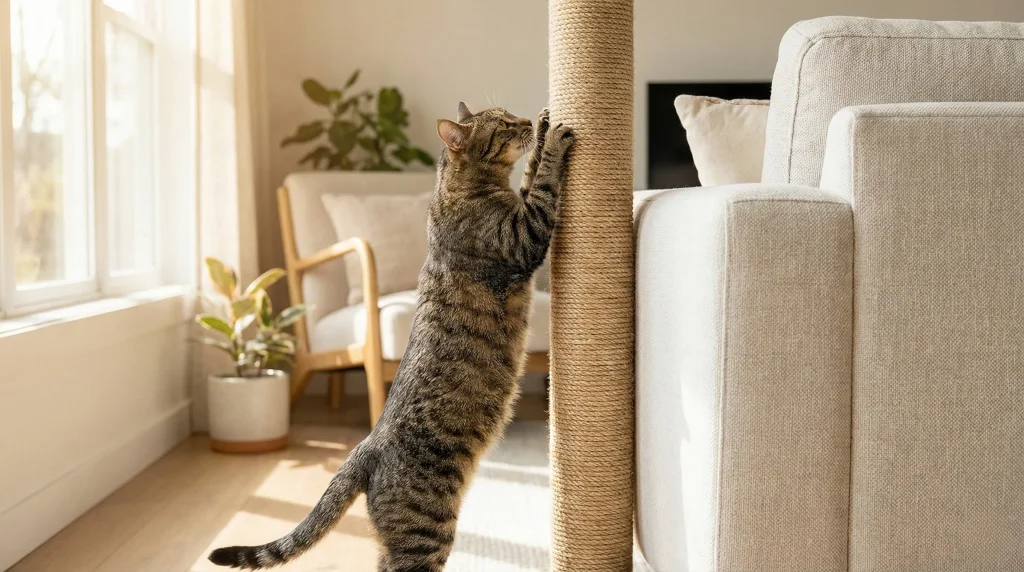
Seeing your furniture get shredded is frustrating and can harm your bond with your cat. Scratching is a normal, necessary behavior, so the goal is not to stop it. This guide will show you how to manage and redirect this instinct onto appropriate targets.
Key Takeaways
- Your goal is to redirect scratching, not stop it. Punishment will increase your cat’s anxiety.
- A new scratching post must be very stable and tall, at least 30 inches, to allow a full stretch.
- Place the new post directly next to the furniture your cat is currently scratching.
- Daily interactive play helps relieve the boredom and stress that can lead to destructive scratching.
Primary List: Why Cats Scratch Furniture
1. To Maintain Claw Health
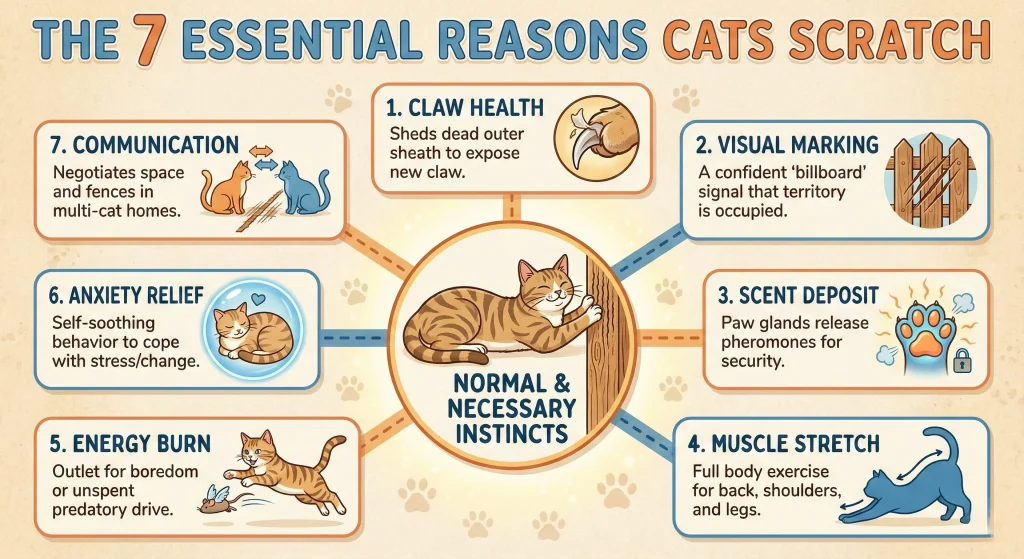
Cats scratch to remove the dead outer layer from their claws. This translucent sheath must be shed regularly to expose the sharp, new claw underneath. This is a vital and normal part of their grooming process.
2. To Mark Territory Visually
The scratch marks themselves are a visual sign to other cats. This visual “billboard” is a clear, confident signal that this territory is occupied. Cats often mark prominent, socially significant areas of the home.
3. To Deposit Scent Markers
Cats have scent glands in their paws that release unique chemical messengers called pheromones. Scratching deposits this personal scent, which makes the cat feel secure in its environment. This scent marking is a major reason they return to the same spot.
4. To Stretch Back and Shoulder Muscles
Scratching is a form of physical exercise that provides a full body stretch. This action is particularly important for the muscles in the back, shoulders, and legs. You will often see this behavior right after your cat wakes up from a nap.
5. To Relieve Boredom or Pent-Up Energy
An indoor cat with unspent predatory drive may scratch destructively. This behavior is a common outlet for boredom and excess energy. Without a proper outlet, the sofa or carpet becomes the most accessible target.
6. To Reduce Anxiety or Stress
Scratching can be a self soothing behavior to relieve anxiety. A cat feeling stressed from a move, a new pet, or a change in routine will scratch to surround itself with its own familiar scent. This scent marking acts as a coping mechanism.
7. To Communicate in Multi-Cat Homes
In a home with multiple cats, scratching is a key form of communication. It can be a way to create visual and scent “fences” to define each cat’s personal territory. This behavior helps negotiate space and avoid direct conflict.
How to Reduce This at Home

1. Identify Your Cat’s Scratching Profile
Before you buy anything, observe your cat to understand their specific preferences. Note whether they scratch vertical surfaces like sofa arms or horizontal ones like rugs. Also, identify the texture they prefer, such as nubby fabric, carpet, or wood.
2. Schedule Daily Predatory Play Sessions
Provide a structured outlet for your cat’s energy with one to three dedicated play sessions per day, lasting 10 to 20 minutes each. Use a wand toy to mimic the “hunt, catch, kill” sequence, ensuring the toy acts like prey. Always let your cat capture the toy and complete the cycle by giving them a treat or a meal immediately after.
3. Choose a Stable and Tall Post
Your cat’s scratching post must be completely stable, as a post that wobbles will be rejected as unsafe. It must also be tall enough for a full body stretch, which is a minimum of 30 to 32 inches. Sisal rope is the most preferred material, while carpet posts should be avoided as they teach the cat to scratch carpet.
4. Place the New Post Next to the Furniture
Placement is the most important factor for success and is non-negotiable. Put the new, high quality post directly in front of the sofa arm or corner your cat is already scratching. Once your cat is using the new post reliably for a week or two, you can move it a few inches each day to a more desirable spot.
5. Make the New Post Highly Appealing
Make the new post the most exciting object in the room to compete with the furniture. You can sprinkle catnip on it, play with a wand toy on and around it, or rub it with a cloth that has your cat’s own facial scent. This scent transfer from their cheeks helps claim the new item.
6. Reward All Use of the Correct Post
When you see your cat use the correct post, reward them immediately, ideally within three seconds. Offer praise, a high value treat, or start a brief play session. This positive reinforcement teaches them that the post is a highly rewarding location.
7. Interrupt and Redirect Without Punishment
Never punish your cat by yelling, hitting, or using a spray bottle, as this only creates fear and anxiety. If you see your cat scratching the furniture, calmly interrupt them. Use a wand toy to lure their attention away from the furniture and over to the new post, then reward them the instant their paws touch the post.
8. Clean Old Spots to Neutralize Scent
Your cat repeatedly scratches the sofa partly because it smells like them, acting as a beacon. You must clean the old scratching spots with an enzymatic cleaner designed to neutralize pet odors. This is critical to break the cycle of remarking the same location.
9. Use Deterrents as a Temporary Measure
After you provide an excellent new post, you can make the old spot physically unappealing. Double sided sticky tape is a good, non damaging option for furniture. Motion activated air puffs can also be effective, but do not use them on an already anxious cat as the hissing sound can increase their stress.
10. Add Calming Pheromone Diffusers
If you suspect the scratching is related to stress or anxiety, a calming pheromone diffuser can help. These products, like Feliway, release a synthetic signal that helps reduce general environmental stress. You can also use a specific pheromone spray on the furniture itself, not the post, to signal the area is “already marked” and safe.
Vet Red Flags for This Behavior
1. Cat Scratches or Licks Itself Excessively
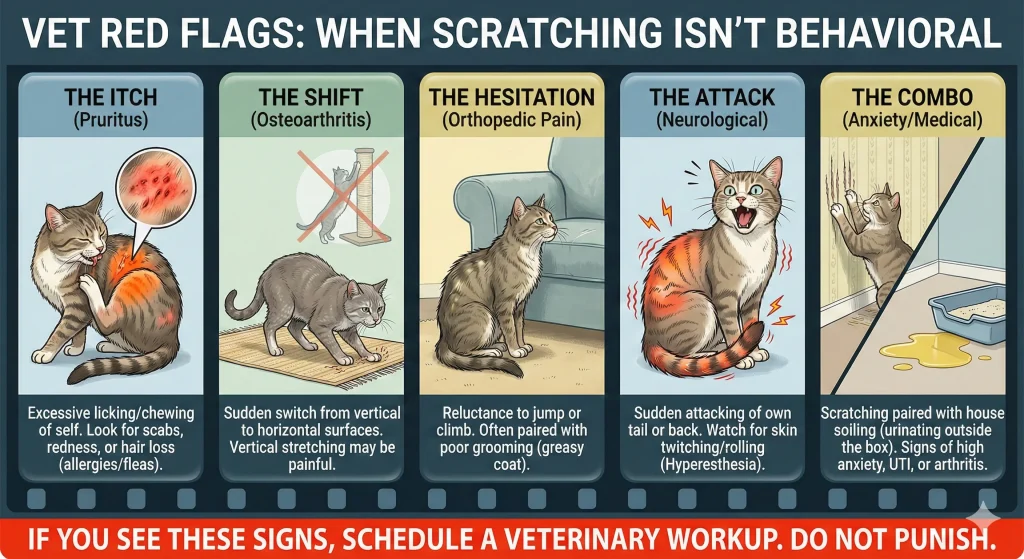
If your cat is scratching, licking, or chewing its own body, this is a medical issue called pruritus, or itching. This is not the same as behavioral scratching of objects. Look for skin redness, scabs, or hair loss and schedule a vet visit to check for allergies, fleas, or other skin conditions.
2. Sudden Scratching on Horizontal Surfaces
A cat that has always used a vertical post and suddenly starts scratching a horizontal rug may be in pain. This is a major red flag for osteoarthritis in senior cats. The full vertical stretch required by the post may have become painful for their joints.
3. Reluctance to Jump or Climb
If the new scratching behavior is paired with a new reluctance to jump up or down, this also strongly points to orthopedic pain. You may also notice a greasy or matted coat from reduced grooming. Any cat showing these signs, especially a senior cat, needs a pain assessment from a vet.
4. Sudden Biting or Attacking of the Tail
Watch for behavior where your cat suddenly attacks, scratches, or bites its own back or tail. This, especially if the skin on their back twitches or “rolls,” can be a sign of a neurological issue. This condition, sometimes called Feline Hyperesthesia Syndrome, requires a veterinary workup.
5. New Scratching Paired With House Soiling
If your cat starts scratching inappropriately at the same time they start urinating outside the litter box, see your vet immediately. This combination can be caused by high anxiety or by a serious medical problem. A urinary tract infection or arthritis, for example, can make using the litter box painful.
Common Questions About Stopping Cat Scratching
1. Why does my cat ignore the scratching post?
The most common reason is that the post is unacceptable to your cat, most often because it is unstable and wobbles. It may also be too short for a full stretch, as it should be at least 30 inches tall. Hiding the post in a basement or spare room also guarantees it will be ignored, as cats mark socially significant areas.
2. Is it okay to use a spray bottle?
No, you should never use a spray bottle, yell, or hit your cat as punishment. Punishment is counter productive because it does not teach the cat what to do instead. It only increases your cat’s fear, stress, and anxiety, which can make the underlying scratching behavior worse and damage your bond.
3. What is the best material for a post?
Sisal rope is considered the gold standard material for most cats as it is durable, rough, and provides a highly satisfying shred. Sisal fabric is also a good option. Cardboard is excellent for horizontal pads, especially for cats that are currently scratching rugs or carpets.
4. How many scratching posts do I need?
In a multi cat household, you should follow the “N+1 Rule” by providing one scratching post per cat, plus one extra. It is critical to place these posts in different, separate locations around the home, not grouped together. This dispersal prevents one dominant cat from “guarding” all the posts as a single resource.
5. Should I declaw my cat?
No, veterinary behaviorists and major veterinary organizations strongly warn against this procedure. Declawing, or onychectomy, is not a nail trim; it is a major surgery involving the amputation of the last bone in all ten front toes. It is linked to a lifetime of chronic pain and often creates new, worse behaviors like biting and house soiling, as the cat’s paws become too sensitive for litter.
Final Thoughts
Redirecting your cat’s scratching requires patience and consistency, but it is the most effective and humane solution. By understanding your cat’s needs and making the right choice easy, you can protect your furniture. This process will also strengthen your bond with your cat.