
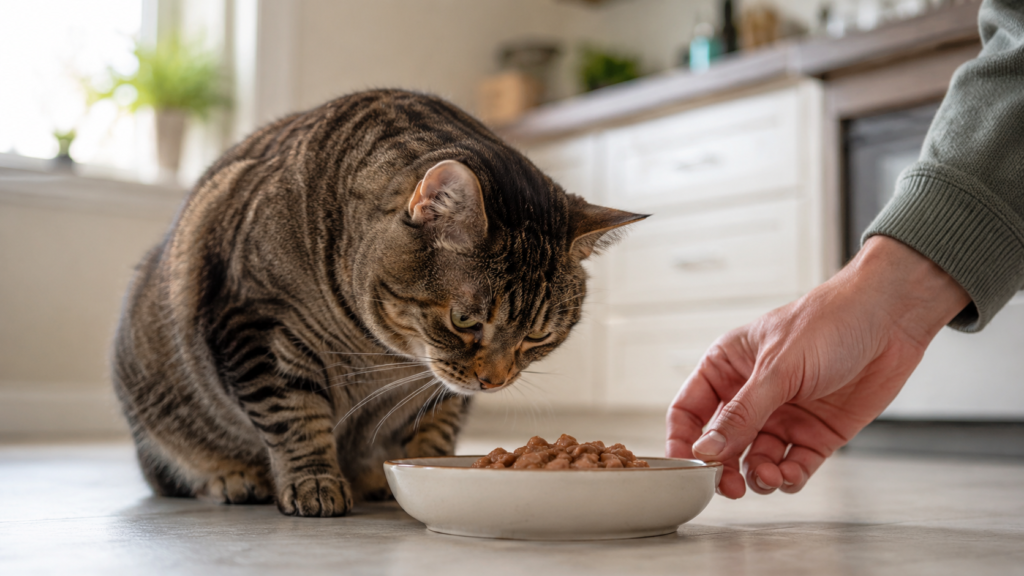
For this keyword, the search intent is a practical food-safety decision: the owner has already served wet food, the cat did not finish it, and they need to know whether to save it, toss it, or keep feeding around a cat that grazes. The safest writer-facing answer should not be “all day” or “overnight.” A defensible general rule is that wet cat food should not sit out beyond 2 hours at room temperature, with a more conservative 1-hour window in hot rooms, outdoor feeding, summer conditions, or homes without air conditioning. This aligns with general CDC food-safety guidance that bacteria multiply rapidly between 40°F and 140°F and that perishable food should not stay out more than 2 hours, or 1 hour above 90°F. Pet-food-specific guidance from Royal Canin also says room-temperature wet food should be discarded after 2 hours, while Purina recommends picking up wet food after more than 1 hour. CDC+2Royal Canin+2
The article should explain that the clock is different for food in the bowl versus food still in the opened can or pouch. Once wet food is served into the dish, it has been exposed to room temperature, air, saliva, crumbs, household dust, insects, and whatever is already on the bowl. That bowl portion should be treated as “served food,” not as clean leftovers. By contrast, food remaining in the can or pouch that has not been touched by the cat should be covered tightly and refrigerated promptly. FDA’s pet-food storage advice is broad but clear: unused or leftover canned and pouched pet food should be promptly refrigerated or thrown out, tightly covered, and kept in a refrigerator at 40°F or below. U.S. Food and Drug Administration+1
A strong article should handle the source disagreement without confusing the reader. Some pet-food brands are stricter than others: Purina says wet food left in the bowl for more than an hour should be tossed, Royal Canin says discard room-temperature food after 2 hours, and Hill’s says moist or canned food not eaten within 4 hours should be emptied if the ambient temperature is above 50°F. These are not identical rules, so the cleanest safety framing is: 2 hours is the practical upper limit most owners should use, 1 hour is better for warm rooms or vulnerable cats, and 4 hours is less conservative and should not be the default for a general cat-safety article. Purina+2Royal Canin+2
The article should avoid implying that wet cat food “becomes poisonous” exactly at minute 121. Food safety is risk-based, not a sudden switch. Time, temperature, moisture, contamination, and the cat’s vulnerability all change the risk. A bowl sitting for 2.5 hours in a cool, clean kitchen is not the same as a bowl sitting for 2.5 hours on a porch in summer heat. But owners need a simple rule because harmful bacteria are not reliably visible. FDA food-safety guidance notes that food can make people sick even when it does not look, smell, or taste spoiled, because pathogenic bacteria differ from spoilage bacteria. That point is useful for cat owners who want to “smell-test” the bowl. U.S. Food and Drug Administration
Wet food deserves stricter handling than dry food because the format is different. PetMD explains that canned cat food contains much more water than dry food, about 70% water versus around 10% in dry food, and that canned foods are cooked and sealed in a way that destroys foodborne pathogens before opening. The safety advantage of an unopened can depends on that sealed, processed environment. Once the can is opened and food is served, the product is no longer in that protected state. Dry food can generally remain available longer, which is why dry food works better for free-feeding, automatic feeders, and puzzle feeders, while wet food should be treated as a timed meal. PetMD+1
The writer should separate “food drying out” from “food safety.” Owners often notice wet food gets crusty, darker, separated, or less appealing after a while, and that matters because many cats reject food after aroma and texture change. But dryness is not the real safety test. Purina emphasizes that opened wet food dries out in several hours and should be picked up after more than an hour; Wellness similarly notes that wet food can congeal and become unappealing while also allowing bacteria to grow. This gives the article a practical angle: even before a bowl becomes clearly unsafe, it may stop being useful because many cats will not eat dried-out wet food anyway. Purina+1
The article should not tell owners to refrigerate the food their cat already licked or partly ate. Food left in the bowl should be discarded after the safe window, because it has already been exposed to the cat’s mouth and the bowl environment. The untouched food still inside the can or pouch is the portion to save. FDA says to refrigerate or throw out unused or leftover canned and pouched pet food promptly, and to wash pet food bowls and utensils after each use. A useful detail for readers is that “leftover” should mean untouched food saved right away, not a half-eaten bowl that sat out for hours and then gets put into the fridge. U.S. Food and Drug Administration
Refrigerator time is another point where sources vary, so the article should avoid overclaiming. Royal Canin says opened wet food should ideally be used within 48 hours, or 72 hours maximum in one regional FAQ, while the US Royal Canin FAQ recommends using opened canned product within 48 hours. Purina says opened wet food should be used within three days if sealed and refrigerated. Hill’s gives a longer maximum of 5–7 days for opened cans stored at 40–45°F. Because these are product/manufacturer instructions, the article should tell readers to follow the specific package or brand guidance, and use a conservative 48–72 hour target when the label is unclear. Hill’s Pet Nutrition+3Royal Canin+3Royal Canin+3
The article should include the “opened but not served” storage method because it solves much of the waste problem. The unused portion should be covered tightly, refrigerated promptly, and kept cold at 40°F or below. Royal Canin suggests covering opened cans, keeping pouches closed in an airtight container, storing them upright in the refrigerator, checking appearance before reuse, and warming cold food to room temperature if the pet dislikes chilled food. The article should warn that microwaving can create hot spots; if warming is mentioned, it should be limited to gentle warming and temperature-checking before serving. Royal Canin+1
The writer should be careful with the phrase “room temperature.” A room at 68–72°F is different from a room at 85°F, a sunny windowsill, a garage, a porch, or a bowl near a heater. CDC’s general danger-zone guidance is useful here because it gives the mechanism: bacteria multiply rapidly at room temperature and especially in the 40°F–140°F range, and perishable food exposed above 90°F should be refrigerated within 1 hour. For cat owners, this means the wet-food window gets shorter in summer, humid climates, outdoor feeding, power outages, or homes where bowls sit near direct sun. CDC
The article should explain why “my cat ate old food before and was fine” is not a reliable safety argument. Some exposures do not cause obvious illness, some pathogens cause delayed symptoms, and different cats have different risk. PetMD notes that food poisoning in cats can involve pathogens such as E. coli, Listeria, and Salmonella, and that kittens and immunocompromised cats are at higher risk. It also notes that many cats affected by salmonellosis may show no signs, while gastrointestinal disease and severe systemic infection can occur. The writer should frame old wet food as an avoidable risk, not a guaranteed emergency every time. PetMD
Red-flag guidance matters because the keyword is safety-adjacent. The article should tell owners to contact a veterinarian if a cat develops vomiting, diarrhea, lethargy, fever, loss of appetite, abdominal pain, blood or mucus in stool, repeated episodes, dehydration signs, or any concerning change after eating questionable food. Texas A&M veterinary guidance says acute vomiting or diarrhea after possible exposure to spoiled food raises suspicion for food poisoning, and that effects can depend on bacterial or mold toxins and exposure amount. PetMD lists vomiting, diarrhea, decreased appetite, lethargy, abdominal pain, fever, and, for Salmonella, mucus in feces and swollen lymph nodes among possible signs. vetmed.tamu.edu+1
The article should be especially cautious for kittens, senior cats, pregnant cats, cats with chronic disease, and immunocompromised cats. PetMD specifically flags kittens and immunocompromised cats as higher-risk for foodborne pathogens. Cornell also notes that kittens need more frequent meals than adults, generally three meals daily until six months, and twice daily from six months to one year, which creates a practical conflict: young cats may need frequent wet-food meals, but that does not mean leaving one large bowl out all day. The safer solution is smaller fresh portions more often, not a longer room-temperature window. PetMD+1
A useful information-gain point is the difference between feline feeding behavior and wet-food safety. Cats often prefer small, frequent meals, and the AAFP consensus statement says feeding programs should account for normal feline behaviors such as hunting, foraging, and eating frequent small meals alone. That can make wet-food management harder, because a cat may nibble rather than finish a serving quickly. The article should not solve that by endorsing all-day wet-food grazing. It should suggest safer feeding logistics: smaller portions, timed meals, refrigerated leftovers from the untouched can, or a dry-food/puzzle-feeder component when appropriate and approved for the individual cat. catvets.com+1
Multi-cat households add a monitoring problem. Hill’s notes that free feeding makes it hard to tell how much each cat eats and can let one cat overeat while another misses out; it also notes that meal feeding helps owners monitor appetite. AAFP says feeding programs should be customized for the household and may include multiple food and water stations, especially in multi-pet homes. For this keyword, the practical implication is that a shared wet-food bowl left out “so everyone can graze” is a poor setup: it increases time-at-room-temperature, makes intake hard to track, and may let a dominant cat control access. Hill’s Pet Nutrition+1
Indoor versus outdoor context should be addressed, but not overexpanded. Outdoor or porch feeding makes wet food harder to keep safe because heat, insects, wildlife, dirt, and time are harder to control. FDA advises throwing out old or spoiled pet food safely in a securely tied plastic bag in a covered trash can, and storing pet food securely so pets cannot eat an entire supply. For indoor cats, the risk is usually less about insects and weather, and more about owners leaving breakfast wet food out until after work or leaving dinner out overnight. Both are poor practices because they exceed the conservative 1–2 hour window. U.S. Food and Drug Administration
The article should avoid making raw or freeze-dried raw diets the main topic, but a brief caveat is useful because raw and lightly processed products change the risk profile. FDA states that raw pet food is more likely than processed pet food to contain harmful bacteria such as Salmonella and Listeria monocytogenes. Recent Cornell-reported research on commercial raw cat foods detected Salmonella strains and other potentially serious microbes in raw samples, and Reuters summarized the same analysis as finding disease-causing microbes, including antibiotic-resistant organisms, in raw or partially cooked meat products. For the wet-food sitting-out article, the safe phrasing is that raw or fresh refrigerated cat foods need even stricter label-based handling than conventional cooked canned food. U.S. Food and Drug Administration+2Cornell Chronicle+2
Bowl hygiene should be more than a throwaway line. FDA recommends washing pet food bowls and scooping or measuring utensils with soap and hot water after each use, not using the pet bowl as the scoop, and washing hands before and after handling pet food. This matters for wet food because residue sticks to the bowl, dries, and can become a repeated contamination source. A PLOS ONE study in dog-owning households found only 4.7% of surveyed owners were aware of FDA pet-food handling and dish hygiene guidelines, and following FDA-style hygiene protocols significantly reduced food dish bacterial counts. The study was on dog bowls, not cat bowls, but the hygiene principle is directly relevant to pet dishes. U.S. Food and Drug Administration+1
The article should give readers a decision rule for common real-life situations. If wet food has been out under 30–60 minutes in a cool indoor room and the cat is still eating, it is generally within the conservative feeding window. If it has been out 1–2 hours, the owner is approaching or at the practical limit, and tossing is the safer choice if the room is warm or the cat is vulnerable. If it has been out longer than 2 hours, overnight, all workday, in sun, near heat, or outdoors in warm weather, it should be discarded. This follows CDC’s perishable-food time/temperature logic and matches the stricter pet-food manufacturer guidance better than the looser 4-hour recommendation. CDC+2Royal Canin+2
A strong article should correct the misconception that refrigeration “resets” unsafe food. Cooling can slow bacterial growth, but it does not make a previously abused bowl safe again. FDA’s food-storage advice says proper chilling slows bacterial growth, and CDC says perishable foods should be refrigerated within the safe time window. The practical cat-food translation is simple: refrigerate untouched food from the can promptly; do not refrigerate and re-serve wet food that has already been sitting in the bowl for hours. This is one of the most useful distinctions because owners often want to save expensive wet food. U.S. Food and Drug Administration+2CDC+2
The article should not overstate mold as the only risk. Mold, sour odor, swelling, leaking packaging, strange texture, or obvious spoilage are automatic discard signs, and FDA says pet-food problems can include foul odor, swollen or leaking cans/pouches, foreign objects, or a pet becoming sick after eating. But waiting for those signs is not enough because pathogenic bacteria may not change smell, taste, or appearance. This gives the writer a useful safety sentence: visible spoilage means “definitely toss,” but no visible spoilage does not mean “definitely safe.” U.S. Food and Drug Administration+1
There is also a nutrition-context angle: wet food is often used because it adds water and is palatable. PetMD notes canned food has much higher moisture than dry food and may benefit cats with health conditions that require higher water intake, such as kidney disease, diabetes, or lower urinary tract disease, depending on veterinary advice. Cornell similarly notes wet food is about 70–80% water and may be more palatable, while cats on dry-only diets need plenty of fresh water, especially if prone to lower urinary tract disease. The article should not scare owners away from wet food; it should teach them to serve it in safer portions. PetMD+1
The writer should make room for picky cats without undermining safety. Some cats dislike cold refrigerated food, and both Royal Canin and PetMD-related guidance acknowledge warming refrigerated food to room temperature can improve acceptance. The safe version is to warm only the portion being served, avoid leaving it out for extended periods, and check that it is not hot before feeding. The article can suggest adding warm water or briefly warming in a safe container, but it should avoid turning this into cooking advice or recommending microwaving inside the can. Royal Canin+1
The article should treat “best by” dates and damaged packaging separately from sitting-out time. FDA says dry pet food and unopened canned food should be stored in a cool, dry place below 80°F because excess heat or moisture can break down nutrients, and it warns not to buy cans, pouches, or bags with visible damage such as dents, tears, or discoloration. Purina also notes that best-by dates apply to unopened packaging and that compromised packaging can allow contamination regardless of expiration date. This gives the writer a broader but still relevant safety detail: a safe serving window does not rescue food from a damaged, expired, swollen, or improperly stored package. U.S. Food and Drug Administration+2U.S. Food and Drug Administration+2
The article should avoid giving home treatment instructions for suspected food poisoning. It is acceptable to say remove the questionable food, provide fresh water, keep the packaging information if a product issue is suspected, and contact a veterinarian if symptoms occur. PetMD says cats with signs of food poisoning should be examined by a veterinarian and notes diagnosis may involve diet history, physical exam, blood work, imaging, fecal culture, or other tests. Texas A&M’s guidance also points owners toward veterinary care even when signs appear mild because spoiled-food effects depend on toxin and exposure amount and can become serious. PetMD+1
The most useful final framing for a writer is: wet cat food is safe and valuable when handled like a perishable fresh meal, not like dry kibble. Serve small portions, pick up leftovers within 1–2 hours, shorten that window in heat, refrigerate untouched can or pouch leftovers immediately, use opened refrigerated food within the brand’s stated window, wash bowls after every wet-food meal, and call a vet if illness follows questionable food. This answer gives the reader a clear action without oversimplifying the real variables: product type, room temperature, cat vulnerability, hygiene, and whether the food was untouched or already eaten from.