A bald, flaky patch on your cat can send your brain in two directions at once: Is this ringworm, and is it already in the house? That worry is fair. Ringworm in cats is usually treatable, but it is also contagious to other pets and people, so guessing for a few weeks can make the problem harder.
The safest way to treat ringworm in cats is not one magic cream. It is a vet-guided plan: confirm the diagnosis, treat the infected cat, reduce fungal spores on the coat, clean the environment, protect vulnerable people, and keep going until your veterinarian says the infection is cleared.
I would not treat a suspected case casually, especially in a home with kittens, multiple pets, children, older adults, or anyone with a weakened immune system. Ringworm is manageable. Shortcuts are usually what make it drag on.
The short answer on treating ringworm in cats
Ringworm treatment in cats usually combines topical antifungal treatment, oral antifungal medication, and environmental cleaning. Your veterinarian decides the exact plan after examining your cat and, in many cases, testing hair or skin samples.
Topical treatment helps reduce spores on the coat and skin. Oral medication treats active infection in the hair follicles. Cleaning removes contaminated hair, skin flakes, and debris from the home. Those three pieces work together.
Untreated ringworm in an otherwise healthy cat may eventually resolve, but that can take many months. During that time, the cat may keep losing hair and spreading fungal spores. For me, that is the practical reason not to wait it out unless a veterinarian has specifically advised monitoring.
Expect treatment to last longer than the skin looks bad. Many cats need at least six weeks of repeated treatment, sometimes longer. Hair growing back is encouraging, but it does not always mean the cat is no longer contagious.
What ringworm is and why it spreads
Ringworm is not a worm. It is dermatophytosis, a superficial fungal infection of keratinized tissue. In plain English, the fungus lives on dead skin layers, hair, and sometimes claws.
That biology matters. The visible bald patch is not the whole problem. Infected hairs can break, shed, and carry spores into bedding, brushes, carpets, carriers, furniture, and other pets’ coats.
The most common cause of feline ringworm is Microsporum canis. Cats can spread it to other cats, dogs, and people. Other species can be linked with soil, rodents, livestock, or outdoor exposure, so ringworm does not always mean a dirty home.
Spores can persist in a dry environment for a long time, but they do not multiply in the home the way mold might. That is a useful distinction. Your house is not ruined. Cleaning works best when it removes shed hair and debris first, then uses appropriate disinfection afterward.
Signs that may look like ringworm
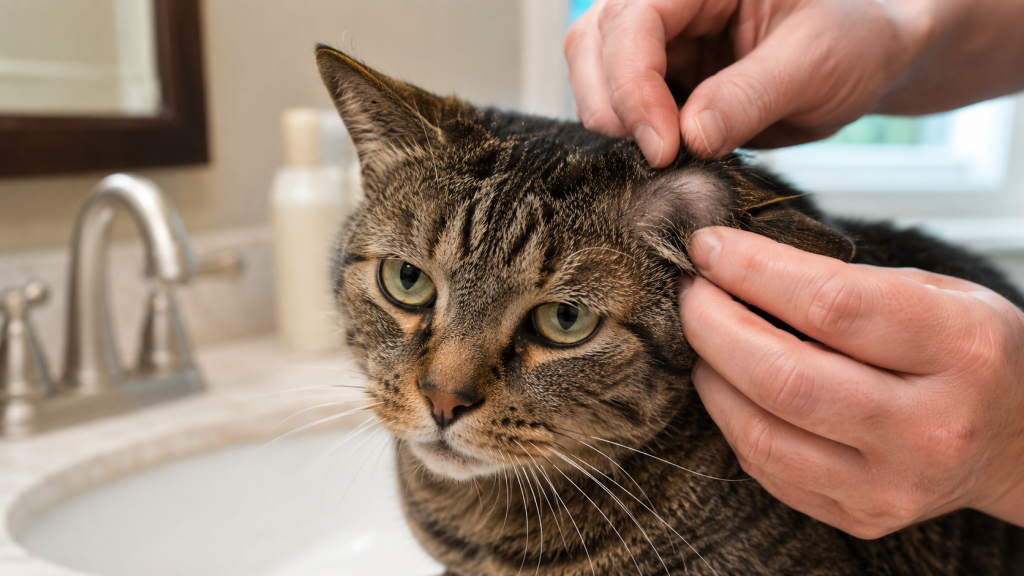
Ringworm can cause circular hair loss, broken stubbly hairs, scaling, crusting, dandruff, skin color changes, inflamed skin, scratching, overgrooming, and infected claws or nail beds. Lesions often show up around the face, ears, legs, or trunk, but they can vary.
What makes this tricky is that cats do not always show the classic ring-shaped patch people expect. Some cats have flaky bald spots. Some have widespread crusting. Some barely look affected but still carry spores on the coat.
Ringworm can resemble flea allergy, mites, bacterial skin infection, allergies, stress-related overgrooming, trauma, or other skin disease. This is where I would stop guessing and call a vet. A photo search cannot tell you whether the fungus is active, whether other pets are exposed, or which treatment is safe.
When to contact a veterinarian
Contact a veterinarian if you suspect ringworm. It is not usually an emergency in a bright, eating, otherwise healthy cat, but it should not be left to home experiments.
I would be more cautious if your cat has multiple lesions, fast-spreading hair loss, heavy crusting, pus, nail-bed changes, nodules, poor appetite, lethargy, or worsening itch. Kittens, senior cats, medically fragile cats, long-haired cats, recently rescued cats, shelter or cattery cats, and multi-cat homes also deserve quicker attention.
Call sooner if anyone in the household is very young, elderly, pregnant, immunocompromised, or already developing a suspicious rash. Ringworm can pass between pets and people, so household risk matters as much as the size of the patch.
How vets confirm ringworm
A vet may use a Wood’s lamp, fungal culture, PCR testing, or a combination. Each test has limits, so one quick check is not always enough.
Wood’s lamp
A Wood’s lamp is a special ultraviolet light. Some hairs infected with M. canis glow apple-green or yellow-green under it, but not all cases fluoresce. Debris, lint, scale, or topical products can also confuse the picture.
That is why buying a blacklight and declaring your cat clear or infected is risky. It can be a screening tool, but it is not a complete diagnosis.
Fungal culture
Fungal culture is an important diagnostic tool because it can confirm ringworm and help identify the species. The downside is time. Some cultures show growth within days, while slow cases can take up to three weeks.
In homes with several cats, the vet may sample more than the visibly affected cat. A normal-looking cat can be infected or can carry spores on the coat after contact with a contaminated environment.
PCR testing
PCR testing can be faster because it detects fungal DNA. The catch is that DNA can come from dead organisms or spores sitting on the coat, so a positive test does not always prove active infection.
Your veterinarian interprets PCR results alongside the cat’s skin, history, treatment status, and other tests. It is useful, but it is not a simple yes-or-no answer.
The main parts of ringworm treatment
Topical treatment for reducing spores on the coat
Topical treatment is not just for the bald patch. In cats, whole-coat treatment is often recommended because spores can sit on hair far from the visible lesion.
Veterinary protocols may use antifungal rinses, shampoos, or dips such as lime sulfur, enilconazole, or miconazole with chlorhexidine, depending on what is available and appropriate. Your vet should tell you exactly what to use and how to use it.
Spot treatment alone may not be enough, especially for long-haired cats or homes with multiple pets. Even if only one area looks affected, the coat may still be carrying spores elsewhere.
Oral medication for active infection
Many cats need systemic, or whole-body, antifungal medication prescribed by a veterinarian. This targets infection in the hair follicles, where topical products alone may not be enough.
Do not self-medicate with human antifungals, leftover pet medication, or online substitutions. Drug choice and formulation matter. Some options are ineffective, some are poor choices for cats, and your vet has to consider age, health status, pregnancy status, interactions, and adverse effects.
Lufenuron is not an effective ringworm treatment. Vaccination is not a reliable treatment strategy for cats. If a product sounds like an easy shortcut, be skeptical unless your veterinarian specifically recommends it.
Why stopping treatment early backfires
Ringworm treatment often continues for weeks after the cat starts to look better. That can be frustrating, but stopping early is one of the biggest reasons cases recur.
Veterinarians may distinguish clinical cure, where lesions have resolved and no new ones appear, from mycological cure, where testing supports that the fungus is no longer active. Hair regrowth alone is not proof of clearance.
If your vet schedules repeat cultures or follow-up testing, keep the appointment. It is not just paperwork. It helps decide when isolation and medication can safely stop.
What to do at home during treatment
Set up an easy-clean space
Restrict the infected cat to an easy-clean area when practical. A room without carpet or fabric furniture is usually easier to manage than the whole house.
This is not about punishing the cat or locking them away indefinitely. Add food, water, litter, washable bedding, hiding space, and gentle enrichment. Young cats especially should not be undersocialized for long periods because stress and isolation can create other problems.
Keep infected cats away from visitors, uninfected pets, and vulnerable people until your vet advises otherwise. In a busy household, even partial restriction can reduce the amount of hair and spores you have to chase.
Clean hair first, disinfect second
The most useful cleaning step is mechanical removal: vacuuming, wiping, washing, and removing shed hair and debris. Disinfectant sprayed over dirty surfaces is not enough.
Clean surfaces with detergent until visibly clear, then use a surface-appropriate disinfectant if your vet recommends one. Bedding and towels can usually be machine washed thoroughly. Carpets may need shampooing or steam cleaning, especially if the cat spent time there before diagnosis.
Cleaning intensity depends on the case. A single mild case in one restricted room is different from an outbreak in a multi-cat home. In general, remove hair and debris often, then do a more thorough cleaning once or twice weekly, or follow the schedule your vet gives you.
If bleach is used on suitable surfaces, use it carefully: never mix it with other cleaners, ventilate the area, and keep cats away until surfaces are safe and dry. More chemical smell does not mean better ringworm control.
Handle exposed pets thoughtfully
Other pets may need veterinary assessment, even if they look normal. Some cats can be subclinically infected, meaning infected without obvious lesions. Others may simply carry spores on the coat after exposure.
That distinction matters. Not every positive test means the same thing, and not every exposed pet needs the same treatment. In a multi-cat home, your vet may test, separate, treat, or decontaminate animals based on lesions, results, exposure, and household risk.
What not to put on your cat
Do not apply essential oils, apple cider vinegar, coconut oil, garlic, alcohol, hydrogen peroxide, household disinfectants, steroid creams, or over-the-counter human rash products to your cat unless your veterinarian specifically approves the product.
Ringworm is a fungal infection, but that does not mean every antifungal-looking product is safe for feline skin or grooming behavior. Cats lick their coats. Products can also interfere with diagnosis by changing the skin or contaminating samples.
Be careful with shaving, too. Trimming small affected areas may help in selected cases, but full-body clipping should only happen under veterinary direction. Rough clipping can irritate skin, spread contaminated hair, and make disease worse.
Protecting people in the household
Ringworm can spread from cats to people through direct contact or contaminated objects such as bedding and towels. Wear gloves and long sleeves when handling an infected cat, then wash your hands well.
Vacuum areas the cat uses, wash bedding, and keep shared fabrics under control. Children should avoid close handling until the cat is being treated and your vet has advised on household precautions.
If someone develops a red, itchy, ring-shaped rash, scalp bald spot, nail changes, severe rash, or a rash that is not improving, they should contact a healthcare provider. People should not use steroid creams for suspected ringworm unless a clinician tells them to, because steroids can worsen fungal infections and make diagnosis harder.
Common mistakes that make ringworm drag on
The first mistake is treating only the visible patch. The patch matters, but shed infected hairs and coat spores are often the bigger spread problem.
The second mistake is stopping treatment when the cat looks better. Skin can improve before the infection is fully cleared, so follow your vet’s endpoint, not just the mirror.
The third mistake is cleaning with disinfectant but leaving hair behind. Hair and debris need to be removed first. Think vacuum, wipe, wash, then disinfect where appropriate.
The fourth mistake is testing one cat and ignoring the rest of the home. In multi-pet households, apparently normal cats can still matter to the outbreak. Your vet can help decide who needs testing or treatment.
The fifth mistake is turning ringworm into a panic project. Yes, spores can persist. No, ordinary homes are not doomed. A steady, realistic routine usually beats frantic overcleaning.
What to remember
Treating ringworm in cats means treating the cat, the coat, and the home at the same time. A vet-confirmed plan usually includes topical therapy, often oral antifungal medication, environmental cleaning, and follow-up until cure is clear.
If you suspect ringworm, avoid home remedies and unapproved creams. Reduce contact, clean shed hair, protect vulnerable people, and book a veterinary visit. Ringworm is usually curable, but it rewards consistency more than shortcuts.
References
- Cornell Feline Health Center — signs, zoonotic risk, treatment length, untreated course.
- ABCD Guideline for Dermatophytosis in Cats — feline ringworm biology, diagnosis, carriers, topical therapy, risk factors, clipping cautions.
- VCA Hospitals — diagnosis, Wood’s lamp limits, culture timing, treatment duration, household management.
- Merck Veterinary Manual — topical plus systemic treatment, medication cautions, environmental cleaning, clinical vs mycological cure.
- CDC: Ringworm Causes — spread between pets, people, and contaminated objects.
- CDC: Ringworm Signs and Symptoms — human skin and scalp signs.
- CDC: Ringworm Treatment — caution against steroid creams for suspected human ringworm.
- Maddie’s Fund — practical isolation and household precautions for infected cats.