Dark debris in your cat’s ear can make you want to fix it immediately. If your cat is scratching, shaking their head, or pulling away when you touch an ear, ear mites may be the first thing that comes to mind.
Ear mites are common, especially in kittens, outdoor cats, feral cats, and newly adopted cats. They are also very treatable. The catch is that mite signs overlap with ear infections, foreign material, polyps, masses, a ruptured eardrum, and deeper ear disease. Brown wax is a clue, not a diagnosis.
The safest answer is practical: confirm the cause, use a cat-safe veterinary treatment, clean only as directed, treat exposed pets when needed, and avoid home remedies or dog products.
Quick answer on treating ear mites in cats
The safest way to treat ear mites in cats is to have a veterinarian confirm the mites, examine the ear canal and eardrum, then choose a cat-safe mite-killing treatment. Many cats are treated at home after that visit, but the plan should be veterinary-directed.
- Book a vet exam. The vet can look in the ear with an otoscope and check debris under a microscope.
- Use the prescribed or recommended cat product. Options may include cat-labeled ear medications or skin-applied parasite products, depending on the cat.
- Clean only as instructed. Ear cleaning may help, but deep cleaning a painful or infected ear can make things worse.
- Treat secondary infection if present. Mites can leave behind yeast or bacterial inflammation that needs separate care.
- Treat all exposed dogs and cats if your vet advises it. Ear mites spread through close contact.
- Go back for a recheck. Cats may feel better quickly, but mite elimination can take about a month.
For me, the safer way to think about it is this: home care can support treatment, but it should not replace diagnosis. A sore cat ear is not a good place for guessing.
What ear mites are
Most cat ear mite cases involve Otodectes cynotis, a non-burrowing mite that usually lives in the outer ear canal. It feeds on skin debris, ear discharge, and tissue fluid. That irritation can trigger inflammation, wax buildup, intense itching, and sometimes secondary infection.
The mite’s egg-to-egg life cycle is about 18 to 28 days. That matters because successful treatment is not just about killing whatever is visible today. Follow-up timing, household pet treatment, and product choice all affect whether signs come back.
Although mites usually stay in the ear canal, they can also be found on the head, face, ear flap, neck, rump, tail, nail beds, or between toes. That is one reason some modern skin-applied treatments can be useful in vet-selected cases. It is also why cleaning the ear alone is not enough.
Signs that may point to ear mites
Ear mites often cause itchy, inflamed, messy ears. Many cat owners notice the scratching first, then see dark material inside the ear.
- Frequent ear scratching
- Head shaking
- Ears held flat or guarded
- Red or inflamed outer ears
- Thick dark debris, sometimes described as coffee-ground-like
- Bad odor from the ear
- Pain or resistance when the ear is touched
- Hair loss around the ears or eyes from scratching
- Head tilt, poor appetite, lethargy, or reduced activity in more concerning cases
What makes this tricky is that these signs do not prove mites. Yeast, bacteria, ear canal swelling, foreign material, polyps, and deeper ear problems can look similar from the outside.
I’d be especially cautious if only one ear is affected, if the ear is very painful, or if the problem keeps returning. Ear mites often affect both ears, while one-sided chronic ear trouble can point to something else that needs a closer exam.
Normal wax vs. concerning ear signs
A small amount of ear wax is not automatically an ear mite problem. Healthy cats can have some dark waxy debris, and unnecessary cleaning can irritate the canal or interfere with the ear’s normal self-cleaning.
| What you see | What it may mean | Safer next step |
|---|---|---|
| Small amount of wax, no odor, no scratching, cat acts normal | May be normal | Monitor. Do not overclean. |
| Dark debris plus scratching or head shaking | Ear mites possible, but not certain | Schedule a vet exam. |
| Strong odor, redness, swelling, discharge, or pain | Infection or inflammation possible | Vet visit soon. |
| Bleeding, pus-like discharge, severe pain, head tilt, poor balance, facial droop, lethargy, or poor appetite | Possible complicated ear disease | Contact a vet promptly. |
| One ear repeatedly painful, smelly, swollen, or draining | May be more than mites | Vet exam, do not assume. |
Why a vet exam matters before treatment
A veterinarian can confirm ear mites by seeing mites in the ear with an otoscope or by checking ear debris under a microscope. Ear cytology, which means looking at a sample from the ear, can also show whether yeast or bacteria are part of the problem.
This step matters because some ear medications should not be used if the eardrum is damaged. If the eardrum is ruptured, certain products can put hearing at risk. You cannot reliably check that at home.
Another reason to confirm the cause: by the time some cats are examined, mites may no longer be obvious, but a painful ear infection remains. In that case, mite drops alone would miss the real problem.
What veterinary treatment usually includes
Cat-safe mite medication
Your veterinarian may prescribe or recommend a cat-labeled parasiticide. Depending on your cat’s age, weight, ear condition, household exposure, and medical history, options may include products containing ivermectin, milbemycin oxime, imidacloprid/moxidectin, or selamectin.
Some treatments go directly into the ear canal. Others are applied to the skin and work through the body. Skin-applied products can be easier for cats who hate ear handling, and they may help when mites are not only inside the canal.
Newer parasite products can be very effective when properly chosen, but they are not all interchangeable. Isoxazoline products, for example, are considered safe and effective for cats and dogs when used as directed, but the FDA has warned about possible neurologic reactions such as tremors, ataxia, and seizures. That does not mean you should avoid a vet-prescribed product. It means your cat’s medical history matters.
Ear cleaning, done the right way
Ear cleaning is often part of treatment because wax and debris can shield mites and make medication less effective. But I would not deep-clean a painful, swollen ear at home.
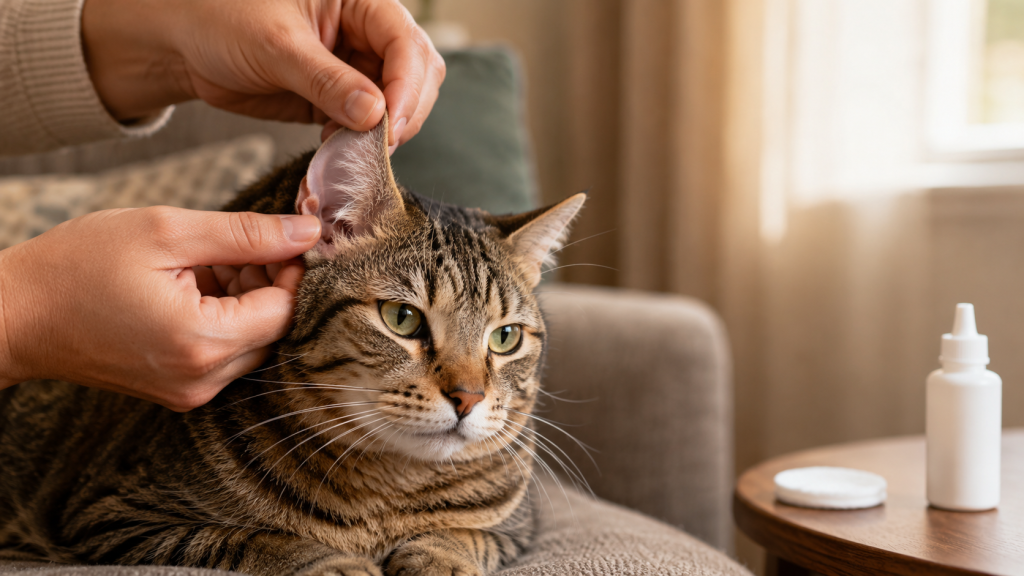
If your vet recommends cleaning, use the cleanser and method they give you. Wipe only accessible debris unless told otherwise. Do not push cotton swabs into the ear canal. If a cat is in pain, fighting hard, or the canal is packed with debris, proper cleaning or examination may require veterinary help, sometimes with sedation or anesthesia.
Treatment for infection or inflammation
Ear mites irritate the ear canal and can create the right conditions for yeast or bacterial infection. That means treatment may include more than a mite-killing product.
A full plan may involve medication for yeast or bacteria, inflammation control, pain control, cleaning, and a recheck. The exact mix depends on what the exam and cytology show.
Follow-up and recheck
Many cats feel better within a few days of starting treatment, but that does not always mean the mites are gone. Full elimination can take about a month.
A recheck helps confirm the mites are gone and that no infection is lingering. I would take that recheck seriously in kittens, multi-pet homes, severe cases, or any cat whose signs return.
What not to put in a cat’s ears
Do not put essential oils in or around your cat’s ears. Cats can absorb essential oils through skin and mucous membranes, then groom them off their coat. Reported problems from dermal exposure can include weakness, depression, behavior changes, poor coordination, low body temperature, and collapse in severe cases.
I would also avoid vinegar, peroxide, random oils, and unverified over-the-counter ear drops unless your vet specifically approves them for your cat’s ear. Even if a substance seems like it might smother mites, it can delay proper care, worsen irritation, add moisture, or be risky if the eardrum is damaged.
Dog flea and tick products are another major no. Products must match the pet’s species, life stage, and weight class. Some dog spot-on products containing ingredients such as permethrin, cyphenothrin, or phenothrin carry strong warnings not to use them on cats because they may be fatal.
Are ear mites contagious?
Yes, ear mites spread mainly through close contact between animals. Kittens can get them from their mother, and mites can move among cats and dogs in the same household.
If one pet is confirmed to have ear mites, all dogs and cats in the home may need treatment as directed by a veterinarian. Treating only the itchy cat is one of the easiest ways for the problem to return.
People are only rarely infested with cat ear mites, so household panic is not usually needed. The bigger concern is pet-to-pet spread, ongoing discomfort, scratching trauma, and secondary ear infection.
Do you need to treat the house?
Environmental cleaning can help, but treating the animals is the main focus. Ear mite survival in the environment is not thought to be the biggest driver of transmission.
Wash bedding, clean shared grooming tools, and avoid sharing brushes or combs between pets until your vet’s plan is underway. I would not jump to house-wide pesticide spraying for an ear mite problem unless a veterinarian gives a specific reason.
Kittens, outdoor cats, and newly adopted cats
Ear mites are especially common in kittens, young cats, feral cats, and outdoor cats. Close contact with other cats makes spread easier, whether that contact happens through a mother cat, fighting, grooming, or friendly contact.
Indoor adult cats can still get mites if exposed to an infested kitten, dog, or new household pet. So while lifestyle helps estimate risk, it does not diagnose the ear.
With kittens, I would be quicker to call the vet. They are small, often newly exposed to other animals, and product safety depends heavily on age and weight.
When to contact a veterinarian promptly
Contact a veterinarian promptly if your cat has severe pain, swelling, bleeding, pus-like discharge, strong odor, head tilt, poor balance, facial droop, suspected hearing loss, lethargy, decreased appetite, or signs that persist or worsen after home care.
These signs can point beyond simple itchy ears. Middle or inner ear disease can cause neurologic signs such as head tilt, poor coordination, Horner’s syndrome, or facial nerve problems. Deep infections can also damage the eardrum and may affect hearing.
If your cat resists ear medication, do not force repeated painful handling. A towel wrap, quiet room, and gentle handling can help some cats, but strong resistance may mean the ear hurts badly or the plan needs adjusting. Call your veterinary team.
What you can do safely while waiting for the appointment
Keep things simple. Do not dig into the ear canal, do not use oils or essential oils, and do not apply leftover dog or cat medications without approval.
You can note which ear is affected, when signs started, whether other pets are scratching, whether there is odor or discharge, and whether your cat is eating and acting normally. That information helps the vet choose the safest plan.
If you have multiple pets, reduce close ear-to-ear contact and avoid shared grooming tools until you have veterinary guidance. This is not about panic. It is about lowering the chance of passing mites around while the real treatment starts.
What to remember
Ear mites in cats are treatable, but the safest treatment starts with confirmation. Dark debris and scratching raise suspicion, yet they do not prove mites or rule out infection, a damaged eardrum, or another ear problem.
The best plan is usually straightforward: veterinary diagnosis, cat-safe mite treatment, cleaning only as directed, treatment of secondary infection if present, household pet management, and a recheck.
If your cat’s ear is painful, smelly, swollen, bleeding, draining, or paired with head tilt, poor balance, lethargy, or poor appetite, stop guessing and call a veterinarian.
References
- Companion Animal Parasite Council: Otodectic Mite — mite biology, life cycle, transmission, household treatment, treatment considerations.
- PetMD: Ear Mites in Cats — signs, spread, treatment timeline, recheck guidance.
- VCA: Ear Infections in Cats — symptom overlap, eardrum concerns, secondary infection context.
- Journal of Feline Medicine and Surgery: Feline Otitis Review — normal debris caution, chronic otitis, unilateral disease, neurologic signs, treatment evidence.
- VCA: Applying Ear Drops to Cats — safe handling, painful ears, when to contact the veterinary team.
- FDA: Safe Use of Flea and Tick Products in Pets — species, life stage, weight-class product safety and dog-product warnings.
- FDA: Isoxazoline Flea and Tick Products Fact Sheet — potential neurologic adverse reactions and veterinary consultation guidance.
- ASPCApro: Are Essential Oils Dangerous to Pets? — essential oil exposure risks, including skin and grooming exposure in cats.