
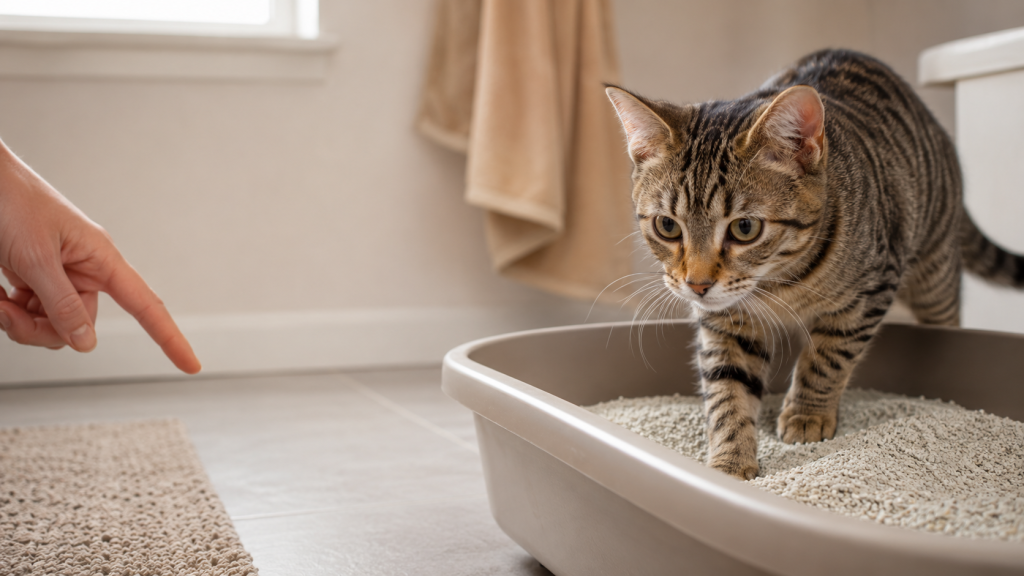
If your cat is missing the litter box, the worry is usually very practical: how do you stop accidents before they become a habit? I think the calmer way to look at litter training is this: you are not trying to make a cat obey. You are setting up a bathroom your cat naturally wants to use.
Most kittens and cats already prefer loose, diggable material for peeing and pooping. Trouble usually starts when the box is hard to find, too dirty, too small, too scary, physically awkward, or socially unsafe. A new kitten may simply need a smaller starting space. A newly adopted adult cat may need time to learn your home. A cat that suddenly stops using the box needs a different kind of attention, including a possible vet call.
Here is the practical approach I would use: make the litter box obvious, clean, roomy, quiet, easy to enter, and safer than every other option in the house.
The Quick Answer to Litter Training a Cat
To train a cat to use a litter box, start small, make the box easy, reward calm success, and avoid punishment. The goal is to make the litter box the simplest, most comfortable place to eliminate.
- Set up a quiet starter room with food, water, resting spots, toys, scratching options, and one clean litter box. Keep food and water away from the box.
- Choose a large, low-entry box, especially for kittens, seniors, or cats with mobility issues.
- Start with unscented, fine-textured clumping litter unless you know your cat prefers something else.
- Use enough litter for digging and covering, often around 2-3 inches, then adjust if your cat struggles.
- Place your cat in the room after waking, eating, and play, when elimination is more likely.
- If your cat sniffs, circles, or paws at the floor, gently scratch the litter with your finger or scoop. Do not force your cat’s paws.
- Give quiet praise or a small reward after your cat uses the box. Keep it low-key.
- Expand access to the rest of the home gradually after your cat is using the box reliably.
- Clean accidents with an enzymatic cleaner, then fix the setup problem the accident points to.
If your cat was previously reliable and suddenly starts peeing or pooping outside the box, I would not treat that as a basic training issue. Sudden house-soiling can be linked with pain, urinary problems, digestive problems, stress, mobility issues, or access problems.
Why Litter Box Training Usually Works
Litter training works because it uses a cat’s normal preference for loose, granular material. Many kittens begin seeking loose substrate at about 30-36 days old, and many cats instinctively use a box when it is accessible and appealing.
That instinct is helpful, but it is not magic. A kitten still has to learn where the box is in your home. A rescue cat may have learned a different substrate, such as soil or sand. A senior cat may know exactly where the box is but find the stairs or high sides too difficult.
For me, the most useful shift is to stop asking, why won’t my cat use the box, and start asking, what makes another spot easier or more attractive? Carpets, bedding, plant soil, corners, and laundry piles can all become tempting if the litter box is unpleasant or too far away.
Set Up the Litter Box Before You Start Training
A good litter box setup prevents many accidents before they happen. This matters most during the first few days with a kitten or newly adopted cat, when your cat is still learning the map of your home.
Choose a box your cat can actually move in
The box should be large enough for your cat to enter, turn around, dig, squat, eliminate, and cover without touching the sides or waste. A strong guideline is at least one and a half times your cat’s length from nose to tail tip. Many store-bought boxes are smaller than ideal, especially for big cats.
For kittens, seniors, arthritic cats, or cats with mobility limits, entry height may matter more than style. A shallow pan or low-entry box can prevent hesitation. For a large adult cat, a big storage container with a cut-out doorway may work better than a cramped commercial box.
Start with cat-friendly litter
A safe default is unscented, fine-textured, clumping litter. Many cats prefer fine-grained litter, and scented products or deodorant-heavy litters can put some cats off. That does not mean every cat will choose the same litter, but it is a sensible place to begin.
Avoid sudden litter changes once your cat is using the box well. If you want to switch litter, offer the new option in a separate box beside the old one and let your cat choose. A forced switch can create a problem where there was none.
Use enough depth for digging
Litter depth is part of the bathroom experience. Too little litter can make digging and covering difficult. Too much can feel unstable, especially for a tiny kitten.
Many cats do well with about 2-3 inches of litter. Watch your cat. If your cat digs normally, squats comfortably, and leaves calmly, the depth may be fine. If your kitten sinks, slips, or avoids the box, adjust it.
Think carefully about covered boxes
Covered boxes are not automatically bad, but they should not be the default fix for accidents. Many cats prefer simple uncovered boxes because they are easier to enter, easier to move in, and easier to escape from.
A covered box can trap odor. In a multi-cat home, it can also make a cat feel cornered. If you use one, it needs to be large, clean, easy to enter, and acceptable to that specific cat.
Where to Put the Litter Box
Put the litter box where your cat can reach it easily, not where it is most invisible to humans. A box hidden in a basement, loud laundry room, tight vanity space, or blocked corner may look tidy to you but feel unusable to your cat.
Good locations are quiet, open enough for movement, away from food and water, and reachable without passing dogs, children, rival cats, loud machines, or clutter. Laundry or furnace rooms can work only if the noise does not scare the cat and the door cannot accidentally block access.
In a larger home, use at least one box on each floor. Kittens, seniors, and newly adopted cats should not have to cross the whole house when they wake up and need to go. Urgency plus distance creates accidents fast.
Step-by-Step Litter Training for a Kitten or New Cat
For a new kitten or newly adopted cat, start with a small, comfortable room. This reduces the search area and makes the litter box the obvious loose substrate.
Set up the room with the litter box on one side and food, water, bedding, scratching, and play items away from it. Let your cat explore without pressure. Too much freedom too soon can lead to hidden accidents under beds, behind furniture, or in quiet corners.
Place your cat near the box after waking, eating, and play. These are common times when kittens may need to eliminate. If your cat steps in and uses it, praise quietly. If your cat walks away, let it go. You are building familiarity, not staging a test.
If your cat sniffs or paws at the floor, lightly scratch the litter with your finger or a scoop. Do not grab your cat’s paws and dig for them. Forced handling can make the box feel stressful.
Once your cat uses the box consistently in the starter room, allow supervised access to another room. Keep the route back to the box simple. Add more boxes before expanding to distant areas of the home.
Training an Adult Rescue Cat
An adult cat is not harder because it is stubborn. It may simply have stronger learned preferences. A cat that lived outdoors may be used to soil, sand, or soft ground. A cat from another home may know a different litter texture, box style, or location pattern.
Use the same starter-room method, but give the cat time to show you what it prefers. If accidents happen or the cat seems hesitant, try a litter box cafeteria: place two or more boxes side by side or in nearby quiet spots, each with one difference. Change only one variable at a time, such as litter texture, depth, box size, or covered versus uncovered.
Once your cat chooses a setup and uses it reliably, keep it consistent. Cats often do best when the bathroom does not keep changing.
How Many Litter Boxes Do You Need?
The usual rule is one box per cat, plus one extra. In a two-cat home, that means three boxes. The boxes should be in different locations, not lined up like parking spaces in one room.
This is about access, not math for its own sake. Two boxes side by side can still function like one toileting area. If one cat guards the laundry room door, stares, blocks the hallway, or ambushes another cat, the blocked cat may avoid the whole area.
In multi-cat homes, each cat should have at least one safe route to a box without crossing a rival. Visual barriers, distance, and boxes in separate areas can help. A cat that avoids the box may not dislike litter at all. It may dislike the social risk of getting there.
What to Do If Your Cat Has an Accident
Do not punish litter box accidents. Do not yell, rub your cat’s nose in urine or stool, strike, scare, or carry your cat to the box in anger. Punishment can make a cat afraid to eliminate near you, which often makes the problem harder to solve.
Clean the accident area thoroughly with an enzymatic cleaner made for pet urine or stool odor. Cats have a strong sense of smell, and lingering odor can draw them back to the same place.
Then treat the accident as information. If urine or stool appears right beside the box, your cat may dislike the box size, litter, odor, cleanliness, entry height, or cover. If accidents happen far from the box, the issue may be distance, blocked access, stairs, or a missing box in your cat’s main living area.
For very early training, some guidance suggests placing a small amount of stool or urine-soaked material in the box as a scent cue. Keep that brief and clean the box normally. The box should smell acceptable to your cat, not dirty.
Troubleshooting Litter Box Problems
| What you notice | What it may suggest | What to try |
|---|---|---|
| Accidents beside the box | The box is nearby, but something about it may be unpleasant. | Increase size, clean more often, remove hood, lower entry, test unscented fine litter. |
| Accidents far from the box | The box may be too hard to reach or absent from the cat’s main area. | Add boxes on each floor and near favorite resting areas. |
| Cat perches on the edge, barely digs, shakes paws, or rushes out | Possible box or substrate discomfort. | Try a larger uncovered box, different litter texture, different depth, or a cleaner box. |
| Small urine marks on vertical surfaces while standing, tail raised or twitching | This may be urine marking or spraying, not basic litter training. | Look at stress, intercat tension, intact-cat behavior, and medical factors. Ask a vet if it is new or persistent. |
| Previously reliable cat suddenly stops using the box | Possible medical, pain, stress, access, or aversion problem. | Contact a veterinarian, then improve the litter box setup. |
Cleaning Routine That Supports Training
A dirty box can undo good training. Scoop urine clumps and stool daily. If possible, remove stool soon after bowel movements. Empty and refresh the box regularly, and wash it with hot water and mild soap when needed.
Avoid strong chemical smells when hot water or mild soap is enough. A box can be too dirty for the cat, but it can also smell too harsh after cleaning. Both can cause avoidance.
Litter boxes wear out too. Scratched plastic can hold odor. If a box stays smelly even after cleaning, replacing it may be simpler than fighting the smell.
When Litter Box Trouble Means Calling the Vet
This is where I would stop guessing: if a cat that used the box reliably suddenly starts eliminating outside it, a veterinary check is the safer choice. Cats do not soil the house out of revenge. Pain, urinary disease, digestive problems, kidney disease, thyroid disease, diabetes, mobility changes, cognitive changes, stress, and resource conflict can all be part of the picture.
Urinary signs deserve special caution. Contact a veterinarian promptly if your cat has painful or difficult urination, frequent trips to the box, crying while urinating, blood in the urine, frequent genital licking, or new urination outside the box.
Treat repeated straining with little or no urine as an emergency, especially in male cats. A blocked cat needs immediate veterinary care.
Defecation problems can also create box avoidance. Call your veterinarian if your cat repeatedly tries to poop without success, passes small hard dry stool, strains or vocalizes, has decreased appetite, lethargy, vomiting, or has no bowel movement for 48-72 hours.
For older cats, do not dismiss accidents as just age. Low-entry boxes, more locations, and fewer stairs can help, but medical causes and pain still need consideration.
Common Mistakes That Make Litter Training Harder
- Giving a kitten the whole house before box use is reliable.
- Using a box that is too small for the cat to turn and dig.
- Choosing scented litter for human odor control.
- Putting the only box in a basement, noisy laundry room, or blocked corner.
- Using one box for multiple cats and placing all boxes together.
- Letting the box get dirty, then trying to solve avoidance with training.
- Changing litter type abruptly after the cat was using the old one.
- Punishing accidents instead of cleaning and troubleshooting.
Most of these mistakes come from human convenience, not bad intentions. I get why people want the box hidden, covered, scented, and out of the way. The problem is that cats choose bathrooms by access, texture, odor, safety, and comfort, not by our decorating plans.
What to Remember
The best way to train a cat to use a litter box is to make the right choice easy. Start in a small space, use a roomy clean box, choose cat-friendly litter, place boxes where your cat actually lives, and expand freedom gradually.
If accidents happen, do not punish. Clean well, look at the pattern, and adjust the setup. Near-box accidents, far-away accidents, spraying, and sudden changes point to different problems.
If your cat is straining, passing little or no urine, crying in the box, showing blood, suddenly changing habits, or struggling to defecate, call a veterinarian. Good litter training starts with comfort, but safety comes first.
References
- Humane Society of Missouri, Kitten Behavior and Litter Box Training – kitten development, training timing, accident handling, cleaning guidance.
- VCA Hospitals, Kitten Behavior and Training: Litter Box Training – starter-room method, box setup, litter preferences, cleaning, no punishment.
- AAHA/AAFP Feline Life Stage Guidelines, General Litter Box Considerations – box size, number of boxes, cleaning, multi-cat access, behavior framing.
- Ohio State Indoor Pet Initiative, Litter Boxes – litter box location, size, access, litter type, multi-cat resource placement.
- Cornell Feline Health Center, House Soiling – house-soiling causes, spraying distinction, medical and environmental factors.
- Cornell Feline Health Center, Feline Lower Urinary Tract Disease – urinary warning signs and emergency obstruction guidance.
- VCA Hospitals, Constipation in Cats – constipation signs, straining, defecation concerns, when to call a veterinarian.
- Today’s Veterinary Practice, Feline Inappropriate Urination – box aversion clues, substrate preference, access patterns, spraying context.