If your cat ignores you, scratches the sofa, bolts from the carrier, or acts offended by the word sit, it is easy to wonder if training a cat is even possible. The answer is yes, but cat training works best when you stop thinking in terms of obedience and start thinking in terms of cooperation.
Cats usually do not respond well to pressure, correction, or repeated commands. They learn when the behavior you want becomes clear, safe, and rewarding. A trained cat is not a cat who has been dominated. It is a cat who understands what works.
For me, the safest way to think about cat training is this: make the right behavior easy, reward it quickly, and pause if your cat looks scared, in pain, or overwhelmed. That simple shift prevents many common mistakes.
Yes, cats can be trained
Cats can learn cues, routines, handling skills, carrier entry, scratching-post use, recall, target touch, and simple tricks. They can also learn household rules, but usually only when you teach a better alternative instead of just trying to stop the behavior you dislike.
One shelter-cat study used 15 five-minute clicker-training sessions over two weeks and found improvement in four cued behaviors: target touch, sit, spin, and high-five. Not every cat mastered every behavior, which is useful to remember. Cats are individuals. Age and sex did not decide learning success in that study, while food motivation and temperament mattered more.
So if your adult or adopted cat seems slow at first, that does not mean training is hopeless. It may mean the reward is wrong, the session is too long, the cue came too early, another pet is interfering, or the cat is not in the right emotional or physical state to learn.
How cat training actually works
Cat training works through consequences. If a behavior reliably leads to something your cat values, your cat is more likely to repeat it. If touching a target earns a treat, entering a carrier earns praise and food, or scratching a post earns play, those choices start to make sense to the cat.
This is why positive reinforcement is the core method. You reward the behavior you want. You do not wait for your cat to be wrong and then punish it. Punishment may interrupt a behavior, but it does not teach the cat what to do instead.
Timing matters more than many owners realize. If the reward comes too late, your cat may not connect it to the behavior you meant to reward. If your cat sits, then walks away, then gets a treat, the lesson may become unclear. Mark the exact moment, then reward right away.
Before you start, choose the right moment and reward
Do not train when your cat is hiding, hissing, growling, ill, in pain, or clearly trying to get away. A cat in that state is not being difficult. The cat is protecting itself. Pushing through can make the situation scarier and can teach your cat that you ignore warnings.
Start in a quiet area with few distractions. Other pets, loud sounds, active children, and competing food can make a simple lesson feel impossible. In a multi-cat home, I would train one cat at a time at first. This prevents one cat from stealing rewards or blocking the more cautious cat from joining in.
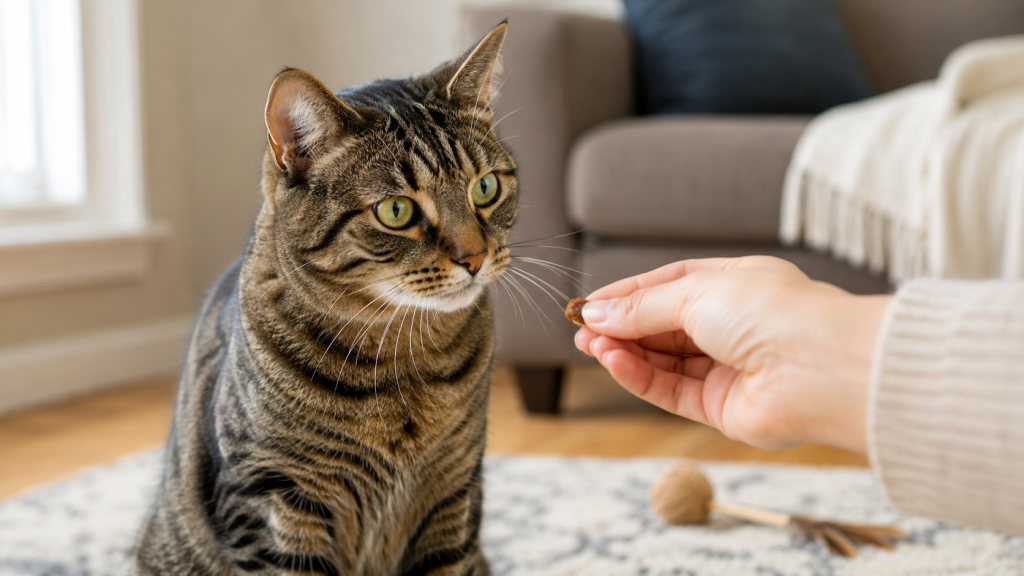
Pick a reward your cat actually wants in that moment. Many cats work well for tiny food rewards, but some prefer play, petting, social attention, or a favorite toy. A cat may choose food one day and a feather toy another day. If one treat fails, do not assume your cat is untrainable. Test the reward first.
Keep sessions short. Five minutes is plenty for many cats, and some do better with less. Stop while your cat is still interested. Early training should reward every correct repetition. Once the behavior is clear, you can reward it less predictably so it stays strong without needing a treat every single time.
Markers, cues, and rewards are not the same thing
A marker tells your cat, that exact moment earned the reward. It can be a clicker, a quiet word like good, a tongue click, or a visual signal for a deaf or sound-sensitive cat. The marker is not the reward. It is a clean signal that a reward is coming.
A cue is different. The cue is the word or gesture you use to ask for the behavior after the cat understands it. Many owners repeat sit before the cat knows what sit means. That turns the cue into background noise.
A better order is this: get the behavior first, mark it, reward it, repeat it, then add the cue just before the cat is about to do it. In plain terms, teach the action before you name it.
Four gentle ways to train a cat
Capturing
Capturing means rewarding a behavior your cat already does naturally. If your cat sits before meals, calmly mark the sit and reward it. If your cat lies on a mat, mark and reward that. Over time, the cat offers the behavior more often.
This is useful because it feels voluntary. You are not pushing the cat into position. You are noticing a behavior you like and making it pay.
Luring
Luring uses food or a toy to guide movement. For example, you might move a treat slightly upward so your cat naturally lowers the rear into a sit. The moment the sit happens, mark and reward.
The trap is becoming dependent on the lure. Once the cat understands the movement, fade the lure and use a cue instead. Otherwise, the cat may learn to respond only when food is already visible.
Shaping
Shaping means rewarding small steps toward the final behavior. If you want your cat to go through a cat door, you might reward looking at it, stepping toward it, touching it, putting one paw through, then walking through.
Shaping is slower, but it is often the kindest path for cautious cats. It lets the cat stay under threshold, meaning the lesson remains manageable instead of scary.
Targeting
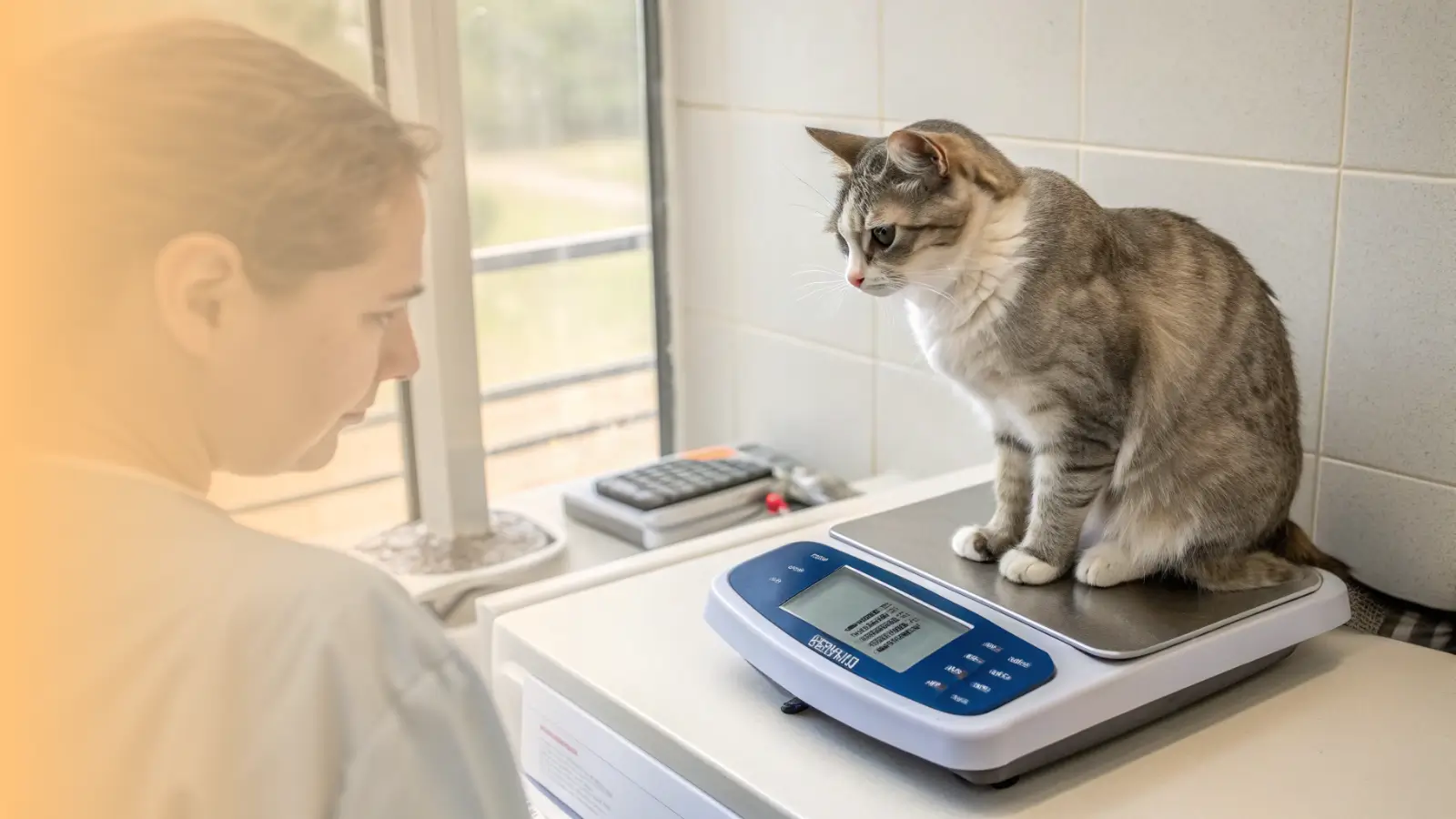
Targeting teaches your cat to touch or follow an object, such as a target stick, pen, or chopstick. This becomes useful far beyond tricks. You can later use a target to guide your cat onto a mat, into a carrier, or onto a scale.
Targeting is often a good first lesson because it is simple and low-pressure. The cat does not need to be handled or positioned. The cat only needs to investigate and touch.
A simple first lesson for target touch
Target touch is a good starting point because it teaches your cat the training pattern: behavior, marker, reward. It also gives you a practical tool for future skills.
- Choose a quiet place and a reward your cat wants.
- Hold a target, such as a chopstick or pen, a few inches from your cat.
- If your cat looks at it, sniffs it, or moves toward it, mark and reward.
- After a few repetitions, reward only closer movement, then only a nose touch.
- When your cat is touching the target reliably, say the cue, such as touch, just before presenting it.
- Move the target slightly to the side, then farther away, always keeping the lesson easy enough for success.
- End the session before your cat walks off or gets frustrated.
If your cat leaves, let the session end. Walking away is information. The reward may not be worth it, the session may be too long, or the environment may be too distracting.
The most useful things to train first
Carrier training
Carrier training is one of the most practical cat skills. Many cats only see the carrier before car trips or veterinary visits, so the carrier becomes a warning sign. Training can slowly change that association.
Start by rewarding any calm interest in the carrier: looking at it, sniffing it, stepping near it, placing one paw inside, then going in. Add a cue only after your cat is entering reliably. Later, you can practice very brief door closings if your cat stays relaxed.
This should be done when your cat is healthy and not showing fear, pain, or protective behavior. If the carrier triggers panic, use smaller steps. Forcing a cat inside may get the cat to the appointment today, but it can make the carrier harder tomorrow.
Cooperative care and handling
Cooperative care means teaching your cat to take part willingly in care tasks. This can include stepping onto a scale, offering a paw, staying still briefly, or tolerating gentle handling.
Keep this very short and voluntary. Touch for one second, mark, reward, stop. Build only if the cat remains comfortable. If your cat suddenly resists touch, swats, hides, or vocalizes when handled, I would stop training and consider pain or illness before assuming stubbornness.
Scratching posts and scratchers
Scratching is normal cat behavior. Cats scratch to stretch, maintain claws, leave visible marks, and deposit scent from glands in the paws. The goal is not to stop scratching. The goal is to make the approved scratching surface the best option.
Match what your cat already likes. A vertical scratcher helps a cat who scratches upright surfaces. A horizontal scratcher may suit a carpet-scratching cat. Texture matters too: sisal, cardboard, wood, carpet-like fabric, or other surfaces may appeal to different cats.
Place the scratcher near the object your cat already scratches, make sure it is sturdy, and reward use immediately. Once the habit transfers, you can gradually move the scratcher if needed. If unwanted scratching suddenly increases or becomes intense, it can be worth looking at stress, conflict, or health, but scratching alone is not automatic proof of stress.
Litter box habits
Litter box training is different from dog housetraining. Many cats naturally prefer a loose, diggable surface, so your job is often to provide the right setup rather than teach the whole concept from scratch.
A good setup usually means one litter box per cat plus one extra, easy access, quiet locations where the cat is not trapped, daily scooping, unscented litter, and low-sided boxes for very young, older, arthritic, or physically limited cats.
If a cat stops using the box, do not treat it as disobedience. Medical problems, pain, box aversion, location preference, surface preference, and urine marking can all be involved. Frequent litter box trips with only small amounts of urine, straining, blood in urine, or seeming unable to urinate should be treated as veterinary concerns, and inability to urinate is urgent.
Counters, meowing, and other nuisance behaviors
For nuisance behaviors, teach an alternative and stop paying off the unwanted behavior. If your cat jumps on the counter and you toss food to the floor, the cat may learn that counter-jumping makes food appear.
Instead, reward a nearby perch, mat, or approved station. For attention meowing, reward calm, quiet moments, offer predictable play and interaction, and avoid turning every loud demand into a payoff. If vocalization changes suddenly or becomes excessive, especially in an older cat, I would stop guessing and call a vet.
Harness and leash skills
Harness training is optional, not a requirement for every cat. Some cats enjoy careful, gradual training. Others find it too stressful, and that should be respected.
Introduce the harness in a favored area. Reward interest, then brief contact, then wearing it for short periods indoors. Attach the leash indoors before any outdoor work. Do not pull the leash to move your cat. Toss a treat or toy in the direction you want instead. Freezing, hiding, flattening, hissing, or frantic escape attempts mean the process is too fast or not right at that moment.
What not to do when training a cat
Do not hit, yell, scruff as correction, rub a cat’s nose in a mess, or use scare tactics as training. Physical punishment should not be used with cats, and verbal punishment can also increase fear. Punishment may stop a behavior while you are present, but it does not teach the replacement behavior.
It can also damage trust. A cat who becomes afraid of the person, the room, the carrier, the grooming tool, or the other pet involved is harder to help later. Fear can also look like aggression when the cat feels cornered.
For fear-based problems, the safer approach is desensitization and counterconditioning. Desensitization means exposing the cat to a trigger at such a low level that the cat stays comfortable. Counterconditioning means pairing that low-level trigger with something good. Forcing a cat to get used to it by trapping or overwhelming the cat is flooding, not training.
Kittens, adult cats, senior cats, and multi-cat homes
Kittens often have an advantage because early positive experiences can help them accept handling, sounds, textures, carriers, people, and household routines. Even so, kitten training should still be gentle. Do not use fingers, hands, feet, or toes as toys, because kittens can learn that biting and scratching people is normal play.
Adult cats can still learn. They may just need smaller steps, better rewards, and more patience, especially if they have a strong history with the carrier, nail trims, visitors, or other triggers.
Senior cats can learn too, but health and mobility matter. Arthritis, pain, sensory loss, cognitive changes, or reduced mobility can make old expectations unfair. A cat who no longer jumps to a training perch may not be refusing. The task may have become uncomfortable.
In multi-cat homes, train separately at first. Provide separate reward stations and prevent one cat from taking another cat’s food or space. Subtle blocking can look like laziness from the outside, when the cautious cat is actually avoiding conflict.
When to pause training and contact a veterinarian
Training should pause when behavior changes suddenly or when pain, illness, urinary trouble, or fear may be involved. This is where I would stop trying to solve it as a training issue first.
Contact a veterinarian if you notice sudden aggression, sudden hiding, appetite change, reduced mobility, hesitation to jump, sensitivity when touched, major grooming changes, litter box changes, straining, frequent trips with little urine, blood in urine, sudden vocalization changes, or abrupt training regression.
Aggression also deserves caution. Fear aggression, play aggression, redirected aggression, pain-related aggression, petting-related aggression, and conflict between cats can look similar to an owner in the moment. If there is risk of injury, separate animals safely and get veterinary or veterinary behavior support.
If your cat is not learning, check these common problems
Most failed cat training is not really failure. It is usually a mismatch between the lesson and the cat in front of you.
- The reward is not valuable enough. Try a different food reward, toy, play style, petting, or social attention if your cat likes those.
- The reward comes too late. Mark the exact behavior, then reward immediately.
- The cue came too early. Teach the behavior first. Name it after your cat is already offering it.
- The session is too long. Use a few short repetitions, then stop.
- You are accidentally rewarding the wrong thing. Food tossed after counter-jumping can teach counter-jumping.
- The environment is working against you. No safe retreat, no good scratcher, poor litter box access, or competition from another cat can undo training.
- Your cat is scared or uncomfortable. A defensive cat is not ready for a lesson.
- There may be pain or illness. Sudden resistance, biting, hiding, litter changes, or mobility changes need a veterinary lens.
When training gets stuck, make the behavior easier. Reward a smaller step. Lower the distraction level. Change the reward. If the problem appeared suddenly, do not keep drilling. Look for what changed.
What to remember
Training a cat is not about making a cat act like a dog. It is about clear timing, good rewards, low pressure, and respect for normal feline behavior. Start with simple skills like target touch, carrier entry, scratcher use, and calm handling.
Avoid punishment. Reward what you want. Teach alternatives instead of only saying no. And if the behavior change is sudden, painful, aggressive, urinary, or very out of character, put training aside and call a veterinarian.
References
- VCA Hospitals: Using Reinforcement and Rewards to Train Your Pet — positive reinforcement, cues, rewards, learning through consequences.
- Cat Friendly Homes: Cat Training Techniques for Caregivers — markers, reward timing, shaping, capturing, luring, targeting, cooperative care, harness training cautions.
- Feline Veterinary Medical Association: Positive Reinforcement of Cats Position Statement — welfare concerns with punishment and support for positive reinforcement.
- Animals: Clicker Training in Shelter Cats — study on shelter cats learning target touch, sit, spin, and high-five.
- VCA Hospitals: Overcoming Fears with Desensitization and Counterconditioning — gradual exposure, counterconditioning, avoiding overwhelming fear.
- ASPCA: Litter Box Problems — medical rule-out, litter box setup, urinary warning signs.
- Cornell Feline Health Center: Destructive Scratching — why cats scratch and how to redirect scratching to appropriate surfaces.
- Cornell Feline Health Center: Aggression — forms of feline aggression and when professional help is needed.