
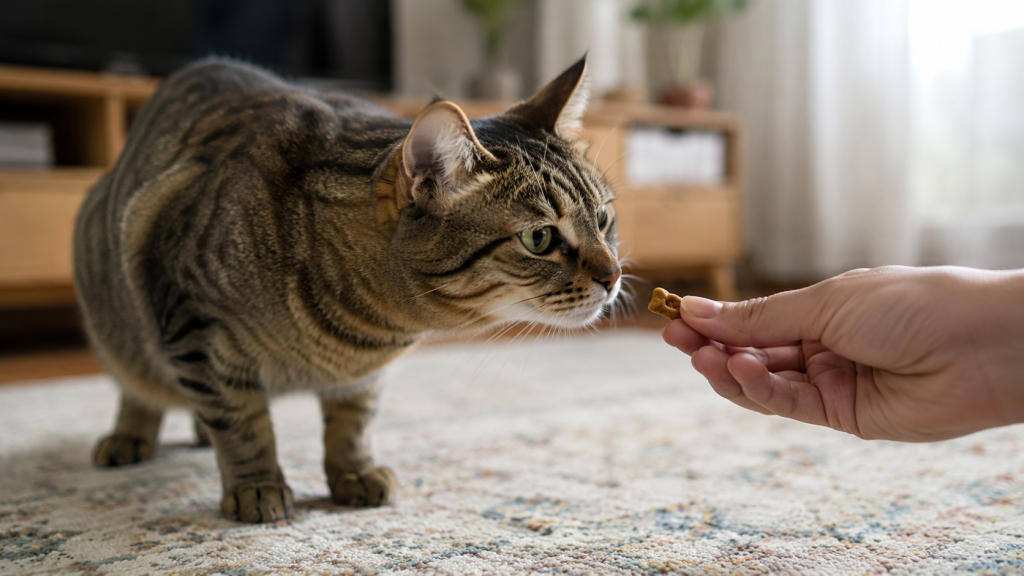
A scared cat can make you feel rejected, even when that is not what is happening. You may offer food, speak softly, sit nearby, and still get hiding, hissing, swatting, or a quick escape under the bed.
The safer way to think about taming a cat is not, “How do I make this cat let me touch them?” It is, “How do I help this cat feel safe enough to choose contact?” That small shift changes almost everything.
Some cats are newly adopted and overwhelmed. Some are stray cats that have lived around people but never fully trusted them. Some are truly feral, which means they are not socialized to human handling and may never feel comfortable as indoor pets. The right approach depends on the cat’s age, history, body language, health, and stress level.
A tame cat is not necessarily a lap cat. For some cats, progress may look like eating while you are in the room, blinking softly from a distance, walking past you without panic, or accepting a brief cheek rub before moving away. That still counts.
What “Taming a Cat” Really Means
Taming a cat means reducing fear and building predictable, positive experiences with people. It does not mean forcing the cat to submit, flooding them with handling, or trying to prove that you are friendly by touching them before they are ready.
Cats are not being rude when they hide or hiss. Those behaviors are usually distance-increasing signals. The cat is saying, in the only way they can, “This is too close,” “I need space,” or “I do not feel safe yet.”
This matters because many owners make the situation worse without meaning to. They reach into hiding spots, pull the cat out, follow the cat around the room, or keep trying to pet the cat after the first hiss. From a human point of view, that can feel like reassurance. From the cat’s point of view, it can feel like being trapped.
For me, the most useful rule is simple: if the cat has to freeze, hiss, swat, bite, or flee, the interaction has already gone too far. The goal is to work at a distance and pace where the cat can stay curious, calm, and able to leave.
First, Know What Kind of Cat You Are Working With
A shy pet cat, a scared stray cat, and a feral cat need different expectations. This is one of the biggest places where generic cat advice gets too vague.
A socialized cat has some history of living with or around people. They may be terrified in a new home, but they still have the capacity to learn that this person, this room, and this routine are safe. A newly adopted cat hiding for a while is not automatically feral.
A stray cat may have lived with people before or may be partly used to human presence. Some stray cats become indoor pets with patience. Others remain cautious and prefer limited contact.
A feral cat is different. A feral cat is not simply a “difficult” cat. Feral cats are not socialized to human handling and may be deeply distressed by forced indoor life. Some may learn to tolerate a regular feeder, but that does not mean they want to be touched, carried, or kept inside as a house pet.
Age matters a lot. Kittens have a sensitive socialization period when positive human handling has the strongest effect. Older kittens and adult cats can still improve, but the process is usually slower and less predictable. Welfare guidance is especially cautious about trying to socialize older feral kittens or adult feral cats into pets, because the process can cause serious stress if the cat is not suited to it.
That does not mean you give up on a scared cat. It means you set the right goal. With a socialized but frightened cat, the goal may be a confident indoor companion. With an adult feral cat, the kinder goal may be safe outdoor management through local rescue, shelter, or TNR/TNVR support rather than forced taming.
Give the Cat a Safe Base Before You Ask for Trust
Start with a quiet, smaller space rather than the whole home. A frightened cat does not need full access to every room on day one. They need a safe base where life becomes predictable.
A good starter room should have food, water, a litter box, bedding, hiding places, a scratching surface, and a few toys. The room should be quiet enough that the cat can rest, but not so isolated that they never get used to normal household sounds.
Do not remove every hiding place. Hiding is not the enemy. A hiding cat is coping. The problem is when the cat has only unsafe hiding places, such as inside furniture, behind appliances, or somewhere you must drag them out.
Use covered beds, boxes, or low furniture where the cat can retreat without being unreachable in an emergency. If the cat prefers height, add a stable perch or cat tree. Some cats calm down when they can observe from above. Others prefer a low, enclosed spot.
Keep the routine boring in the best possible way. Feed around the same times. Move slowly. Avoid sudden loud introductions. Sit in the room without demanding contact. A predictable person becomes easier to trust than a person who keeps changing the rules.
Let the Cat Choose the First Contact
The first contact should usually come from the cat, not from your hand. That may sound slow, but it prevents many setbacks.
Sit sideways or at an angle instead of facing the cat directly. Keep your hands close to your own body. Avoid leaning over the cat, staring, reaching into a hiding place, or blocking the exit. A cat who can leave is more likely to stay.
You can talk softly, read near the cat, or simply sit in the room for short periods. If the cat watches you but does not run, that is information. If they eat while you are nearby, that is progress. If they come out, sniff, and retreat, that is also progress.
Food can help, but do not use food as a trap. Toss treats away from your body at first, so the cat does not have to come too close. Over time, you can toss treats slightly closer, but only if the cat stays relaxed.
The mistake is rushing from “the cat took a treat” to “the cat is ready to be petted.” Those are different steps. A cat can be brave enough to grab food and still not be ready for touch.
Read the Body Language Before You Move Closer
A cat’s body language tells you whether you are building trust or pushing too hard. Watch the whole cat, not just one sign.
Relaxed signs may include a softer body, normal blinking, ears in a neutral or forward position, grooming, eating, exploring, or resting with the body loose. A cat may still be cautious, but the body does not look locked or ready to flee.
Stress signs include crouching low, freezing, hiding tightly, flattened or rotated ears, wide pupils, tail twitching or tucked posture, growling, hissing, swatting, or refusing food they normally like. A cat who suddenly stops eating a treat when you move closer is telling you something.
Purring can be confusing. Many owners assume purring always means happiness, but cats may purr in more than one emotional state. Do not use purring alone as proof that the cat is comfortable. Look at whether the cat can move freely, whether the body is soft, and whether the cat is choosing to stay.
I would be more cautious with a cat who looks still but tense. Stillness can look like acceptance, but it may be freezing. Real trust has more choice in it.
Use Small Steps, Not Forced Exposure
The safest taming process uses gradual exposure and positive associations. In plain English, that means exposing the cat to something mildly challenging only at a level they can handle, then pairing it with something good.
For example, if the cat is afraid of you sitting nearby, you do not start by petting them. You sit far enough away that the cat can still eat, groom, or watch without panic. Then you make that distance feel safe by staying calm and offering food, play, or quiet presence.
If the cat stays relaxed, you repeat. Later, you reduce the distance a little. If the cat hisses, hides tightly, stops eating, or swats, you made the step too big. Go back to an easier version.
This is different from flooding, which means forcing the cat to endure something scary until they stop reacting. Flooding can look like progress because the cat becomes quiet, but that quiet may be fear, shutdown, or exhaustion. It does not create real trust.
Short, calm sessions are better than long, emotional ones. End while the cat is still doing well. A tiny success that repeats every day is more useful than one dramatic session that leaves the cat more guarded tomorrow.
When and How to Start Touch
Start touch only when the cat is already choosing to approach and can leave easily. Even then, keep it brief.
Let the cat sniff your hand if they want to. Do not push your fingers into their face. If the cat rubs against you, you can try a short touch around the cheek, chin, or side of the head. Many cats prefer those areas over the belly, legs, or tail area.
Stop after a second or two. That may feel too brief, but stopping early teaches the cat that your hand is not a trap. If the cat stays close, you can offer another short touch. If they move away, let them go.
Avoid picking up a cat during early taming unless it is necessary for safety or veterinary care. Being lifted removes the cat’s control, and for a fearful cat, that can undo a lot of careful work.
Do not punish a cat for hissing or swatting. Those are warnings. If you punish the warning, the cat may become more afraid or may skip warnings next time and go straight to biting. The better response is to pause, create distance, and make the next session easier.
Use Play to Build Confidence Without Pressure
Play can help a scared cat engage with you without needing to be touched. A wand toy is often better than hands because it gives the cat distance and control.
Keep the toy movement gentle at first. Some cats are frightened by fast, chaotic play, especially in a new space. Move the toy like small prey hiding, pausing, and moving away from the cat rather than rushing toward them.
If the cat only watches, that can still be a start. A fearful cat may need several sessions before they pounce. Do not wave the toy in their face or poke it into a hiding spot.
Food puzzle toys, scattered treats, and gentle hunting-style play can also make the room feel more normal. The goal is not to exhaust the cat. The goal is to help them use natural behavior in a space where you are present but not threatening.
Be Extra Careful With Visitors, Children, and Other Pets
A cat who is starting to trust you may still panic around guests. That does not mean the taming failed. It means trust is often person-specific at first.
Before visitors arrive, give the cat a safe room or hiding option. Do not ask guests to reach for the cat, stare at the cat, or “just try giving them a treat” if the cat is clearly hiding. Some cats need to hear visitors from a distance many times before they can calmly be in the same room.
Children need very clear rules. No chasing, no cornering, no grabbing, no reaching under furniture. A child who wants to help can toss a treat away from their body or sit quietly while the cat observes.
Other pets add another layer. In a multi-cat home, a timid cat may avoid you because another cat controls the food area, hallway, litter box, or favorite resting spot. Give separate resources in different locations. Do not assume cats are fine together just because they eat near each other.
If there is a dog in the home, keep early introductions controlled and separated. A scared cat should have high places, escape routes, and a dog-free zone. Trying to tame a cat while also forcing pet introductions is too much for many cats.
What Is Normal, and What Should Worry You?
Some hiding, caution, and slow progress can be normal, especially after adoption, moving homes, loud guests, or a stressful capture. A cat may need days or weeks to relax, and poorly socialized cats may need much longer.
Progress is not always linear. A cat may come out one evening and hide again the next morning. They may accept treats from one person but avoid another. They may be comfortable in one room and nervous in the hallway. That does not automatically mean you did something wrong.
I would pay closer attention if the fear is sudden, intense, or very different from the cat’s normal behavior. Sudden hiding, new aggression, fear when touched, changes in appetite, litter box changes, weight loss, repeated vomiting, breathing trouble, collapse, severe pain, or any major behavior change should not be treated as a simple taming problem.
This is where I would stop guessing and call a veterinarian. Pain, illness, or stress-related medical issues can change a cat’s behavior. Home trust-building can help a scared cat, but it cannot rule out a health problem.
How Long Does It Take to Tame a Cat?
There is no reliable deadline. A well-socialized cat in a new home may settle in faster. A poorly socialized cat, a cat with bad experiences, or an older cat who has spent a long time avoiding people may need much more time.
Measure progress by behavior, not by the calendar. Useful signs include eating while you are nearby, hiding less often, recovering faster after noises, grooming in your presence, approaching to sniff, playing at a distance, resting in the open, or accepting brief touch without tension.
Do not compare the cat to another cat you have known. Some cats become affectionate quickly. Some stay cautious but peaceful. Some choose one trusted person. Some never enjoy being picked up. A realistic goal is not to turn every cat into the same kind of companion.
For me, a good taming plan leaves room for the cat’s personality. Trust is not only about how close the cat gets to you. It is also about whether the cat can relax, make choices, and move through the home without constant fear.
Common Mistakes That Slow Trust Down
The most common mistake is doing too much too soon. Owners often wait quietly for a day or two, see a small improvement, and then rush to petting, carrying, guest introductions, or full-house access.
Another mistake is treating the cat’s hiding spot as a problem to remove. If you block all hiding places, the cat may feel more exposed and defensive. Safer hiding options work better than no hiding options.
Some owners also rely too much on treats. Treats can build a positive association, but they do not replace body language. If the cat takes food with a tense body and runs away, the cat is still scared.
The hardest mistake to notice is inconsistency. One person moves slowly, another person reaches. One day the cat is left alone, the next day guests try to touch them. A fearful cat learns from patterns. The calmer and more predictable the household is, the easier the pattern is to understand.
When a Cat May Not Be a Good Candidate for Indoor Taming
Some cats, especially adult feral cats, may not be good candidates for indoor pet life. This can be hard to accept because bringing a cat inside feels kinder from a human point of view.
But kindness has to include the cat’s stress level. If an adult outdoor cat panics around people, cannot settle indoors, and has no history of human handling, forcing close contact may create more fear rather than safety.
In that situation, contact a local rescue, shelter, veterinarian, or community cat program. Depending on the cat and your area, humane options may include trap-neuter-return or trap-neuter-vaccinate-return programs, managed outdoor care, or assessment by people experienced with community cats.
A young kitten is different from an adult feral cat. Kittens have a stronger socialization window, and early positive handling can make a major difference. Even then, the process should be gentle, structured, and based on the kitten’s stress signals.
A Practical Way to Think About the Process
A safe taming process starts with space, then routine, then association, then contact. Skipping straight to contact is where many problems begin.
First, make the cat’s environment feel safe. Then become predictable in that environment. Then pair your presence with good things like food, calm voice, and play. Only after the cat is choosing to approach should you try brief touch.
If a step creates fear, make the step smaller. Sit farther away. Move slower. End sooner. Use a quieter room. Give the cat a better exit. The cat is not failing the process. The process needs adjusting.
Taming a cat is less about winning affection and more about becoming trustworthy. That means respecting the warning signs, protecting the cat’s ability to choose, and knowing when a behavior problem may actually need veterinary help.
If your cat’s fear is new, severe, linked to pain or appetite changes, or getting worse despite a calm setup, call a veterinarian or a qualified behavior professional. If the cat is likely feral, ask for local welfare guidance before trying to make them an indoor pet.
A cat who trusts you may still have boundaries. That is not a poor result. For many cautious cats, the real success is a life with less fear, more choice, and a person who finally understands what they are saying.
References
- Frontiers in Veterinary Science, The Mechanics of Social Interactions Between Cats and Their Owners — supports cat-human interaction, socialization history, owner behavior, and the value of cat-led contact.
- FelineVMA, Socialization of Feral Kittens Position Statement — supports age-related socialization limits and welfare cautions for feral kittens.
- VCA Animal Hospitals, Cat Behavior Problems: Fears and Phobias — supports fear signs, causes, desensitization, counterconditioning, and when veterinary help may be needed.
- Cats Protection, Why Is My Cat Hiding? — supports hiding as a stress response and cautions against forcing a hiding cat out.
- AAFP and ISFM Feline Environmental Needs Guidelines — supports environmental setup, resource placement, stress reduction, and multi-cat considerations.
- MSD Veterinary Manual, Behavior Problems of Cats — supports safe-room setup, anxiety management, and avoiding punishment in fearful cats.
- Alley Cat Allies, Cat Socialization Continuum Guide — supports the distinction between socialized, stray, and feral cats and realistic expectations for community cats.