Holding a cat sounds simple until the cat twists, kicks, freezes, or gives you that very clear “put me down” look.
Most cat owners are not trying to force affection. They just want to pick up their cat safely, move them out of the way, cuddle for a moment, or get them into a carrier without scratches. The hard part is that being held can feel very different from the cat’s point of view. When you lift a cat, you take away their ability to leave.
The safest way to hold a cat is to support both the chest and the back end, keep the cat close to your body, stay calm, and put the cat down before they struggle. Just as important, you need to know when not to pick them up at all.
Some cats enjoy being held. Some tolerate it for a short time. Some hate it, even if they love sitting near you. That does not mean the cat is unfriendly. It means holding should be treated as a careful, consent-based interaction, not a test of love.
The Best Way to Hold a Cat
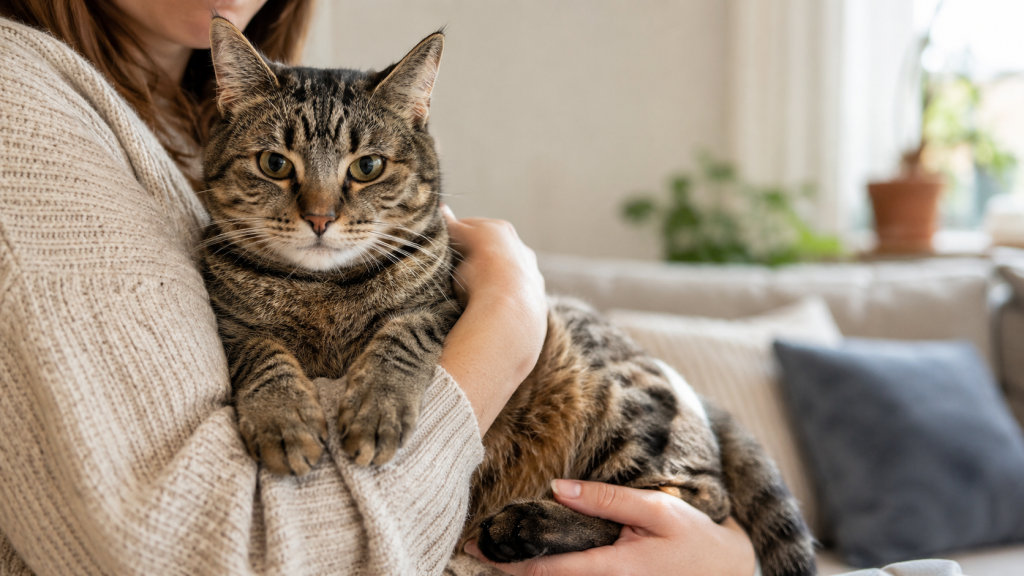
The safest basic method is to use two hands: one hand supports the cat’s chest behind the front legs, while the other supports the back legs and rear end.
Once the cat is lifted, bring them close to your body. This gives them a stable surface and helps prevent that dangling, panicky feeling that can make a cat kick or twist. A secure hold should feel supportive, not tight. You are not squeezing the cat into stillness. You are giving their body enough support that they do not feel like they are falling.
A simple way to picture it is this:
- Approach calmly and let the cat notice you first.
- Place one hand under the chest, just behind the front legs.
- Use your other hand or arm to support the back legs and bottom.
- Lift smoothly, without jerking.
- Hold the cat close against your chest or torso.
- Keep the hold brief.
- Lower the cat gently until all four paws are near the floor before letting go.
That last step matters more than people think. Many scratches happen when a cat decides to launch out of someone’s arms. If you lower them before they panic, they are less likely to kick off your body or dig in with their claws.
I’d think of a good cat hold as boring: stable, short, predictable, and easy for the cat to end.
Why Cats Often Dislike Being Picked Up
Many cats dislike being picked up because it removes their sense of control. On the floor, a cat can step back, walk away, hide, or choose a different position. In your arms, they depend on you to let them go.
That loss of control can feel threatening, even when you mean well. A friendly cat may enjoy rubbing against your legs but still dislike being lifted. Another cat may sit on your lap for an hour but panic when held off the ground. These are not contradictions. Cats often prefer affection when they can choose the distance and leave when they want.
Past experience matters too. A cat that was handled gently as a kitten may be more relaxed about being picked up. A cat that was grabbed, restrained, chased, or only picked up before stressful events may be much more suspicious. Early socialization can help, but adult cats can still learn better associations when handling is calm, brief, and not forced.
This is where many generic cat tips get too simple. The issue is not only hand placement. A technically correct hold can still be wrong if the cat is scared, painful, cornered, or already trying to leave.
Check the Cat Before You Pick Them Up
Before lifting, look at the whole cat, not just whether they are close to you.
A cat who may be comfortable being handled will usually have a loose body, soft eyes, relaxed ears, normal whisker position, and a willingness to stay near you. They may rub against you, lean into a gentle touch, or remain calm when your hand rests near their chest.
A cat who should not be picked up may move away, crouch, freeze, stare, flatten their ears, flick or thrash their tail, hiss, growl, swat, hide, tense their body, or turn their head away from your hand. Some cats also show stress more quietly. A rigid cat who goes still in your arms is not always “being good.” They may be freezing because they feel trapped.
Purring can also confuse owners. A relaxed purr can be a happy sign, but purring alone does not prove a cat is comfortable. Cats may purr when stressed or in pain too, so the full body picture matters more than one sound.
For me, the safer rule is simple: if the cat is already trying to avoid contact, do not turn that moment into a pickup.
Where to Touch a Cat Before Holding Them
Many cats are more comfortable being touched around the head and neck than on the belly, tail base, legs, or feet. The cheeks, under the chin, and around the base of the ears are often safer places to test whether a cat is open to contact.
Start with a small amount of touch. Pause. See what the cat does.
If the cat leans in, stays loose, or keeps choosing the interaction, you may be able to continue. If they pull away, duck, tense, flick their tail, or turn sharply toward your hand, stop. That pause is not overthinking. It is how you avoid turning a mild “no” into a scratch.
Avoid using belly rubbing as a test before picking up a cat. Some cats expose their belly when relaxed, but that does not always mean they want it touched. For many cats, the belly is a vulnerable area, and touching it can quickly change the mood.
How Long Should You Hold a Cat?
Hold a cat for less time than you want, and put them down before they escalate.
Many cats only tolerate being held for a short moment. That may be a few seconds. It may be a minute or two. The exact time matters less than the cat’s body language. If they start shifting, looking for the floor, pushing away, stiffening, tail-thrashing, growling, or trying to climb out, the hold has gone on too long.
One mistake owners make is waiting until the cat struggles before releasing them. That teaches the cat that struggling is the only way to be heard. Over time, the cat may skip the polite signals and go straight to biting, clawing, or avoiding you.
A better pattern is to release early while the cat is still calm. That makes being held feel less like a trap.
How to Put a Cat Down Safely
To put a cat down, lower them slowly while still supporting their chest and back end. Let their paws reach the floor or a stable surface before you fully release them.
Do not drop them. Do not let them leap from a high position if you can avoid it. This is especially important for kittens, senior cats, overweight cats, and cats with possible joint pain.
If the cat is already tense, stay calm and lower them as smoothly as you can. Do not scold them for wanting down. The goal is to end the interaction safely, not to “win” the hold.
After you put them down, give them space. If they choose to come back, that is more useful than forcing another pickup right away.
What Not to Do When Holding a Cat
Do not lift a cat by the scruff. Scruffing is no longer recommended as a routine handling method, and it can cause fear, stress, distress, or defensive aggression.
The common argument is that mother cats carry kittens by the scruff. That does not make it appropriate for a person to lift an adult cat by the neck skin. A mother cat carrying a tiny kitten is not the same as a human holding the full body weight of a grown cat by loose skin.
Also avoid lifting a cat by the front legs, armpits, tail, or abdomen. Do not let the back legs dangle. Do not hold the cat upside down or belly-up unless you already know that specific cat calmly accepts that position. Most cats feel vulnerable when their belly is exposed.
A “tight hug” is another common mistake. Squeezing may stop movement for a moment, but it can make the cat feel trapped and more likely to panic. Secure handling means supported, not pinned.
Should You Hold a Cat Like a Baby?
Most cats should not be held belly-up like a baby.
Some individual cats may tolerate or even enjoy it with a trusted person, but it should not be the default way to hold a cat. The belly-up position exposes a vulnerable area and gives the cat less control. Many cats respond by twisting, kicking, or grabbing with their claws.
If a cat stiffens, stares, thrashes their tail, pins their ears, or tries to roll out of the position, put them down. Do not keep testing it because it looks cute. A photo-friendly hold is not always a cat-friendly hold.
For most cats, upright and close to your body is safer.
When You Should Not Pick Up a Cat
Do not pick up a cat who is sleeping deeply, hiding, eating, hunting, playing intensely, frightened, guarding kittens, injured, or showing clear signs of stress.
A cat in play mode may redirect claws and teeth onto your hands. A scared cat may feel cornered. A painful cat may bite because being touched or lifted hurts. A sleeping cat may startle and defend themselves before they understand what is happening.
If you need to move a nervous cat for safety, a towel or blanket may be safer than grabbing them directly. The goal is not to wrestle the cat. It is to calmly cover and support them just long enough to move them to a carrier or safer area.
For regular vet trips, carrier training is usually better than last-minute chasing and grabbing. If the carrier only appears during stressful events, many cats learn to fear both the carrier and being picked up.
If Your Cat Suddenly Hates Being Held
A sudden change in how your cat reacts to being held should be taken seriously.
If your cat used to tolerate being picked up but now growls, hides, bites, cries, stiffens, or struggles, do not assume they are being dramatic. Pain, illness, injury, arthritis, or another health problem can make normal handling uncomfortable.
This is especially worth watching in older cats. Senior cats may have joint pain or other health issues that make lifting, pressure on the hips, or being held against the body unpleasant. Some signs are easy to miss, such as reduced grooming, hiding more, eating less, drinking more or less than usual, avoiding jumps, moving stiffly, or reacting badly when touched.
This is where I’d stop guessing and call a vet, especially if the change is sudden or comes with appetite changes, hiding, reduced movement, litter box changes, aggression, or obvious pain. Handling practice is not the answer if the cat is hurting.
Holding Kittens Safely
Kittens need the same basic support as adult cats: chest supported, back end supported, and no dangling.
Because kittens are small, people often pick them up one-handed or hold them in awkward positions. That may seem harmless, but it can still scare them or make them feel unstable. Gentle, steady handling helps kittens learn that human touch is predictable.
Kittenhood is also an important socialization period. Positive handling during early development can make cats more comfortable with people later in life. That does not mean forcing constant handling. It means short, calm, pleasant interactions where the kitten feels safe and can recover easily.
Children should be supervised closely with kittens and cats. A child who wants to hold a cat may squeeze too hard, chase the cat, or miss warning signs. It is usually safer to have the child sit on the floor and let the cat approach rather than letting the child carry the cat around.
Holding Senior Cats or Cats With Health Issues
Senior cats and cats with health problems need slower, more supportive handling.
For older cats, avoid sudden lifting and avoid pressure on the abdomen, hips, spine, or sore joints. Support the whole body and keep the lift short. If the cat seems stiff, reluctant to jump, sensitive to touch, or newly defensive, be more cautious.
Overweight cats may also feel insecure if their back end is not supported well. A one-arm lift can put too much strain on the front of the body and make the cat panic. Use both arms and keep them close.
If your cat has a known medical condition, recent surgery, injury, arthritis, or unexplained behavior change, ask your veterinarian how to handle them safely. The best hold may depend on the cat’s specific body condition and pain points.
What to Do If Your Cat Scratches or Bites When Held
If your cat scratches or bites when held, put them down calmly and give them space. Do not punish them.
A bite or scratch during handling usually means the cat felt trapped, frightened, overstimulated, painful, or ignored. The useful response is to change the handling plan, not to force the cat to “get used to it” through repeated bad experiences.
For future attempts, make the interaction shorter and easier. Touch first. Pause. Lift briefly. Put the cat down while they are still calm. You can also reward calm handling with something the cat likes, such as a treat or a quiet release, as long as the cat is relaxed enough to take it.
If you are bitten or scratched, wash the wound with warm soapy water. Seek medical advice if the wound is deep, serious, swollen, red, warm, painful, or if the cat seems sick or their rabies vaccination status is unknown.
How to Help a Cat Become More Comfortable With Being Held
You can help some cats become more comfortable with handling, but the process should be gradual.
Start with touch the cat already accepts. Keep it short. Stop before they move away. Over time, you can add tiny steps: touching the chest area, briefly supporting the body without lifting, lifting for one second, then putting them down calmly.
The release is part of the reward. A cat that learns “I get put down before I panic” may become less defensive over time.
Do not practice when the cat is already stressed. Do not chase them. Do not use pickup practice as punishment or as a way to force affection. If every pickup leads to a carrier, a bath, medication, or nail trimming, the cat may learn that being held predicts something unpleasant.
Some cats may never enjoy being held, and that is fine. A cat can trust you deeply and still prefer sitting beside you instead of being carried.
Final Thoughts
The best way to hold a cat is not complicated, but it does require respect. Support the chest and back end, keep the cat close, stay calm, and put them down before they struggle.
Just as important, pay attention to whether your cat wants to be picked up in that moment. A relaxed cat may accept a short, steady hold. A tense, painful, frightened, or avoiding cat should not be forced unless there is a safety reason.
If your cat suddenly reacts badly to being held, especially with hiding, appetite changes, stiffness, aggression, or other behavior changes, treat that as a possible health warning and contact a veterinarian.
References
- AAFP/ISFM Cat Friendly Veterinary Interaction Guidelines — supports low-stress handling, avoiding scruffing, recognizing feline emotional state, and using the least restraint necessary.
- Cats Protection: How to Pick Up a Cat — supports the two-hand chest-and-hindquarter hold, signs a cat wants to be put down, and advice for nervous cats.
- Cats Protection: Cat Body Language — supports reading relaxed and stressed cat body language, including why purring alone is not enough.
- Frontiers in Veterinary Science: CAT Human-Cat Interaction Guidelines — supports giving cats choice and control, limiting touch to preferred areas, and reducing negative handling responses.
- SPCA New Zealand: How to Safely Handle Your Cat — supports avoiding scruffing, using minimal restraint, and handling cats in a way that reduces fear and distress.
- Cornell Feline Health Center: Feline Behavior Problems, Aggression — supports the link between pain and aggression or avoidance during handling.
- VCA: Recognizing Signs of Pain in Cats — supports pain-related behavior changes such as hiding, grooming changes, appetite changes, and aggression when handled.
- HSE: Teaching Safety Around Cats — supports child safety around cats and warning signs that children should leave a cat alone.