
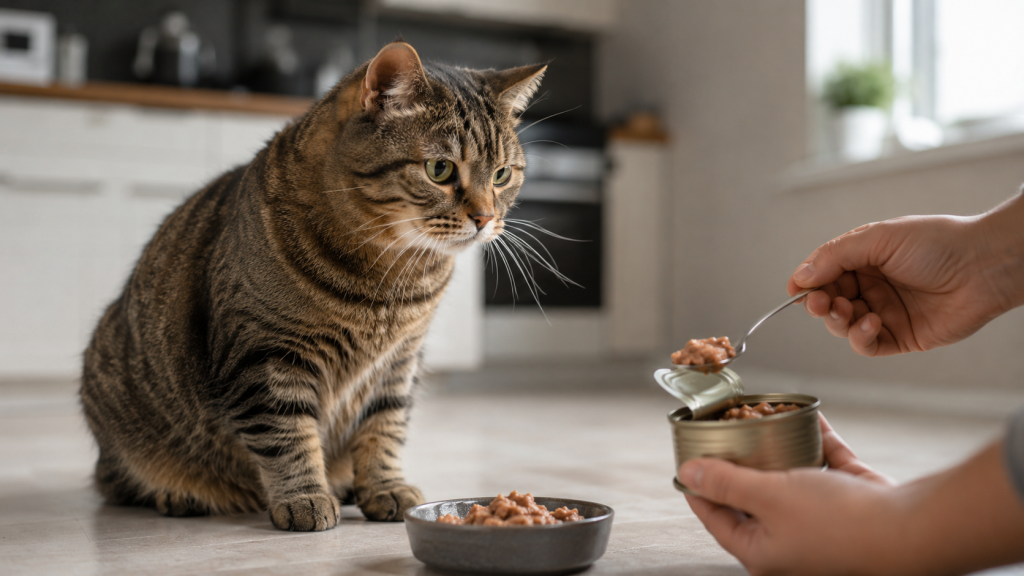
Figuring out how much wet food to feed a cat can be oddly confusing. One can looks small. Another looks huge. Then the label says one thing, your cat’s appetite says another, and suddenly you are wondering whether your cat is hungry, underfed, overfed, or slowly getting chunky.
The most useful answer is not “one can” or “two cans.” It is calories first, can size second.
A healthy adult cat often needs somewhere around 200 to 300 calories per day, depending on body size, age, neuter status, activity level, and body condition. The exact wet food amount depends on how many calories are in that specific can, pouch, tray, or serving. Two wet foods can look similar in the bowl but have very different calorie counts.
For me, the safer way to think about it is simple: find your cat’s daily calorie target, check the calorie content on the wet food label, then divide. After that, watch your cat’s weight and body shape, because the label is only a starting point.
The short answer
Most adult cats need enough wet food to meet their daily calorie needs, not a fixed number of cans.
As a rough starting point, many average adult cats may need about 200 to 300 calories per day. A smaller, less active indoor cat may need less. A larger or more active cat may need more. Kittens, pregnant cats, nursing cats, cats with medical conditions, and cats who need to lose weight should not be fed from a simple adult-cat estimate.
The easiest way to calculate wet food amount is:
- Estimate your cat’s daily calorie need.
- Find the wet food’s calories per can, pouch, tray, or ounce.
- Divide your cat’s daily calories by the food’s calories per serving.
- Subtract calories from dry food, treats, toppers, or human food.
For example, if your cat needs around 240 calories per day and one can of wet food has 80 calories, your cat would need about three cans per day if that wet food is the only food. If one larger can has 180 calories, the same cat may need about one and a third cans per day.
That is why “how many cans?” can mislead you. The can is just the container. The calories are what actually feed the cat.
Why can size alone is not enough
A 3-ounce can, 5.5-ounce can, pouch, or tray does not tell you enough by itself. Wet foods vary in moisture, fat, protein, texture, and calorie density.
One pâté may be calorie-dense. Another shredded food with gravy may contain fewer calories per ounce. Some wet foods are complete meals. Others are broths, toppers, or treats that are not meant to be the main diet.
The label matters. Look for the “Calorie Content” line, usually written as kcal per can, kcal per pouch, kcal per tray, kcal per cup, or kcal per kilogram. In pet food, “kcal” means the same thing owners usually mean when they say “calories.”
Also check whether the food is “complete and balanced” for your cat’s life stage. A complete and balanced adult maintenance food can be used as the main diet for an adult cat. A product labeled for intermittent or supplemental feeding should not become the main food, even if your cat loves it.
This is one of the biggest wet food mistakes I’d watch for. A cat may happily eat a topper or broth every day, but that does not mean it provides the full nutrition of a complete cat food.
A practical wet food calculation
To work out your cat’s wet food portion, start with the calories your cat should eat in a day.
A healthy adult cat in ideal body condition around 8.8 lb may need roughly 225 to 250 calories per day. A healthy adult cat around 11 lb may need roughly 250 to 290 calories per day. Those numbers are still estimates, not rules.
Now compare that with the wet food label.
| Example daily calorie target | Wet food calories | Approximate daily wet food amount |
|---|---|---|
| 220 calories/day | 75 calories per 3-ounce can | About 3 cans |
| 240 calories/day | 95 calories per can | About 2.5 cans |
| 260 calories/day | 130 calories per pouch | About 2 pouches |
| 280 calories/day | 180 calories per 5.5-ounce can | About 1.5 cans |
This table is only an example. Your cat’s food may be much higher or lower in calories.
If your cat also eats dry food, do not feed the full wet food amount on top of the full dry food amount. That is where many cats get overfed.
Say your cat’s target is 240 calories per day. If dry food already provides 100 calories, wet food should provide about 140 calories, before treats. If the wet food has 70 calories per can, that would be two cans, not three or four.
What changes your cat’s daily wet food amount?
Your cat’s body weight matters, but it is not the only factor. Two cats can weigh the same and need different amounts of food.
Neutered adult cats often need fewer calories than intact cats. Indoor cats may need fewer calories than active cats who move more. Some cats are naturally more obesity-prone. Older cats may need adjustment depending on health, muscle, appetite, and weight changes.
This is why I would not trust a chart blindly if your cat’s body is telling a different story. A feeding guide is a starting point. Your cat’s weight trend and body condition show whether that starting point is working.
A cat who is slowly gaining weight on the label amount may be getting too many calories. A cat who is losing weight, begging constantly, or acting unwell needs a closer look, not just a bigger serving.
Your vet can help estimate a healthier target if your cat is underweight, overweight, senior, still growing, pregnant, nursing, diabetic, dealing with kidney disease, or on a prescription diet.
How to tell if the amount is working
The right amount of wet food should keep your cat’s weight stable if your cat is already at a healthy size.
You should be able to feel your cat’s ribs with light pressure, but they should not be sharply sticking out. From above, your cat should have some waist behind the ribs. From the side, the belly should not be steadily expanding over time.
Body condition is more useful than appetite alone. Some cats ask for food because they enjoy the routine, the smell, the attention, or the habit of getting a response from you. Begging does not always mean your cat needs more calories.
On the other side, a cat leaving food behind is not always “self-regulating perfectly.” The food may be too cold, the texture may be wrong, the portion may be too large for one sitting, or the cat may not feel well.
I’d monitor four things together: weight, body shape, appetite, and energy. If only one thing changes slightly, you may just need to adjust portions. If several things change at once, especially appetite and weight, that is where guessing becomes risky.
Wet food for kittens is different
Kittens should not be fed like adult cats. They need more calories per pound of body weight because they are growing, and they need food labeled for growth or all life stages.
A kitten may also need more frequent meals than an adult cat. Young kittens have small stomachs and high energy needs, so two adult-style meals may not be enough.
The label on kitten wet food is a better starting point than an adult-cat chart. Still, the same logic applies: check the calories, feed according to growth needs, and watch body condition.
If a kitten refuses food, I would be much more cautious than I would be with a healthy adult cat. Young kittens can get into trouble faster when they do not eat enough. If a very young kitten is not eating, contact a veterinarian promptly.
Wet food for senior cats
Senior cats do not automatically need less food just because they are older. Some older cats gain weight because they move less. Others lose weight or muscle because of health problems, dental discomfort, or changes in appetite.
That makes senior feeding more individual.
If your senior cat is eating the same amount but losing weight, do not simply increase wet food and move on. Weight loss in an older cat can be a sign that something else needs veterinary attention.
Wet food can be helpful for some senior cats because it is softer and provides more moisture than dry food. But the amount still needs to fit the cat’s body condition and health status.
For senior cats, I would use the label and calorie math as the starting point, then lean more heavily on regular weigh-ins and veterinary advice if anything changes.
Wet food, hydration, and urinary health
Wet food can help increase your cat’s total water intake because canned food contains a lot of moisture. This is one reason many owners choose wet food, especially for cats who do not drink much from a bowl.
That does not mean wet food replaces fresh water. Your cat should still have clean water available every day.
Higher-moisture diets can support more diluted urine, and that may be helpful for cats prone to some urinary issues. But wet food should not be presented as a cure for urinary disease, kidney disease, or any medical condition.
If your cat is straining to urinate, crying in the litter box, producing little or no urine, urinating outside the box, or showing sudden distress, do not try to solve it by changing food first. Contact a veterinarian or emergency vet. Urinary problems can become serious quickly, especially in male cats.
Wet food can be part of a good feeding plan. It is not a substitute for diagnosis.
Wet food and weight control
Wet food can make portion control easier because it is usually served in meals instead of being left out all day. It also contains more water than dry food, so the same physical volume may provide fewer calories than a calorie-dense dry food.
But wet food can still cause weight gain.
A cat can gain weight from extra cans, full wet portions plus full dry portions, frequent treats, or high-calorie toppers. Lickable treats, broths, freeze-dried snacks, and bits of cooked meat can add up faster than they look.
A useful rule is to keep treats to no more than about 10% of daily calories. For a cat eating 240 calories per day, that means treats should stay around 24 calories or less.
If your cat is overweight, do not crash diet. Cats can become seriously ill if they stop eating or lose weight too aggressively. Overweight cats, obese cats, and cats with health conditions should have a weight-loss plan made with a veterinarian.
If your cat eats both wet and dry food
If your cat eats both wet and dry food, decide how many daily calories should come from each.
For example, if your cat needs 250 calories per day, you might feed 150 calories from wet food and 100 calories from dry food. Or you might feed mostly wet food and keep a small dry portion for a timed feeder. The exact split depends on your cat, your schedule, and what your vet recommends if your cat has health issues.
The mistake is feeding both labels separately.
A wet food label may assume that food is the full daily diet. A dry food label may do the same. If you follow both at full amounts, you may accidentally double-feed.
This is especially easy in multi-cat homes. One cat may eat quickly, steal another cat’s wet food, then still snack from the dry bowl. If one cat is gaining weight and another is staying thin, separate feeding areas or supervised meals may be needed.
How often should you feed wet food?
Most healthy adult cats can be fed wet food once or twice daily, but many cats do better with two or more measured meals. Kittens usually need more frequent feeding.
Wet food is not ideal for all-day grazing because it is perishable after opening. If your cat does not finish a portion, refrigerate the unused food and follow the storage directions on the package.
For refrigerated leftovers, many cats prefer the food slightly warmed or brought closer to room temperature before serving. Do not make it hot. The goal is simply to make the smell and texture more appealing.
If your cat tends to leave food behind, smaller meals may work better than one large wet meal. This also helps you notice appetite changes sooner.
Food safety matters with wet food
Opened wet food should be handled more carefully than dry kibble. Unused portions should be covered and refrigerated promptly. Bowls and utensils should be washed after use.
Do not leave opened cans sitting out. Do not keep old wet food in the bowl for long periods. If it smells spoiled, looks dried out, or has been sitting around too long, throw it away.
This matters even more if your cat is a grazer. Wet food may be healthy as part of the diet, but it is not meant to sit in a bowl all day like dry food.
If your cat regularly eats only part of a can, smaller cans or portioned containers may be easier and safer than repeatedly guessing what to do with leftovers.
When to call a vet about feeding or appetite
Call a veterinarian if your cat refuses food, has a sudden appetite change, loses weight, vomits repeatedly, has diarrhea, seems lethargic, or shows signs of pain or distress.
A mature cat who does not eat for around 24 hours should not be ignored. Very young kittens can become unsafe even sooner. Overweight cats are also at higher risk if they stop eating, because cats can develop a serious liver condition called hepatic lipidosis after going without enough food.
This is where I’d stop adjusting cans and call a vet. Portion math is useful for healthy cats. It is not enough when appetite, weight, or behavior suddenly changes.
Also check with your vet before making major diet changes if your cat has diabetes, kidney disease, urinary problems, dental disease, pancreatitis, or a prescription diet. Wet food may still be useful, but the food type and amount need to fit the medical situation.
Common wet food feeding mistakes
One common mistake is feeding by can count without checking calories. “Two cans a day” can be too much, too little, or just right depending on the food and the cat.
Another mistake is treating wet food as automatically slimming. It can help with portion control, but calories still count.
Some owners also forget to subtract treats. A few lickable treats, table scraps, or extra toppers can shift the whole day’s calorie intake.
The mistake I’d be most careful with is cutting food too hard when a cat is overweight. Cats should not be put on harsh diets without veterinary guidance. A slow, monitored plan is safer.
And finally, do not ignore the label statement. A complete wet food and a supplemental wet treat are not the same thing.
So, how much wet food should you feed your cat?
Feed enough wet food to meet your cat’s calorie needs, using the calorie content on the label instead of guessing by can size.
For many healthy adult cats, that may work out to roughly two to three small cans per day, or one to two larger cans per day, depending on the food. But that is only a practical estimate. Your cat’s actual amount may be different.
Start with the label and a reasonable calorie target. Subtract dry food and treats. Watch your cat’s weight and body shape over the next few weeks. Adjust carefully if your cat is gaining or losing weight.
If your cat is a kitten, senior, pregnant, nursing, overweight, underweight, sick, or suddenly eating differently, get veterinary guidance. Food amount is simple only when the cat is healthy and stable.
References
- AAFCO, Reading Labels — Supports calorie label reading, feeding directions, and why label guidance is a starting point.
- FDA, Complete and Balanced Pet Food — Supports the difference between complete diets and supplemental feeding products.
- WSAVA, Calorie Needs for Healthy Adult Cats — Supports estimated daily calorie ranges for healthy adult cats by body weight.
- MSD Veterinary Manual, Nutritional Requirements of Small Animals — Supports energy requirement differences by life stage, neuter status, and individual variation.
- Cornell Feline Health Center, Feeding Your Cat — Supports canned food moisture, food completeness, water access, and storage basics.
- Cornell Feline Health Center, How Often Should You Feed Your Cat? — Supports feeding frequency, kitten feeding, obesity context, and health-condition feeding considerations.
- Cornell Feline Health Center, Anorexia — Supports appetite-loss warnings and when not eating becomes concerning.
- Pet Nutrition Alliance Calorie Calculator — Supports veterinary calorie-estimation context and the 10% treat-calorie guideline.