Feeding a cat sounds simple until you actually try to do it. The bag says one thing, the can says another, your cat acts hungry five minutes after eating, and the measuring cup never feels precise enough.
The most honest answer is this: your cat should be fed the number of calories that keeps them at a healthy body condition, not a fixed number of cups, cans, or scoops.
For many healthy adult cats, the daily amount may fall somewhere around 200 to 260 calories, but that is only a starting range. A small, inactive, neutered indoor cat may need less. A larger, lean, active cat may need more. Kittens, pregnant cats, nursing cats, senior cats, overweight cats, and cats with medical issues should not be treated like “average adult cats.”
For me, the safer way to think about feeding is this: start with calories, check the label, measure the food, watch your cat’s body condition, then adjust carefully. That gives you a better answer than copying a feeding chart and hoping it fits.
The Short Answer: Feed by Calories, Not by Cups
A good starting point is to estimate your cat’s daily calories, then divide that amount across meals.
Veterinary nutrition references often use a formula called resting energy requirement, or RER. That is an estimate of how many calories a cat’s body needs at rest. For adult cats, the maintenance amount is then adjusted based on factors like whether the cat is neutered, intact, or prone to weight gain.
As a rough example, a 4 kg adult cat has an estimated RER of about 198 calories per day. A neutered adult cat of that size may start around 238 calories per day using common veterinary maintenance calculations. An obesity-prone cat of the same weight may start closer to 198 calories per day, while an intact adult may need more.
That does not mean every 4 kg cat should eat exactly that amount. It means you have a reasonable starting point.
The real test is what happens over time. If your cat is gaining unwanted weight, the portion may be too high. If your cat is losing weight, losing muscle, acting unwell, or showing appetite changes, the answer is not just “feed more.” That is when you need to look closer and, in some cases, call a vet.
Why Cat Food Labels Can Be Confusing
The feeding chart on a cat food label is a guide, not a personalized plan.
Pet food labels usually list calories as “kcal” per kilogram and also as a familiar unit, such as per cup, can, tray, or pouch. That familiar number matters most for daily feeding because it tells you what your cat is actually getting from the amount you serve.
This is where many owners accidentally overfeed. One cup of dry food is not the same as one cup of another dry food. One can of wet food is not the same as another can. Some foods are much more calorie-dense than they look.
Dry food is especially easy to over-pour. A small-looking scoop can contain a lot of calories because dry food has much less water than wet food. Wet food usually looks like a larger meal for the same calories because much of it is moisture.
That does not mean wet food is automatically “better” or dry food is automatically “bad.” Complete and balanced wet and dry foods can both fit a healthy diet. The important point is that you need to count the calories from the specific food your cat eats.
A Practical Way to Calculate Your Cat’s Food Amount
Start with the calorie number on the food label.
Look for the “Calorie Content” line. It may say kcal/cup, kcal/can, kcal/pouch, or kcal/tray. Once you know that number, you can divide your cat’s estimated daily calories by the calories in the food.
For example, if your cat’s starting target is 240 calories per day and the dry food contains 400 calories per cup, your cat’s full daily dry food amount would be about 0.6 cup. If you split that into two meals, each meal would be about 0.3 cup.
If you feed wet food and dry food together, count both. This is one of the easiest places to make a mistake.
Say your cat’s starting target is 240 calories per day. If half a can of wet food provides 90 calories, that leaves 150 calories for dry food. If the dry food has 450 calories per cup, that is only about one-third cup of dry food for the entire day.
That is why “I feed one can plus some dry food” is not precise enough. “Some dry food” can quietly turn into a large calorie surplus.
Use Body Condition, Not Just Body Weight
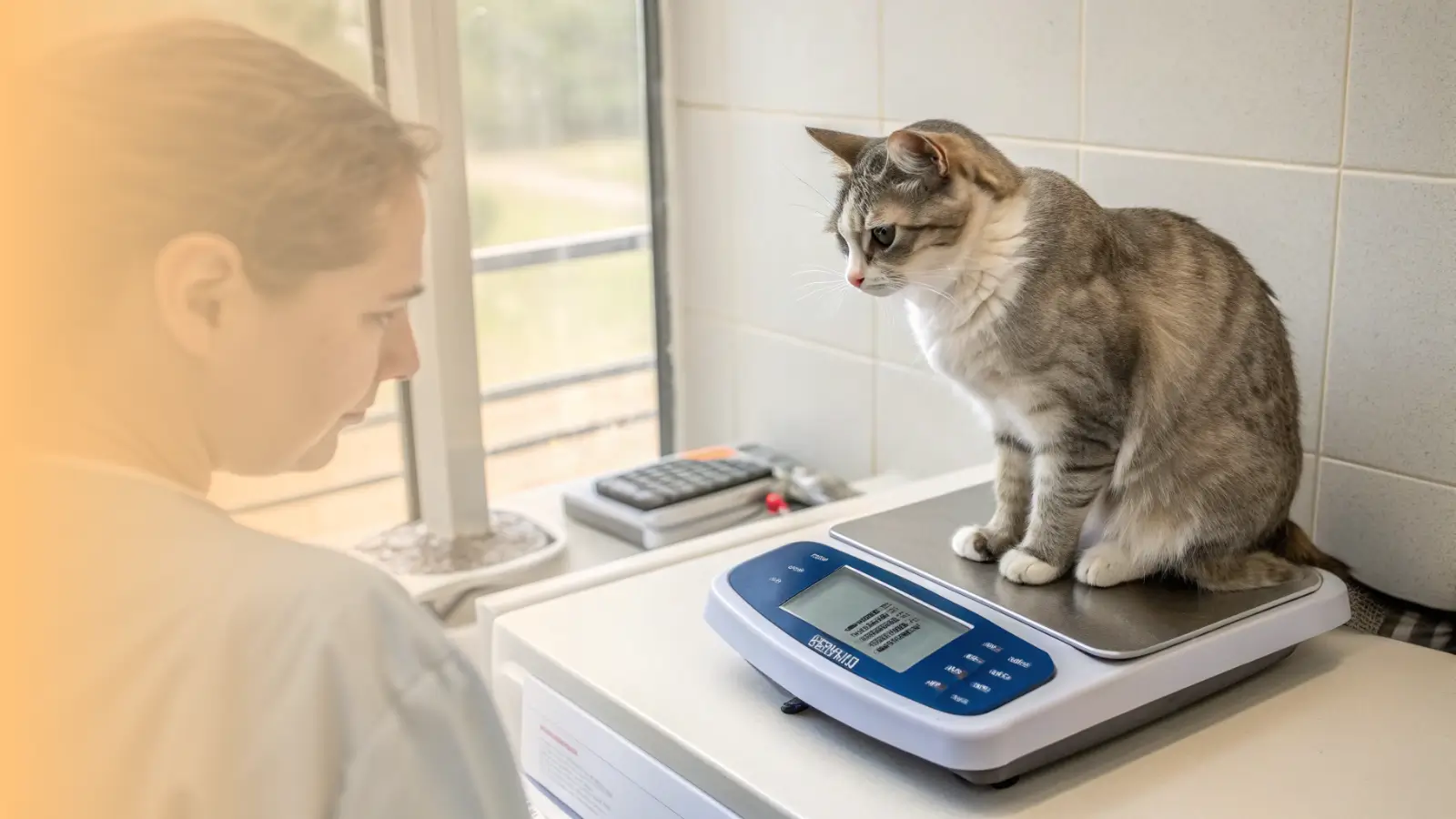
Your cat’s weight matters, but it does not tell the whole story.
Two cats can weigh the same and look very different. One may be lean and muscular. Another may be carrying extra fat. A third may be overweight but also losing muscle, especially if they are older or unwell.
That is why body condition score is so useful. A healthy cat should usually have ribs that are easy to feel without pressing hard, a visible waist when viewed from above, and only a minimal belly fat pad from the side.
If you have to dig through a thick fat layer to feel the ribs, your cat may be overweight. If the ribs, spine, or hip bones feel too sharp or obvious, your cat may be too thin. Either situation deserves attention.
I would not rely only on breed charts or average-weight lists. Frame size, muscle, age, and body shape matter too much. A better question is, “Does this cat have a healthy body condition for their own body?”
How Often Should You Feed a Cat?
Most adult cats can be fed once or twice a day, but many cats do better with a routine that splits food into smaller portions.
The total daily calories matter more than the exact number of meals. If your cat needs 220 calories per day, feeding 110 calories twice daily and feeding smaller portions across more meals are both possible approaches.
Some cats seem calmer with predictable meals. Some do well with puzzle feeders or small food searches using their measured daily ration. This can be especially helpful for indoor cats because it adds activity without adding extra calories.
Free feeding can work for some cats, but it is risky for cats that overeat. It is also hard to monitor in a multi-cat home. If one cat grazes slowly and another cat eats everything in sight, a shared bowl makes it almost impossible to know who ate what.
Dry Food, Wet Food, and Mixed Feeding
Dry food is convenient, but it needs careful measuring.
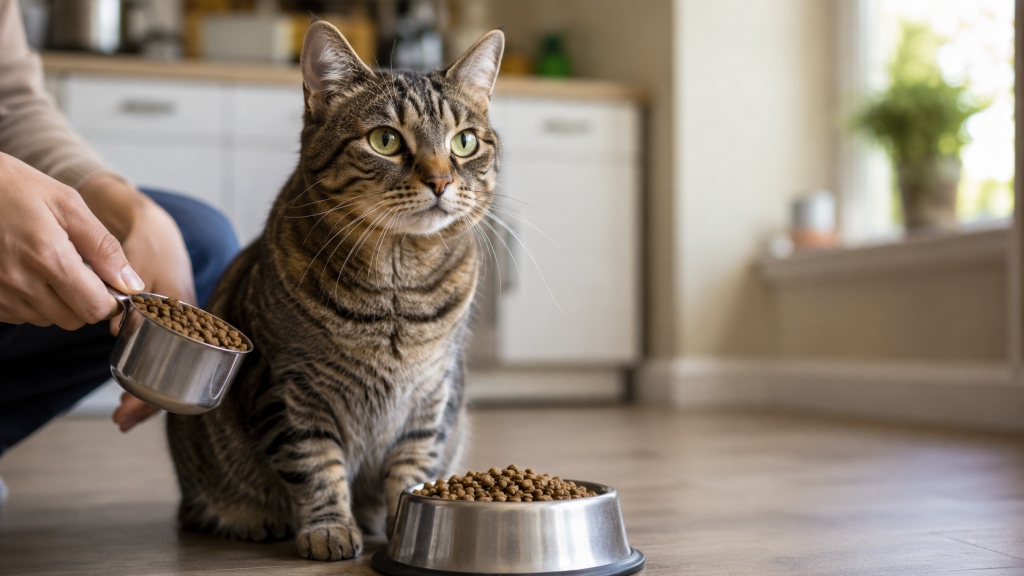
Because dry food is calorie-dense, even a small extra pour can matter. A kitchen gram scale is often more accurate than a cup, especially if your cat needs weight control. If you do use a measuring cup, use a real measuring cup and level it off.
Wet food adds more moisture to the diet and often creates a larger-looking meal for the calories. That can help some cats feel more satisfied, but the calories still count. A large can, a small can, and a pouch may all have different calorie amounts.
Mixed feeding can be a good routine, but only if you subtract one food from the other. Do not feed a full dry ration and then add wet food on top unless that total calorie amount fits your cat’s needs.
Treats count too. A cautious rule is to keep treats to about 10% of daily calories, with the rest coming from complete and balanced cat food. For a cat eating 220 calories per day, that leaves only about 22 calories for treats. It is not much, which is exactly the point.
Kittens Need a Different Feeding Plan
Kittens should not be fed like adult cats.
They are growing, so their calorie needs are much higher relative to body weight. Young kittens also need food formulated for growth, not an adult maintenance diet. Their portions change quickly as they grow, which makes regular monitoring more useful than a fixed chart.
Many kittens do better with several meals a day. A common pattern is around three meals daily until about six months, then twice daily between six months and one year. The exact plan should depend on the kitten, the food, and veterinary guidance.
I would be careful with any advice that tells you to restrict a kitten the same way you might restrict an overweight adult cat. Growth is a different situation. If a kitten is not eating, losing weight, or failing to grow as expected, that is a veterinary issue, not a portion-chart problem.
Senior Cats May Need More Careful Monitoring
Older cats are not all the same.
Some senior cats gain weight because they move less. Others lose weight, lose muscle, or have appetite changes. Some older cats may even need more calorie-dense nutrition depending on their condition.
This is why I do not like the simple advice that “senior cats need less food.” Sometimes they do. Sometimes they do not.
For senior cats, body weight trends matter. Muscle condition matters too. If an older cat is getting thinner, eating less, eating more but losing weight, drinking more, urinating more, vomiting, or acting weaker, do not solve that by guessing at portions. A vet visit is the safer choice.
Multi-Cat Homes Need Separate Feeding Plans
In a multi-cat home, the bowl can lie to you.
You may think each cat is eating half, but one cat may be eating most of the food while another waits, avoids the area, or gets pushed away. This can create one overweight cat and one underfed cat in the same house.
Separate feeding can help. Some homes use different rooms, timed meals, supervised feeding, or microchip feeders. The goal is simple: each cat gets their own measured portion.
This also makes it easier to notice appetite changes. If all the cats share one bowl, it may take longer to realize that one cat has stopped eating or that another cat is eating much more than usual.
Indoor and Outdoor Cats Can Need Different Amounts
Indoor cats often need closer portion control because they may move less and have fewer chances to hunt, roam, or work for food.
That does not mean every indoor cat is lazy. Some are active, playful, and lean. But indoor life often makes calorie mistakes easier to see because food is fully controlled by the owner and activity may be limited.
Outdoor cats are harder to estimate. They may eat prey, food from neighbors, or food from another source. If an outdoor cat is gaining or losing weight, the food you provide may not be the full picture.
For indoor cats, I like the idea of using part of the measured daily ration for enrichment. Puzzle feeders, food-search games, or hiding small portions around a safe area can make mealtime less passive without adding extra calories.
Common Feeding Mistakes That Cause Problems
The most common mistake is measuring by habit instead of calories.
A scoop that used to work may stop working after a food change. A “small handful” may be much larger than it looks. A full bowl may make life easier for the owner but harder for a cat that tends to overeat.
Another mistake is forgetting treats, toppers, and “just a little extra.” Those small extras can matter a lot for a cat because their daily calorie needs are relatively low.
A third mistake is cutting food too aggressively when a cat is overweight. Cats should not be crash-dieted. Sudden or severe food restriction can be dangerous, especially for overweight cats, because cats that stop eating can be at risk for hepatic lipidosis, a serious liver condition.
If your cat needs to lose weight, that plan should be gradual and ideally guided by a veterinarian. The goal is steady progress, not a sudden drop.
When Hunger Is Not Just Hunger
A cat that begs for food is not always underfed.
Some cats beg because they have learned the routine. Some want attention. Some are bored. Some are reacting to a schedule change. Some may be getting too many calories and still acting hungry.
But appetite changes can also be medical. A cat that suddenly eats much more, eats much less, loses weight, drinks more, urinates more, vomits, has diarrhea, seems weak, hides, or acts unlike themselves should not be treated as a simple feeding issue.
Loss of appetite deserves special caution. A cat that refuses food for a prolonged period needs veterinary advice, especially if the cat is overweight, very young, old, or already unwell.
For me, this is where I would stop adjusting the scoop and start asking what changed. Food amount is one piece of the picture. Appetite, weight, body condition, water intake, litter box habits, and behavior all matter.
When to Call a Veterinarian
Contact a veterinarian if your cat stops eating, has a sudden appetite change, loses weight without explanation, gains weight quickly, seems weak, vomits repeatedly, has diarrhea, drinks or urinates more than usual, shows signs of pain, or has a major behavior change.
You should also ask for veterinary guidance before putting an overweight cat on a weight-loss plan. Cats need gradual weight loss, and cutting food too sharply can create new risks.
A vet can help estimate your cat’s ideal weight, assess body condition and muscle condition, check for medical causes of appetite or weight changes, and recommend a safe calorie target.
Feeding amount is something owners can manage day to day, but unexplained changes are not something to guess through.
A Simple Feeding Check You Can Use at Home
Start with the food label. Find the calories per cup, can, pouch, or tray. Estimate your cat’s daily calorie target using weight, life stage, and body condition as starting points.
Measure the full day’s food, not just each meal. Count wet food, dry food, treats, and extras. Then watch your cat over the next few weeks.
A good feeding amount should help your cat maintain a healthy body condition. Their weight should not creep up or drop without explanation. Their ribs should be feelable, their waist should be visible from above, and they should have a normal appetite and energy level for their age and health.
If the numbers look right but your cat’s body says otherwise, trust the cat’s body. The chart is only a starting point.
Conclusion
The best answer to “how much should I feed my cat?” is not a universal cup measurement. It is a measured calorie amount that fits your cat’s age, body condition, activity level, food type, and health.
Start with the label, measure carefully, include treats, and adjust based on body condition and weight trends. Be especially careful with kittens, senior cats, overweight cats, and multi-cat homes.
If your cat’s appetite, weight, thirst, litter box habits, or behavior changes suddenly, do not treat it as a normal feeding puzzle. That is when veterinary help is the safer next step.
References
- Tufts Petfoodology: How much should I feed my dog or cat? — Supports using calorie estimates as a starting point, then adjusting based on body weight and body condition.
- AAFCO: Calories in Pet Food — Supports how calorie content appears on pet food labels and why kcal per cup, can, or treat matters.
- MSD Veterinary Manual: Daily Maintenance Energy Requirements for Dogs and Cats — Supports RER and maintenance calorie estimates for adult cats.
- AAHA: Nutrition and Weight Management Guidelines — Supports nutritional screening, body condition score, muscle condition, and weight-management context.
- Cornell Feline Health Center: Feeding Your Cat — Supports wet versus dry food context, feeding environment, and practical feeding considerations.
- Cornell Feline Health Center: How Often Should You Feed Your Cat? — Supports feeding frequency guidance and multi-cat feeding concerns.
- Cornell Feline Health Center: Obesity — Supports obesity risks and the need for careful weight management.
- Cornell Feline Health Center: Anorexia — Supports appetite-loss warning signs and the need for veterinary attention when cats stop eating.