Figuring out how much cat food per day your cat needs sounds like it should be simple. Then you look at one label, another label, a feeding chart, a measuring cup, and your cat staring at you like dinner was miscalculated.
The honest answer is this: most healthy adult cats need roughly 200 to 330 calories per day, depending on their size, body condition, activity level, and whether they are neutered. But that does not translate neatly into “one cup” or “one can,” because cat foods vary a lot in calories.
For me, the safer way to think about it is not, “How much food should a cat eat?” It is, “How many calories does this cat need, and how much of this specific food provides those calories?”
That small shift prevents a lot of overfeeding. It also helps you avoid underfeeding a kitten, senior cat, pregnant cat, or cat with a medical issue.
The Short Answer Is to Start With Calories, Not Cups or Cans
A typical healthy adult cat may need about:
| Cat’s weight | Approximate daily calories |
|---|---|
| 3 kg / 6.6 lb | 200–210 kcal/day |
| 4 kg / 8.8 lb | 225–250 kcal/day |
| 5 kg / 11 lb | 250–290 kcal/day |
| 6 kg / 13.2 lb | 265–330 kcal/day |
These numbers are only starting points. A calm indoor neutered cat may need fewer calories than a younger, lean, active cat of the same weight. A cat who is already overweight may need a carefully reduced plan. A senior cat who is losing weight may need veterinary help before anyone adjusts the food bowl.
Once you have a calorie target, check your cat food label for the calorie content. Look for wording such as:
- kcal per cup
- kcal per can
- kcal per pouch
- kcal per tray
- kcal per kg
Then divide your cat’s daily calorie target by the calories in that food.
For example, if your cat needs about 240 calories per day and the dry food has 400 calories per cup, that is about 0.6 cup per day. If a wet food has 90 calories per small can, the same cat may need about 2.5 cans per day. If another wet food has 180 calories per larger can, the same cat may need about 1.3 cans per day.
That is why “feed one can” or “feed half a cup” can be wrong. The food matters as much as the cat.
Why Feeding Guidelines Are Only a Starting Point
The feeding chart on a cat food package is useful, but it is not personalized. It cannot know your cat’s body condition, muscle condition, activity level, age, neuter status, medical history, or how many treats they get.
Pet food labels usually provide feeding directions because complete and balanced foods need to tell owners how to use the product. But those directions are still guidelines. Two cats can weigh the same and need different amounts of food.
This is especially true for indoor cats. Many indoor cats do not burn many calories unless their home routine includes regular play, climbing, chasing, and food puzzles. A cat who mostly naps near the window may not need the same amount as a cat who is active, lean, and constantly moving.
Neutered cats also often need fewer calories than intact adult cats. That does not mean neutering “makes cats fat” by itself. It means the food amount may need to be recalibrated after surgery, maturity, and lifestyle changes.
I would be cautious with any advice that gives one fixed serving size for all adult cats. It sounds helpful, but cats are too variable for that.
How to Calculate Your Cat’s Daily Food Amount
The simplest owner-friendly method is:
- Estimate your cat’s daily calorie need.
- Find the calorie content on your cat food label.
- Convert the calories into cups, cans, pouches, trays, or grams.
- Divide the total into meals.
- Monitor body condition and weight over time.
For a healthy adult cat, you can start with the calorie range from a trusted chart or ask your veterinarian for a target. If you want a more precise veterinary-style estimate, many professionals use resting energy requirement, often shortened to RER.
A common formula is:
RER = 70 × body weight in kg^0.75
For cats over 2 kg, another common estimate is:
RER = 30 × body weight in kg + 70
Then that number is adjusted depending on the cat. A neutered adult cat may need around 1.2 times RER. An obesity-prone cat may need closer to RER. An intact adult may need more. These are still estimates, not final answers.
For most cat owners, the practical takeaway is simpler: use calories to choose a starting amount, then let your cat’s body condition tell you whether that amount is working.
What Body Condition Tells You That Weight Alone Cannot
Your cat’s weight matters, but it does not tell the whole story. A small-framed 10 lb cat may be overweight, while a large-framed 10 lb cat may be lean.
Body condition score is a better everyday check. At an ideal body condition, your cat’s ribs should be easy to feel with a light fat covering. From above, you should be able to see a waist behind the ribs. From the side, the belly should not be heavily rounded or hanging with excess fat.
A cat who is too heavy may have ribs that are hard to feel, little waist definition, a rounded abdomen, and visible fat deposits. A cat who is too thin may have very visible ribs, spine, or hip bones, with little fat covering.
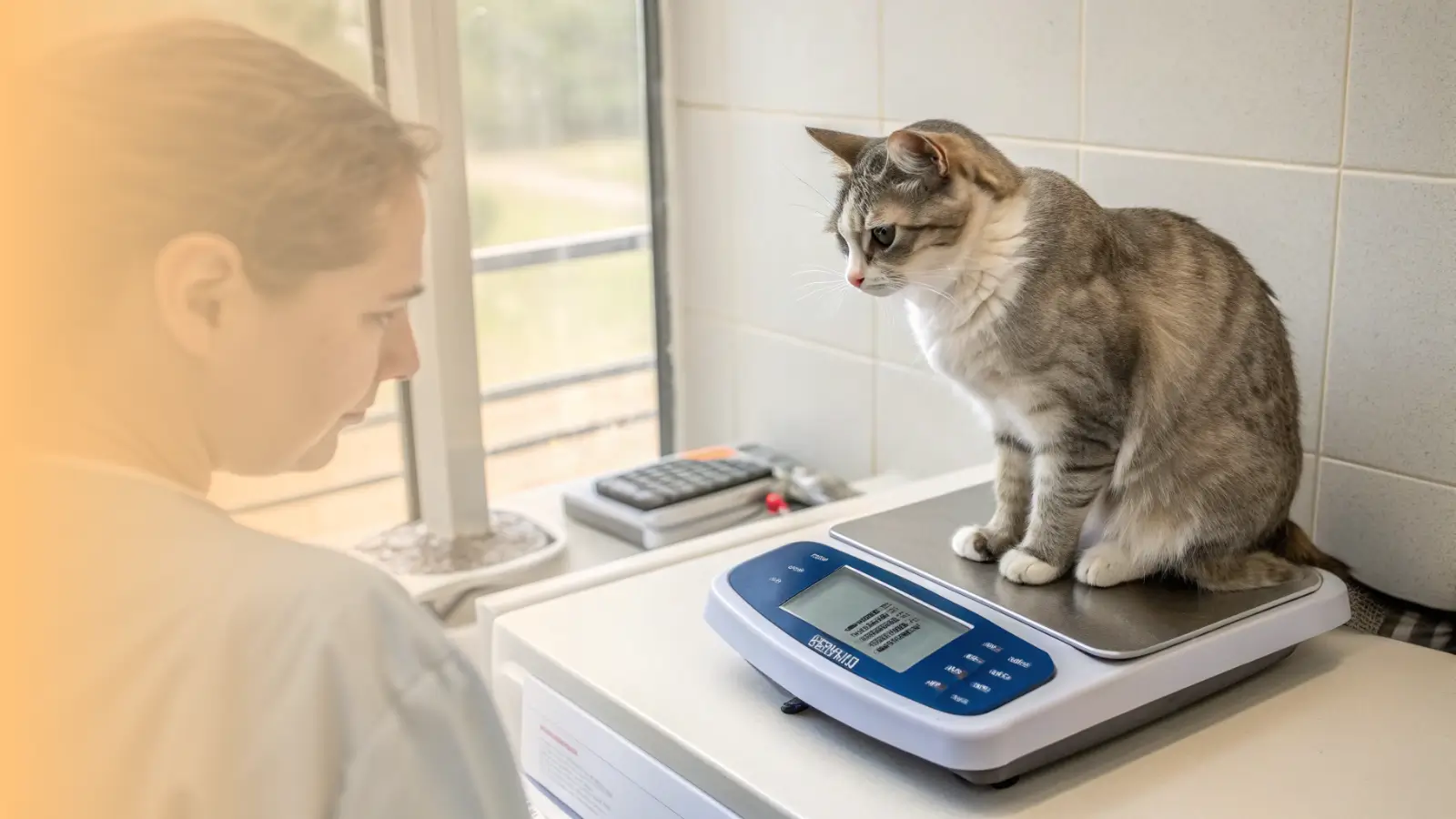
This is where I would not rely only on the scale. A monthly weigh-in helps, but looking and gently feeling matters too. If your cat’s body shape is changing, the daily food amount may need adjusting.
Wet Food, Dry Food, and Why the Amount Looks So Different
Wet food and dry food should not be compared by volume. They contain very different amounts of water.
Dry cat food usually has much less moisture and is calorie-dense. Canned food contains much more water, so the same number of calories often looks like a larger amount of food. That can make wet food feel more generous in the bowl, even when the calories are controlled.
This does not mean wet food is automatically the correct choice for every cat, and it does not mean dry food is automatically bad. It means you need to compare calories, not scoops or visual fullness.
Wet food may help some owners with portion control because cans, trays, and pouches are easier to count than loose kibble. It also adds water to the diet. Dry food can be convenient, but it is easy to over-pour, especially if you use a loose measuring cup or refill the bowl throughout the day.
If you feed both wet and dry, do not feed a full dry portion plus a full wet portion unless your veterinarian has specifically advised it. The calories add together.
Measuring Mistakes Are More Common Than Owners Think
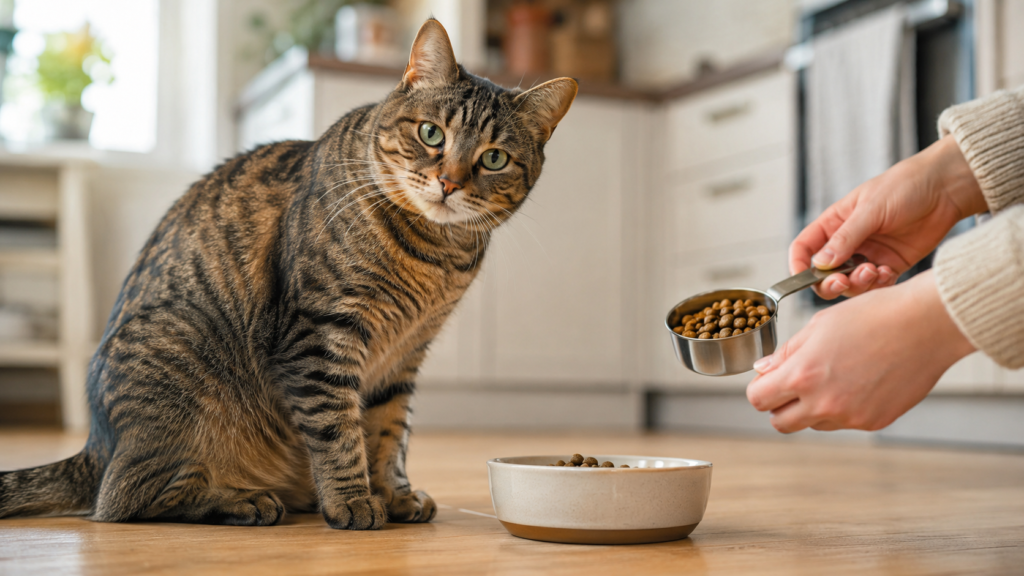
A measuring cup can be surprisingly inaccurate with kibble. One person’s “half cup” may be heaped, packed, shaken down, or loosely filled. For a small animal with a daily need around 200 to 250 calories, a small measuring error can matter.
A digital kitchen scale is more accurate, especially for dry food. Weighing food in grams also makes it easier to stay consistent if several people feed the cat.
The cleanest method is to measure the full daily ration in the morning. Then every meal, snack, and puzzle feeder portion comes from that amount. When the daily amount is gone, feeding is done except for any planned treats already included in the calorie budget.
This is especially useful in homes where one person feeds breakfast and someone else gives dinner. Without a system, cats become very skilled at collecting “second dinner.”
Do Treats Count?
Yes, treats count. They are often the hidden reason a carefully measured food plan does not work.
A good rule is to keep treats to about 10% of daily calories, with most calories coming from complete and balanced cat food. For a cat eating 200 calories per day, that means only about 20 calories from treats.
That can disappear quickly. A few crunchy treats, a lickable treat, a bite of cooked meat, or scraps from the kitchen can push the daily total higher than you intended.
I do not think treats are the enemy. They can be useful for bonding, training, grooming, and giving medication when appropriate. But they need to live inside the daily calorie budget, not outside it.
How Many Meals Should a Cat Eat Per Day?
Most adult cats can eat once or twice daily, but many cats do better with smaller, more frequent meals. Kittens usually need more frequent meals because they have small stomachs and high energy needs.
A practical routine might look like two to four small meals per day, depending on your schedule and your cat’s needs. Automatic feeders, puzzle feeders, and measured portions can help if your cat begs between meals or eats too quickly.
The number of meals is separate from the amount of food. Splitting 240 calories into four meals is still 240 calories. It just changes how the food is delivered.
This matters for indoor cats because feeding can also be enrichment. Cats naturally show hunting and foraging behavior, so puzzle feeders or small hidden portions can make feeding less passive. In a multi-cat home, separate feeding spots may also prevent one cat from eating another cat’s share.
Is Free-Feeding Okay?
Free-feeding can work for some cats, but it makes monitoring harder. If food is always available, you may not know how much your cat actually eats in a day.
That becomes a problem if your cat is gaining weight, losing weight, vomiting, eating less, or living with other cats. In a multi-cat home, one cat may quietly eat most of the food while another cat gets less. From across the room, it can look like everyone is eating normally.
If you free-feed, measure the amount offered over 24 hours. Do not just keep topping up the bowl. Weigh or measure what goes in, then check what is left the next day.
For weight control, meal feeding is usually easier to manage because you can see who eats what.
Kittens Need a Different Feeding Approach
Kittens are not small adult cats. They need food formulated for growth, and they need more calories per pound than adult cats.
Young kittens may need several small meals a day. As they approach adulthood, their calorie needs change, and many cats transition toward an adult feeding pattern around one year of age. The exact timing depends on the cat, growth rate, and veterinary advice.
The biggest mistake is using adult-cat calorie thinking for a growing kitten. Kittens need enough energy and nutrients to grow properly. At the same time, you still want to monitor body condition because overfeeding during growth can set up weight problems later.
If a kitten is not gaining weight, seems weak, has poor appetite, or has digestive problems, that is not a situation to solve by guessing with larger portions. A veterinarian should check them.
Senior Cats May Need More Nuance, Not Just Less Food
Older cats are tricky because aging does not create one single feeding rule. Some senior cats gain weight because they move less. Others lose weight because of reduced digestion, muscle loss, dental problems, chronic disease, or appetite changes.
A mature or senior cat who is eating well but losing weight should not simply be given more food without asking why. Increased appetite with weight loss can be linked with medical conditions such as hyperthyroidism or diabetes. Increased thirst, increased urination, vomiting, diarrhea, hyperactivity, or an unkempt coat also deserve veterinary attention.
On the other side, an older cat who is slowly becoming overweight may need fewer calories, better portion control, more careful treat management, and a diet plan that protects nutrition.
This is where I would stop guessing. Senior cats deserve regular weight checks and a veterinarian’s input if appetite, thirst, litter box habits, coat condition, or body weight changes.
Overweight Cats Should Not Be Crash-Dieted
If your cat is overweight, the answer is not to suddenly cut the food in half. Cats can become seriously ill if they stop eating or lose weight too quickly.
Rapid weight loss can increase the risk of hepatic lipidosis, also known as fatty liver disease. This is a dangerous condition that can happen when a cat, especially an overweight cat, eats too little and mobilizes too much body fat to the liver.
A safer weight-loss plan should be gradual and supervised, especially if your cat is significantly overweight. Veterinary guidance often targets slow weight loss rather than a quick drop.
Another issue is nutrition. Feeding much less of a regular maintenance food may reduce calories, but it may also reduce essential nutrients. Cats on a real weight-loss plan may need a food designed for calorie control while still providing adequate vitamins, minerals, and protein.
So yes, portion control matters. But for an overweight cat, portion control should be careful, not harsh.
When to Call a Veterinarian About Feeding Amount
Call your veterinarian if your cat’s appetite or weight changes suddenly, or if the feeding question is connected to symptoms.
I would be more cautious if you notice:
- weight loss despite normal or increased appetite
- sudden refusal to eat
- eating much less than usual
- increased thirst or urination
- repeated vomiting or diarrhea
- rapid weight gain or weight loss
- poor coat condition
- weakness, hiding, or major behavior change
- a senior cat becoming unusually hungry
- an overweight cat refusing food during a diet
A cat who refuses food and loses weight should be examined. This is especially important for overweight cats, cats already on a diet, sick cats, kittens, and seniors.
You should also ask your veterinarian before changing food amounts for cats with diabetes, chronic kidney disease, urinary problems, chronic digestive problems, pregnancy, lactation, or any prescription diet. In those cases, “how much food per day” is part of medical care, not just home portioning.
Common Misunderstandings About Daily Cat Food
One common misunderstanding is that a cat who begs is always hungry. Some cats beg because food is rewarding, because mealtimes are predictable, because they are bored, or because they learned that meowing works. Hunger can be real, but begging alone is not a perfect measurement tool.
Another mistake is assuming indoor cats need the same amount as active outdoor cats. Lifestyle changes calorie needs. A cat who spends most of the day resting indoors may need fewer calories than the feeding chart suggests.
Many owners also forget that “complete and balanced” does not mean “feed any amount.” It means the food is formulated to provide required nutrients when fed appropriately for the right life stage. A complete food can still cause weight gain if too much is fed.
The last big mistake is comparing wet and dry food by appearance. A full-looking bowl of wet food may contain fewer calories than a small-looking scoop of kibble. The label tells the truth better than your eyes.
A Practical Way to Set Your Cat’s Daily Amount
Start with your cat’s current weight and body condition. If your cat is a healthy adult, use a calorie estimate as a starting point. Then check the food label and calculate the actual amount of that food.
Measure the full daily ration. Split it into meals. Include treats within the daily calorie budget. If you use both wet and dry food, count both.
Then watch the trend. Is your cat maintaining a lean shape? Are the ribs easy to feel? Is the waist still visible from above? Is your cat gaining or losing weight over several weeks?
If the body condition is drifting, adjust slowly and carefully. If the change is sudden, unexplained, or paired with symptoms, call your veterinarian instead of treating it like a math problem.
The best daily amount is not the number that looks normal in the bowl. It is the amount that keeps your cat well-nourished, at a healthy body condition, and stable over time.
Conclusion
Most adult cats need their daily food measured by calories, not by vague servings. A healthy adult cat may need somewhere around 200 to 330 calories per day, but the right amount depends on the individual cat and the specific food.
Use the label, measure carefully, count treats, and check body condition over time. Cups and cans are just delivery methods. Calories and body condition are the real guide.
If your cat is a kitten, senior, pregnant, nursing, overweight, losing weight, refusing food, eating more than usual, or living with a medical condition, do not rely on a generic feeding chart alone. That is the point where a veterinarian’s guidance is the safer choice.
References
- AAFCO, Reading Labels — Supports pet food calorie labeling, feeding directions, and label interpretation.
- WSAVA, Calorie Needs for Healthy Adult Cats — Supports approximate daily calorie ranges for healthy adult cats.
- WSAVA, Cat Body Condition Scoring — Supports ideal and overweight body condition descriptions.
- MSD Veterinary Manual, Nutritional Requirements of Small Animals — Supports RER formulas and maintenance energy requirement context.
- Cornell Feline Health Center, How Often Should You Feed Your Cat? — Supports meal frequency guidance and age-related feeding context.
- AAFP/FelineVMA, How to Feed a Cat Consensus Statement — Supports feline feeding behavior, enrichment, frequent small meals, and multi-cat feeding considerations.
- VCA Hospitals, Nutrition Feeding Guidelines for Cats — Supports free-feeding cautions, measuring intake, and general feline nutrition context.
- Cornell Feline Health Center, Feeding Your Cat — Supports appetite and weight-change cautions, including when refusal to eat needs veterinary attention.