If you have just heard the words “FIP” and “cat” in the same sentence, the first question is usually simple and frightening: how did this happen?
The honest answer is a little more complicated than “your cat caught FIP.” In most cases, cats do not catch FIP directly from another cat. They are usually exposed to feline coronavirus, often shortened to FCoV. Most cats exposed to this virus never develop FIP. In a smaller number of cats, the virus changes inside the body, and the cat’s immune response turns it into a serious disease called feline infectious peritonitis.
That difference matters. It affects how you think about your cat, your other cats, your home, and whether anyone did anything wrong. FIP can feel sudden and unfair, especially in kittens, rescue cats, or cats from multi-cat homes. But it is not as simple as poor hygiene, one bad interaction, or one sick cat passing “FIP” directly to another.
The Short Answer: Cats Usually Get FIP After Feline Coronavirus Changes Inside the Body
Cats usually develop FIP after being infected with feline coronavirus first. Feline coronavirus is common in cats, especially in places where many cats share litter boxes or living spaces.
For many cats, feline coronavirus causes no obvious illness. Some may have mild stomach upset, soft stool, diarrhea, or brief signs that do not look dramatic. Then they seem fine. The difficult part is that in a minority of cats, the virus changes in a way that lets it behave differently inside the body.
Instead of staying mostly in the intestines, the changed virus can infect certain immune cells. Those cells can move through the body, which helps explain why FIP can affect the belly, chest, eyes, brain, kidneys, and other organs. The disease is not only about the virus being present. It is also about how the cat’s immune system reacts to it.
That is why two cats can be exposed to the same general coronavirus environment, but only one develops FIP. One cat may clear the infection or carry it without serious illness. Another cat, often because of age, stress, genetics, immune response, or other risk factors, may develop FIP.
What Is Feline Coronavirus?
Feline coronavirus is not the same thing as the human COVID-19 virus. The name “coronavirus” refers to a broad family of viruses, and feline coronavirus is a cat-specific virus.
In cats, the common form is often called feline enteric coronavirus. “Enteric” means it mainly involves the intestines. This is the form many cats are exposed to, especially in shelters, catteries, rescues, breeding homes, and multi-cat households.
Most cats with feline coronavirus do not look severely ill. Some show no signs at all. Others may have mild diarrhea or brief digestive signs. This is one reason FIP is so confusing for owners. The first exposure may not look like a major event, and the cat may seem healthy for a while.
FIP is the severe disease that can happen later in some infected cats. It is not the usual outcome of feline coronavirus infection. That distinction is one of the most useful things to understand before reading anything else about FIP.
How Do Cats Catch the Virus That Can Lead to FIP?
Cats usually catch feline coronavirus through the fecal-oral route. In plain English, that means virus from an infected cat’s stool somehow gets into another cat’s mouth.
That sounds unpleasant, but it can happen in ordinary cat environments. A cat may step in tiny contaminated particles around a litter box, groom their paws, and swallow the virus. Cats may also be exposed through shared litter trays, contaminated scoops, bedding, surfaces, or objects in places where infected cats have been shedding the virus.
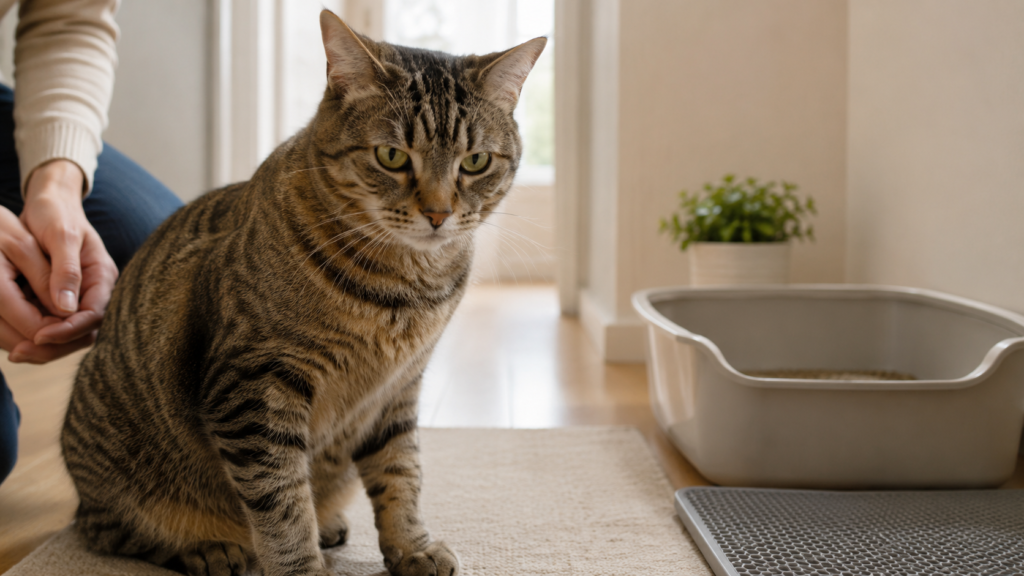
Shared litter boxes are one of the biggest practical concerns because feline coronavirus is shed in feces. This is why the risk is higher in multi-cat settings, not because every cat is obviously sick, but because the virus has more chances to circulate.
Kittens may also be exposed early in life. One common route is from an infected mother cat to her kittens when they are still young. This helps explain why FIP is often discussed in relation to kittens, young cats, breeders, shelters, and newly adopted cats.
Why Do Some Cats Develop FIP While Most Do Not?
Most cats exposed to feline coronavirus do not develop FIP. The tricky part is that exposure and disease are not the same thing.
FIP happens when the virus changes in a way that allows it to infect immune cells called monocytes and macrophages. You do not need to remember those names, but the idea matters. These cells can travel through the body. Once the virus can survive and multiply in them, the infection is no longer just a mild intestinal issue.
The cat’s immune response then becomes a major part of the disease. Inflammation can affect blood vessels and organs. Fluid may build up in the abdomen or chest in some cats. In others, inflammation can affect the eyes, nervous system, kidneys, or other tissues without obvious fluid buildup.
This is why FIP can look different from cat to cat. It is also why it should not be treated as something an owner can identify with one simple home checklist. A cat with possible FIP needs veterinary evaluation.
Is FIP Contagious to Other Cats?
Classical FIP is generally not considered directly contagious in the simple way many owners imagine. A sick cat with FIP usually did not “give FIP” to another cat the way one cat might pass a respiratory infection.
The contagious part is usually feline coronavirus, not FIP itself. Cats can spread feline coronavirus through feces. Then, in some cats, that virus may later change inside the body and lead to FIP.
For a multi-cat home, this is both reassuring and still worth taking seriously. It is reassuring because a diagnosis of FIP in one cat does not mean every other cat is doomed to get FIP. But it still matters because the other cats may have shared exposure to feline coronavirus, especially if they share litter boxes or came from the same high-density environment.
If one cat in your home is diagnosed with FIP, I would not rely on guesswork. Ask your veterinarian how to monitor the other cats, whether testing makes sense, and what cleaning or litter box changes are appropriate for your situation.
Why FIP Is More Common in Kittens and Young Cats
FIP can affect cats of different ages, but it is more common in kittens and young cats. Veterinary sources note that many cases are diagnosed in cats under 1.5 years old, with a large portion in kittens under 7 months.
There are several likely reasons. Young cats may be exposed early in life, especially in shelters, rescues, breeding environments, or multi-cat homes. Their immune systems are still developing. They may also go through stressful changes such as weaning, adoption, moving homes, surgery, vaccination appointments, or illness.
That does not mean those normal life events “cause” FIP by themselves. This is a point worth saying carefully. Stress, age, immune response, genetics, and viral exposure may all influence risk, but blaming one event is usually too simple.
For owners, the practical takeaway is different: do not ignore a young cat who is not growing well, has persistent fever, loses weight, stops eating normally, seems unusually tired, develops a swollen belly, or shows breathing, eye, or neurological changes. Those signs do not prove FIP, but they are reasons to call a vet.
Can an Indoor Cat Get FIP?
Yes, an indoor cat can develop FIP. Indoor-only living does not erase past exposure.
A cat may have been exposed to feline coronavirus before adoption, while living with a mother cat, in a shelter, in a foster home, at a breeder, or in another multi-cat environment. FIP can appear weeks, months, or even longer after the first exposure.
This can be confusing because owners often look for a recent cause. They may think, “But my cat never goes outside,” or “My cat has not met another cat lately.” With FIP, the relevant exposure may not be recent or obvious.
For me, the safer way to think about it is this: indoor life can reduce many risks, but it cannot rewrite a cat’s early history. If an indoor cat develops signs that fit a serious illness, the fact that they stay indoors should not delay a vet visit.
Wet FIP and Dry FIP Are Not Always Separate
FIP is often described as wet or dry. This can help owners understand the general pattern, but it can also oversimplify the disease.
Wet FIP, also called effusive FIP, involves fluid buildup. That fluid may collect in the abdomen, causing a swollen or pot-bellied look. It may also collect in the chest, which can make breathing harder.
Dry FIP, also called non-effusive FIP, may not cause obvious fluid buildup. It can be slower and harder to recognize. It may involve the eyes, nervous system, kidneys, or other organs. Signs can include eye changes, wobbliness, seizures, weakness, weight loss, or ongoing illness that does not fit a simple explanation.
Some cats do not fit neatly into one category. A cat with dry FIP can later develop fluid. A cat with wet FIP can also have organ inflammation. So, if your cat does not have a swollen belly, that alone does not rule out FIP.
Signs That Should Make You Call a Vet
FIP signs can overlap with many other illnesses. That is one reason it is hard to diagnose and one reason owners should not try to confirm it at home.
Possible concerning signs include ongoing lethargy, poor appetite, weight loss, failure to gain weight in a kitten, persistent or fluctuating fever, a swollen abdomen, breathing difficulty, jaundice, eye changes, wobbliness, weakness, seizures, or other neurological signs.
Some of these signs can be emergencies, especially labored breathing, seizures, collapse, severe weakness, or rapid worsening. A cat with breathing trouble should not wait for a routine appointment.
This is where I would stop guessing and call a vet. FIP is serious, but it is also not the only possible cause of these signs. A veterinarian needs to examine the cat and decide what tests are appropriate.
Why a Positive Coronavirus Test Does Not Automatically Mean FIP
A positive feline coronavirus test does not mean a cat has FIP. This is one of the most common and stressful misunderstandings.
Many cats, especially cats from multi-cat environments, have been exposed to feline coronavirus. Some may test positive because they have encountered the virus, not because they have FIP. Antibody tests can show exposure, but they cannot reliably prove that a cat has FIP.
Fecal PCR testing can detect shedding of feline coronavirus in stool, but that also has limits. Cats may shed the virus intermittently. One positive test does not automatically mean the cat will develop FIP. One negative test does not always prove the cat is not shedding at other times.
For a cat suspected of FIP, vets usually look at the whole picture. That may include age, history, symptoms, physical exam findings, bloodwork, imaging, fluid analysis, PCR testing, and other diagnostic tools. There is no simple home test that can settle the question.
Can FIP Be Prevented?
FIP cannot be perfectly prevented in every cat because the disease depends on more than exposure alone. The virus, the cat’s immune response, age, stress, genetics, health status, and environment can all matter.
Still, owners can reduce the conditions that help feline coronavirus spread. The most practical focus is lowering fecal contamination and reducing crowding or stress where possible.
In a home setting, that usually means keeping litter boxes clean, having enough litter boxes for the number of cats, avoiding overcrowding, introducing cats carefully, and keeping shared areas hygienic. In shelters, rescues, and catteries, prevention is more complicated because more cats are moving through the same spaces.
Cleaning matters, but it should be done safely. Feline coronavirus can survive in the environment for a period of time, especially in dry indoor conditions, but it is an enveloped virus and can be inactivated by appropriate disinfectants. Cat-safe cleaning choices are important because some disinfectants and essential-oil-based products can be unsafe for cats.
Should You Get Your Cat Vaccinated Against FIP?
The FIP vaccine is not generally recommended in standard feline vaccination guidance. Its effectiveness is questionable, and many kittens may already be exposed to feline coronavirus before the labeled vaccination age.
This is useful for owners who feel guilty after an FIP diagnosis. Not having given an FIP vaccine is not the same as failing your cat. It is not treated like core vaccines such as rabies or panleukopenia vaccines.
If you are worried about FIP risk in a kitten, rescue cat, breeding cat, or multi-cat household, the better next step is a conversation with your veterinarian. They can help you understand your cat’s actual risk and what prevention steps are realistic.
What If One Cat in the House Has FIP?
If one cat in your home has FIP, the first thing to understand is that housemates are more likely to share exposure to feline coronavirus than to “catch FIP” directly from the sick cat.
That does not mean you should ignore the rest of the household. Watch for changes in appetite, weight, energy, fever, belly size, breathing, eyes, or movement. Keep litter boxes clean. Reduce crowding where you can. Ask your vet whether any testing or monitoring is useful for your specific home.
Try not to panic-test every cat without a plan. Coronavirus testing can be difficult to interpret, especially from a single result. A positive result may only show exposure. A negative result may not settle the matter if shedding is intermittent.
In a breeding home, rescue, shelter, or high-density household, your vet may approach this differently than they would in a simple two-cat home. The more cats involved, the more important it is to make decisions with veterinary guidance rather than internet rules.
Is FIP Always Fatal?
Older articles often describe FIP as almost always fatal. That used to be the standard way FIP was discussed, and untreated clinical FIP is still a very serious disease.
However, treatment context has changed. Antiviral treatment with GS-441524 has changed how veterinarians and researchers discuss FIP in some regions. Compounded oral GS-441524 became available in the United States by veterinary prescription in 2024, although these compounded products are not FDA-approved drugs.
For cat owners, the practical meaning is simple: suspected FIP is urgent, but it is not a reason to give up without speaking to a vet. Diagnosis, access to treatment, monitoring, legal details, and drug quality all matter. This is not a condition to manage through home remedies, supplements, or unverified online medication advice.
If your cat may have FIP, contact a veterinarian quickly. The earlier you get proper guidance, the better chance you have of understanding what is actually happening and what options exist.
What Owners Often Misunderstand About How Cats Get FIP
The biggest misunderstanding is thinking FIP is something cats usually catch directly from another visibly sick cat. In most ordinary cases, cats catch feline coronavirus first. FIP happens later in a smaller number of cats after the virus changes and the immune system responds in a damaging way.
Another misunderstanding is thinking a positive coronavirus result equals FIP. It does not. Many cats are exposed to feline coronavirus and never develop FIP.
Some owners also blame one stressful event, such as adoption, vaccination, neutering, boarding, or moving. Stress may be part of the risk picture, but it is rarely fair or accurate to point to one event as the cause. Cats who develop FIP often have a mix of exposure history and individual vulnerability.
The final misunderstanding is thinking an indoor cat cannot get FIP. A cat may have been exposed long before the signs appeared. That is especially true for kittens, rescue cats, and cats from multi-cat backgrounds.
The Practical Way to Think About FIP Risk
The most practical way to think about FIP is in layers.
First, feline coronavirus exposure is common in cats, especially in multi-cat environments. Second, most exposed cats do not develop FIP. Third, a smaller number of cats develop FIP because of viral changes and the cat’s immune response. Fourth, risk is higher in some situations, especially in young cats, high-density cat environments, certain purebred lines, older cats, stressed cats, and cats with other health issues.
That layered view is less dramatic than saying “FIP is contagious,” but it is more useful. It helps you avoid both panic and false reassurance.
If your cat is healthy and you are only worried about general risk, focus on clean litter management, reducing overcrowding, careful introductions, and routine veterinary care. If your cat is already showing concerning signs, do not try to solve the FIP question alone. Call a vet.
Final Thoughts
Cats usually get FIP after exposure to feline coronavirus, not because they directly catch FIP in a simple one-cat-to-another way. The virus is commonly spread through fecal contamination, especially around shared litter boxes and multi-cat environments. In a minority of cats, the virus changes inside the body and triggers a serious inflammatory disease.
That means FIP is not usually a sign that you did something wrong. It also means suspicious signs should be taken seriously, especially in kittens, young cats, newly adopted cats, and cats from shelters, rescues, breeders, or multi-cat homes.
If your cat has persistent fever, weight loss, poor appetite, swelling, breathing trouble, eye changes, wobbliness, seizures, or sudden worsening, contact a veterinarian. FIP is complicated, and the safest next step is professional evaluation rather than guessing from symptoms or test results alone.
References
- Cornell Feline Health Center: Feline Infectious Peritonitis
- MSD Veterinary Manual: Feline Infectious Peritonitis
- MSD Veterinary Manual: Feline Enteric Coronavirus Infection
- AAFP and EveryCat: Feline Infectious Peritonitis Diagnosis Guidelines
- Cornell Animal Health Diagnostic Center: Feline Coronavirus RT-PCR
- AAHA/AAFP Feline Vaccination Guidelines: Not Recommended Vaccines
- FDA: Position on Compounded GS-441524 for FIP
- Cornell Feline Health Center: FIP Treatment with GS-441524