Giving a cat a pill can sound simple and feel impossible in real life. The pill is tiny. The cat is not. Somehow, your calm, normal cat can suddenly become suspicious of every treat, every hand movement, and every corner of the room.
The goal is not just to get the pill into your cat’s mouth. The safer goal is to make sure your cat gets the right medication, in the right way, with as little stress and risk as possible. That means checking whether the pill can be given with food, choosing the easiest method first, watching to make sure the dose is swallowed, and knowing when to stop trying and call your vet.
For me, the safest way to think about pilling a cat is this: start with the least stressful method that still follows the prescription instructions. If that fails, move to a more direct method. If that becomes a fight, do not keep forcing it. There are often other options your veterinarian can discuss.
Before You Give the Pill, Check the Medication Instructions
Before you hide, crush, split, or coat a pill, check whether the medication can be handled that way. Some pills can be divided or crushed. Others need to stay whole. Some can be given with food, while others may need an empty stomach.
This matters because changing a pill can change how it works. A tablet that should stay whole may not be safe or effective if crushed into wet food. A medication that needs to be given without food may not work properly if hidden inside a treat. If the label is unclear, ask your veterinarian or pharmacist before adjusting anything.
This is one of the biggest mistakes in generic “how to give a cat a pill” advice. Hiding a pill in food sounds harmless, but it is only a good option when the medication allows it. The same goes for using tuna, cheese, butter, pill pockets, or any strong-smelling food. These can be useful tools, but they should be tiny medication vehicles, not casual diet changes.
If your cat has kidney disease, diabetes, food allergies, a history of pancreatitis, stomach issues, or is on a prescription diet, be even more careful about what you use to hide the pill. A small treat may still be fine, but the right choice depends on your cat’s health and the medication.
Try Food First, If the Pill Can Be Given With Food
If the medication can be taken with food, hiding the pill in a small bite is usually the easiest first attempt. The key word is small. Do not mix the pill into a full meal unless your vet specifically tells you to.
A full bowl creates a problem. Your cat may eat around the pill, leave part of the food, or spit the tablet out when you are not looking. Then you are left guessing whether any medication was actually swallowed.
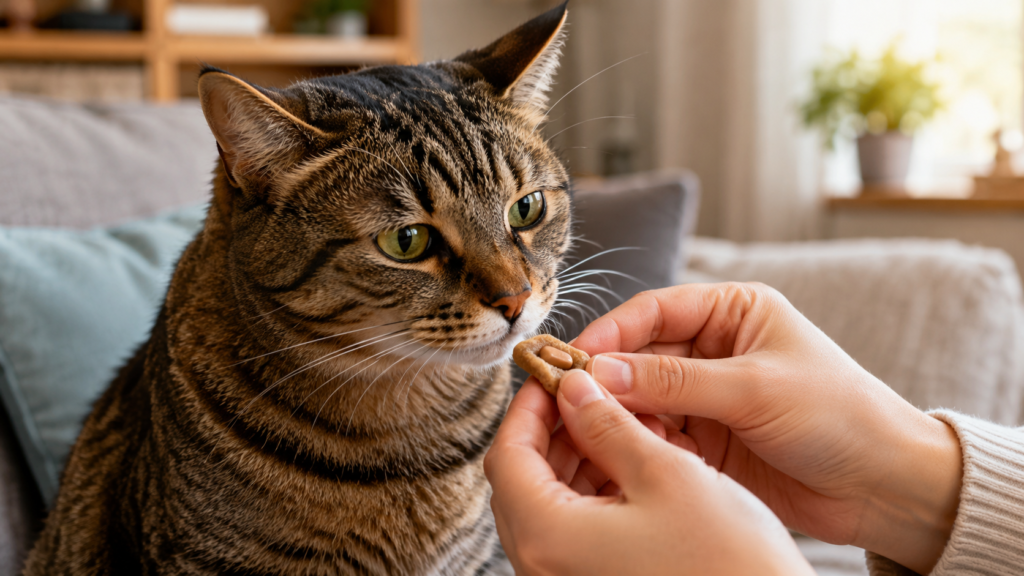
A better approach is to use one small, high-value bite before the main meal. Soft wet food, a pill pocket, a small piece of plain cooked meat, or another vet-approved treat may work. The medicated bite should be small enough that your cat is likely to swallow it without chewing carefully. Some veterinary guidance suggests a pea-sized “meatball” because a larger bite gives the cat more time to discover the pill.
A useful trick is the plain bite, medicated bite, plain bite method. Give your cat one normal treat first, then the treat with the pill, then another normal treat right after. The first bite lowers suspicion. The third bite encourages your cat to keep swallowing instead of stopping to inspect the second one.
Watch the whole process. Cats are very good at eating the good part and leaving the medicine behind. Check the floor, the bowl, the towel, and your cat’s mouth area if you are unsure. If you clearly see the whole pill spat out, you can try again based on your vet’s instructions. If you are unsure how much was swallowed, do not guess with extra medication. Call your vet or pharmacist.
How to Give a Cat a Pill by Hand
If food does not work, direct pilling may be needed. This is the part many owners dread, but preparation makes a real difference.
Get everything ready before you bring your cat over. Have the pill, a small water or food chaser if your vet approves, a towel if needed, and a reward for afterward. Choose a quiet place with a stable surface. A non-slip mat or towel can help your cat feel more secure.
Hold your cat calmly. Some cats do better sitting on your lap, facing away from you. Others do better on a table or counter with another person helping. If your cat uses their front paws to push you away, a towel wrap may help. Wrap the body gently with only the head exposed. The towel should prevent frantic movement, not turn the moment into a wrestling match.
To open the mouth, gently hold the top of your cat’s head from above, with your fingers near the cheekbones. Tilt the head slightly upward. With your other hand, use a finger to lower the bottom jaw, then place the pill as far back on the tongue as you safely can. Close the mouth and let the head return to a normal position.
Many cats will lick their lips or nose after swallowing. That can be a good sign, but it is not perfect proof. A cat can still hold a pill in the mouth or spit it out a few seconds later. Watch briefly after you release your cat.
Do not drop the pill loosely into the front of the mouth and hope for the best. That often gives the cat time to taste it, chew it, gag, or spit it out. The goal is quick, calm placement toward the back of the tongue, followed by swallowing and a chaser when appropriate.
Why a Water or Food Chaser Matters
A pill that disappears from your cat’s mouth has not always reached the stomach. This is one of the most important safety details many owners never hear.
Research on cats has shown that dry-swallowed tablets and capsules can sit in the esophagus instead of moving quickly into the stomach. The esophagus is the tube that carries food and pills from the mouth to the stomach. If a pill sits there, especially an irritating medication, it may increase the risk of inflammation or injury.
That is why veterinary sources often recommend following a pill with water, a small amount of food, or another vet-approved chaser. Cornell’s guidance describes using about a teaspoonful of water, around 5 to 6 ml, after a tablet or capsule. Other veterinary guidance mentions food, tuna water, or a small butter coating when appropriate.
Do not force water into a cat that is coughing, choking, struggling to breathe, or unable to swallow normally. That is no longer a routine pilling problem. That is a reason to contact a veterinarian or emergency clinic.
For a normal pill attempt, though, a chaser can be the difference between “the pill left the mouth” and “the pill actually moved down safely.” I would not skip this step unless your vet has told you not to use food or liquid with that medication.
Should You Use a Pill Popper?
A pill popper, sometimes called a pill gun or pet piller, can help if your cat bites, clamps the mouth shut, or reacts strongly to the bitter taste of a pill. It lets you place the pill farther back without putting your fingers as close to the teeth.
The tool is useful, but it needs to be used correctly. The wrong angle or too much force can hurt your cat’s mouth. If you have never used one, ask your vet or vet nurse to show you. This is especially worth doing if your cat needs medication for more than a few days.
In general, the tool is inserted from the side of the mouth, behind the canine teeth, rather than straight from the front. The pill is then released toward the back of the tongue. After that, the same rules apply: close the mouth gently, allow swallowing, use a chaser if appropriate, and watch for spitting.
A pill popper is not a solution for every cat. Some cats tolerate it better than fingers. Others find the tool more stressful. If it turns each dose into a battle, it is time to ask about another option.
What If Your Cat Foams, Drools, or Spits After the Pill?
Brief drooling, foaming, lip licking, or a disgusted reaction can happen after a bitter medication. It does not always mean something dangerous happened. Some cats react strongly to taste, especially if the pill touched the tongue or started dissolving in the mouth.
What makes this tricky is that normal taste reactions can look dramatic. A cat may foam at the mouth, shake the head, or act offended for a few minutes. If your cat settles quickly, breathes normally, and otherwise seems stable, it may simply be a bad taste response.
Still, do not ignore signs that go beyond a short taste reaction. Repeated swallowing, persistent drooling, regurgitation, trouble swallowing, appetite loss, obvious pain, coughing, breathing trouble, facial swelling, collapse, or severe vomiting or diarrhea after medication should be treated more seriously. Contact your veterinarian or an emergency vet, depending on the severity.
I would also be more cautious if the pill was given dry, your cat fought hard, or the medication is known to be irritating to the esophagus. Certain medications, including doxycycline, have been associated with esophageal injury in cats when they do not pass down properly. That does not mean the medication is bad. It means administration technique matters.
What If Your Cat Will Not Take the Pill?
If your cat will not take the pill, stop before the process becomes unsafe. A missed or difficult dose is frustrating, but repeated force can make future medication harder and can put both of you at risk.
Call your veterinarian if your cat is hiding, panicking, trying to bite, or refusing every method. Also call if you are not sure whether a dose was swallowed. Do not automatically give another pill unless you are certain none was taken and your vet has said what to do in that situation.
There may be other options. Some medications are available as liquids. Some can be compounded into flavored liquids or treats. Some may have injectable or transdermal options, depending on the drug and the condition being treated.
Compounded medication needs careful wording. It can be very helpful when a standard pill is not workable, but compounded drugs are not the same as FDA-approved products. Their absorption, strength, quality, and effectiveness can vary depending on the medication and pharmacy. Ask your vet whether a different form is appropriate for your cat’s specific prescription.
Transdermal gels also are not universal substitutes. Some medications can work through the skin, but many cannot. Even when a transdermal option exists, it needs veterinary guidance because the dose and absorption are medication-specific.
Common Mistakes That Make Pilling Harder
One common mistake is hiding the pill in too much food. The cat eats some, leaves some, and the owner has no idea how much medication was taken. Use a tiny portion first, then feed the normal meal afterward if allowed.
Another mistake is crushing pills without asking. Some tablets should not be crushed, split, or mixed with food. If your cat refuses a whole pill, ask your vet about a different form rather than changing the medication yourself.
Dry pilling is another risk. If your vet has not told you otherwise, ask whether you should follow the pill with water or a small food chaser. This is especially important for tablets or capsules that may stick in the esophagus.
A fourth mistake is turning every dose into a physical contest. Cats learn from repeated stressful handling. If your cat starts hiding at medication time or becoming defensive, the method is no longer just inconvenient. It is becoming less sustainable.
In a multi-cat home, there is one more practical issue: make sure the right cat gets the right medication. Give the pill or medicated treat in a quiet separate space, watch the dose being swallowed, then let your cat rejoin the household.
When to Call Your Veterinarian
Call your veterinarian if you cannot give the medication reliably, if your cat spits out doses and you are unsure what was swallowed, or if your cat becomes highly distressed or aggressive during attempts. Medication only helps if it can be given safely and consistently.
You should also contact a vet promptly if your cat shows concerning signs after pilling, such as repeated swallowing, persistent drooling, regurgitation, trouble swallowing, refusal to eat, signs of pain, coughing, or unusual tiredness. Breathing trouble, collapse, severe vomiting or diarrhea, or facial swelling should be treated as urgent.
Do not stop a prescribed medication early just because your cat seems better or because pilling is difficult. Some medications need a full course. Others may cause problems if stopped suddenly. If the current method is not working, the safer choice is to ask for a different plan.
This is where I would stop guessing. A vet or vet nurse can often demonstrate the technique, suggest a different formulation, or help you decide whether the medication can be given another way.
Final Thoughts
The best way to give a cat a pill is the method that follows the prescription, gets the full dose swallowed, protects the cat’s throat, and does not turn every dose into a fight.
Start with a small food-based method if the medication allows it. If you need to pill by hand, prepare first, place the pill correctly, follow with a vet-approved chaser, and watch for spitting. If your cat is distressed, unsafe to handle, or showing concerning signs afterward, contact your veterinarian instead of pushing through.
Getting medicine into a cat can be awkward, but it should not feel like a daily battle with no exit. If one method is failing, that is useful information. It means the plan needs adjusting.
References
- VCA Hospitals: Giving Pills to Cats — Supports practical pilling methods, food-hiding, pill poppers, restraint, swallow cues, and alternative medication forms.
- Cornell University College of Veterinary Medicine: Giving Your Cat Oral Medications — Supports preparation, direct oral medication technique, follow-up water, and normal taste-related salivation.
- PDSA: How to Give Your Cat a Pill — Supports checking medication instructions, using food only when allowed, safe restraint, asking for veterinary demonstration, and not stopping medication early.
- Auburn University Veterinary Clinic: Cats and Medications — Supports pea-sized food “meatball” methods, voluntary medication strategies, pill popper handling, and water or food chasers.
- PubMed: Evaluation of esophageal transit of tablets and capsules in 30 cats — Supports the risk of dry-swallowed pills remaining in the esophagus and the benefit of wet swallowing.
- Merck Veterinary Manual: Esophagitis in Small Animals — Supports warning signs related to esophageal irritation or injury after medication.
- VCA Hospitals: Giving Liquid Medication to Cats — Supports liquid medication technique, slow syringe delivery from the side of the mouth, and caution about uncertain swallowed doses.
- FDA: Medicines for Your Pet, What’s the Difference Between FDA-Approved and Pharmacy-Compounded Drugs? — Supports cautious wording around compounded medication alternatives.