Giving a cat liquid medicine sounds simple until you are holding the syringe, your cat is twisting away, and half the dose seems to be on their chin.
That is what many cat owners worry about most. Not just, “How do I get this medicine in?” but also, “What if they choke, spit it out, bite me, or start hating me every time I walk near them?”
The safest way to give a cat liquid medicine is to prepare the dose first, keep your cat calmly restrained, place the syringe into the side of the mouth, and give the liquid slowly in small amounts so your cat has time to swallow. Do not aim the liquid straight down the throat. If your cat spits some out, do not automatically give more unless your veterinarian tells you to.
Liquid medication can be easier than pills for many cats, but it still needs care. The goal is not to win a wrestling match. The goal is to give the prescribed dose as accurately and safely as possible while keeping the experience short, calm, and manageable.
Before You Give the Medicine, Read the Label Carefully
Start by checking the label and your veterinarian’s instructions before you bring your cat into the situation. This sounds basic, but it prevents a lot of rushed mistakes.
Make sure you know how much to give, how often to give it, whether it should be given with food, and whether the bottle needs shaking first. Some liquid medicines settle and need to be mixed before each dose. Others may have special storage instructions, especially if they are refrigerated.
Draw the exact prescribed amount into the oral syringe or dropper before you pick up your cat. This matters because the longer your cat is held while you fumble with the bottle, the more likely they are to struggle. I would rather spend an extra minute preparing quietly than spend five minutes trying to medicate a cat that is already suspicious.
Use the measuring syringe or dropper provided by your vet or pharmacy. Do not use a spoon or a random household dropper. Liquid medication dosing needs to be accurate, and improvised tools make it much harder to control both the amount and the speed.
If the medicine has been refrigerated, ask your vet or follow the pharmacy instructions on whether it can be gently warmed. Some veterinary guidance suggests warming a syringe in your hand or a warm water bath when appropriate, but not microwaving it. Microwaving can heat unevenly and may affect the medication.
Can You Mix Liquid Cat Medicine With Food?
You can mix liquid medicine with food only if your veterinarian or the medication label says it is allowed.
This is often the least stressful method when it works. Many cats would rather eat a small medicated portion than have a syringe placed in their mouth. The problem is that “mix it with food” only works if your cat eats the entire medicated amount.
Use a small amount of food, not a full meal. A teaspoon-sized portion of wet food or another vet-approved treat is usually easier to monitor than a whole bowl. If your cat eats only half of a full meal with medicine mixed through it, you may not know how much medicine they actually got.
This is especially important in multi-cat homes. If another cat eats the medicated food, one cat may miss the dose and the other may get medicine they were never prescribed. Feed the medicated portion separately and watch until it is finished.
Food choice also matters. Do not assume tuna, cheese, or rich human food is safe for every cat. Cats with kidney disease, heart disease, diabetes, inflammatory bowel disease, allergies, prescription diets, or poor appetite may need very specific treat choices. When in doubt, ask your vet what food or treat is safe to use with that medication.
How to Give Liquid Medicine to a Cat With a Syringe
If you need to give the medicine directly by mouth, choose a quiet room and prepare everything first. Put the filled syringe nearby, have a towel ready if needed, and keep a small reward within reach for afterward.
Place your cat on a stable surface or hold them securely against your body. Some cats do better on a counter with a non-slip towel underneath. Others do better sitting on the floor or in your lap. The best position is the one that lets you support your cat without chasing, grabbing, or pinning them too hard.
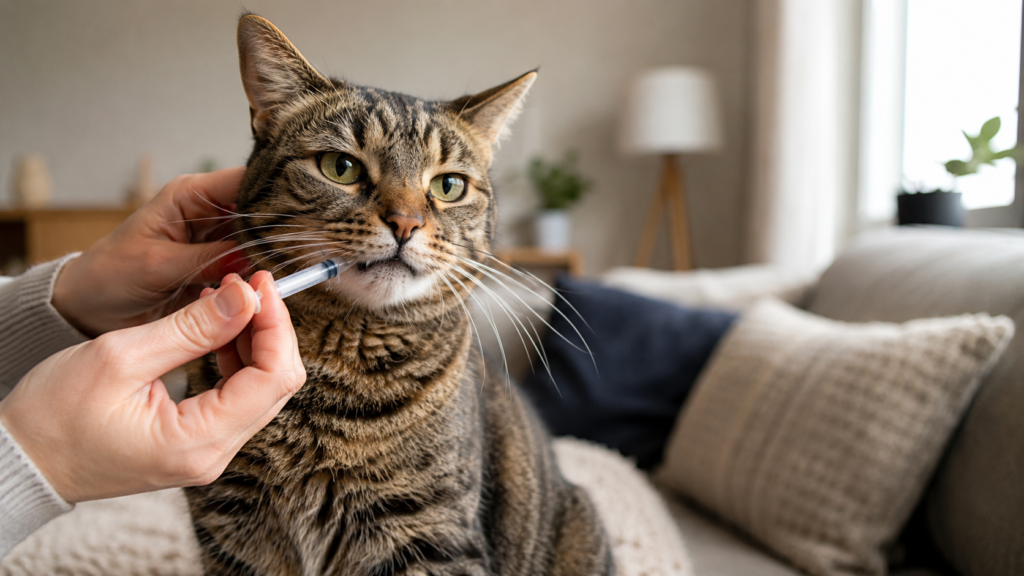
Hold your cat’s head gently but firmly. Slide the syringe tip into the side of the mouth, just behind one of the canine teeth. There is a small gap between the front canine teeth and the back teeth where the syringe can fit more naturally.
Aim the syringe slightly toward the tongue or cheek pouch, not straight toward the back of the throat. Then press the plunger slowly. Give a small amount, pause, and let your cat swallow. Continue until the dose is given.
This slow side-of-mouth method is the detail I would not skip. It is safer than trying to shoot the medicine straight in, and it gives your cat time to breathe and swallow. A rushed squirt can make the cat cough, panic, or inhale liquid.
After the dose, let your cat settle. Offer praise, a small vet-approved treat, or a bit of food if allowed. Even if the dose was not perfect, ending calmly helps make the next dose less difficult.
Should You Tilt Your Cat’s Head Back?
For liquid medicine, do not tilt your cat’s head far back and shoot the liquid down the throat.
That method is sometimes shown in a rough, old-fashioned way, but it is not the safest approach for liquids. When a cat’s head is tilted upward, liquid can be harder to swallow normally. If it goes the wrong way, there is a risk of aspiration, which means the liquid is inhaled into the airway instead of swallowed.
A slight lift may help you see the mouth or place the syringe, but the important points are direction and speed. The syringe should go into the side of the mouth, and the liquid should be given slowly enough for your cat to swallow.
Think of it less like “getting it over with” and more like helping your cat take several tiny swallows. Fast is not always kinder if fast makes the cat choke or fight.
What If Your Cat Spits Out the Medicine?
If your cat spits out some liquid medicine, do not automatically give another full dose.
This is one of the easiest mistakes to make. You see liquid on the fur, panic, and think, “None of it went in.” But some of it may have been swallowed. Giving more without knowing how much was lost can accidentally lead to too much medication.
If you are sure your cat swallowed none of it, follow the instructions your vet gave you. If you are not sure, call the veterinary clinic or pharmacy and ask what to do. This is especially important for medications where dosing precision matters, such as pain medicine, heart medicine, thyroid medicine, seizure medicine, antibiotics, or appetite stimulants.
A little drooling, foaming, or lip-smacking can happen because some medications taste bitter. That does not always mean your cat is having a dangerous reaction. It often means the medicine tasted bad.
What I would not ignore is repeated vomiting, severe lethargy, swelling, breathing trouble, collapse, or a cat that seems clearly worse after medication. Those signs need veterinary guidance.
Is Foaming or Drooling After Liquid Medicine Normal?
Mild foaming or drooling can be normal after liquid medicine, especially if the medication tastes bitter.
Cats are dramatic tasters. A small amount of bitter liquid can lead to lip-smacking, drooling, or foam around the mouth. It can look alarming, but veterinary guidance notes that this kind of taste reaction is often not harmful by itself.
The difference is in the pattern. A brief taste reaction that happens right after the dose and then settles is different from a cat that is coughing, struggling to breathe, vomiting repeatedly, collapsing, or acting extremely weak.
If your cat keeps drooling heavily, seems distressed, or develops other symptoms, call your veterinarian. If your cat has trouble breathing, that is urgent.
The Main Safety Risk Is Liquid Going Down the Wrong Way
The biggest safety concern with liquid medicine is aspiration, which means the cat inhales liquid into the airway.
Aspiration can lead to aspiration pneumonia, a lung problem caused by inhaling foreign material. Veterinary manuals list improper administration of liquid medicine as one possible cause. This is why the “slowly into the side of the mouth” advice is not just a handling preference. It is a safety point.
Watch for coughing, choking, wheezing, fast or difficult breathing, weakness, fever, bluish or pale gums, or unusual nasal discharge after a difficult dosing attempt. Do not wait and see for long if breathing looks abnormal. Contact a veterinarian or emergency vet.
Cats with swallowing problems, throat or esophageal issues, respiratory disease, frailty, or serious illness may be more vulnerable. Kittens and senior cats may also need extra caution because they can be harder to restrain safely and may have less margin for stress.
If your cat repeatedly coughs or gags when medicated, stop forcing the method and call your vet. The medication may still be needed, but the delivery method may need to change.
How to Restrain a Cat Without Making Things Worse
Use the least restraint that safely works.
Some cats only need gentle body support and a steady hand. Others need a towel wrap with only the head exposed. A towel can protect you from claws and help your cat feel more contained, but it should not become a tight, frightening trap.
Place the towel around the body like a snug wrap, keeping the legs covered but the neck free. Your cat should be able to breathe normally. If you have another person helping, one person can support the cat while the other gives the medication.
Avoid chasing your cat around the house. Once a cat is hiding, panting, growling, or escalating, the dose usually becomes harder and riskier. I would rather pause and call the vet for advice than turn every dose into a fight that makes tomorrow worse.
Punishment does not help here. Scolding, spraying, or forcing the cat after they panic can make them more fearful of future doses. For medication that must be given for several days or longer, preserving trust is practical, not sentimental.
Use Rewards and Practice When You Can
If your cat needs liquid medicine more than once, rewards matter.
Offer something your cat actually likes after the dose, as long as it is safe with the medication and your cat’s diet. This may be a small treat, a bit of approved wet food, gentle petting, or simply letting them leave and decompress.
For cats that need ongoing medication, practice can help. Some veterinary behavior guidance recommends gradually teaching cats to accept a syringe by using food or liquid treats first, without medication. The cat learns that the syringe does not always predict a bad taste or a stressful hold.
This is not always possible when your cat is already sick and needs medicine today. But if your cat has a chronic condition or has always been hard to medicate, training outside the actual dose time can make a real difference.
Keep practice short. If your cat starts avoiding the syringe, you have gone too fast. The goal is to build comfort, not force a rehearsal.
Common Mistakes Cat Owners Make With Liquid Medicine
One common mistake is using too much food. If the medicine is mixed into a full bowl and the cat eats only part of it, you cannot tell whether the dose was taken. Use a small portion first, then offer more food afterward if the medication allows it.
Another mistake is aiming straight down the throat. This may seem efficient, but it increases the risk of coughing, choking, and aspiration. The side of the mouth is safer.
A third mistake is re-dosing after spitting. Unless you know exactly what happened, this can be risky. Call the vet or pharmacy instead of guessing.
Owners also sometimes stop the medication course because the cat is difficult to dose. That is understandable, but it can leave the original health problem untreated. If medicating is not working, contact the clinic. Ask for a demonstration, a different syringe size, a flavoring option, or another formulation if medically appropriate.
This is where I would stop trying to tough it out. A cat that cannot be medicated safely needs a new plan, not more pressure.
When to Call the Veterinarian
Call your veterinarian if you cannot give the medicine, your cat misses doses, your cat spits out an unknown amount, or the medication seems to make your cat worse.
You should also call if your cat repeatedly vomits after dosing, refuses food, becomes unusually lethargic, develops diarrhea, shows swelling, or has a sudden major behavior change. The seriousness depends on the medication and your cat’s condition, so it is better to ask than guess.
Seek urgent veterinary help if your cat has trouble breathing, coughs or chokes repeatedly after medication, collapses, has blue or very pale gums, or seems severely weak. Those signs are not normal medication drama.
If your cat bites or scratches you during dosing, wash the wound right away. Cat bites can become infected, even when they look small. Get medical care if the wound is deep, painful, red, swollen, warm, worsening, or if you are unsure about rabies or tetanus risk.
If Liquid Medicine Is Not Working, Ask About Alternatives
Liquid medicine is often preferred by cat owners, but it is not automatically the best option for every cat.
Some cats refuse the taste. Some foam and spit. Some become impossible to handle after one bad attempt. Research on cat-owner experiences has found that many owners struggle with medicating cats, and some do not complete treatment because administration is too difficult.
That is a medical adherence problem, not a personal failure.
Ask your vet whether there is another safe option. Depending on the medication, this might mean a different flavor, a different concentration, a tablet, a capsule, an injection given at the clinic, or an approved transdermal form. Do not switch forms yourself.
Compounded medications can be useful when a standard approved option does not work for a specific cat, but they need veterinary oversight. Compounded drugs are not the same as FDA-approved products, and their safety, effectiveness, stability, and quality may depend on how they are made.
Transdermal medication also needs care. Some drugs can be absorbed through the skin, but not all drugs work that way. Even when a transdermal option exists, owners may need gloves, careful application, and separation from other pets or people for a period of time. It is not just “rub it on the ear and forget about it.”
Do Not Use Human Liquid Medicine Unless Your Vet Prescribed It
Do not give human liquid medication to your cat unless your veterinarian specifically prescribed it for that cat.
This includes children’s pain relievers, leftover antibiotics, cough medicine, and anything bought over the counter. Some human medications are dangerous or fatal to cats. Acetaminophen is one clear example that veterinary and FDA sources warn should never be given to cats.
Even veterinary medication can be harmful if it is the wrong drug, the wrong cat, the wrong amount, or the wrong schedule. Liquid form does not make a medicine gentle or safe by default.
For me, the safer rule is simple: if the bottle was not prescribed or approved for this cat, do not use it. Call the vet instead.
Final Thoughts
Giving a cat liquid medicine is easiest when you slow the process down before you start. Prepare the dose, use the right syringe, keep restraint calm, place the syringe at the side of the mouth, and give the liquid gradually.
A little drooling or foaming can happen, especially with bitter medicine. Coughing, choking, breathing trouble, collapse, repeated vomiting, or severe weakness is different and needs veterinary help.
If your cat keeps fighting the medication or you are not sure how much they swallowed, do not keep guessing. Call your veterinarian. A better delivery plan is safer for your cat and usually easier for you too.
References
- Cornell Feline Health Center: Giving Your Cat Oral Medications — supports safe oral medication handling, liquid medication technique, and normal salivation after dosing.
- VCA Hospitals: Giving Liquid Medication to Cats — supports syringe placement, slow delivery, food-mixing cautions, warming guidance, towel restraint, and what to do if medicine is spat out.
- Ontario Veterinary College Health Sciences Centre: Giving Liquid Medication to Your Cat — supports practical owner technique, small food portions, side-of-mouth syringe use, and avoiding automatic re-dosing.
- MSD Veterinary Manual: Pneumonia in Cats — supports aspiration pneumonia risk and respiratory warning signs.
- Journal of Feline Medicine and Surgery: Cat owner experiences with medicating cats — supports owner difficulty, medication-form preferences, refusal in food, scratching or biting during medication, and treatment-adherence concerns.
- AAFP: Positive Reinforcement Position Statement — supports reward-based handling and avoiding punishment that increases fear or stress.
- FDA: Animal Drug Compounding — supports cautious wording around compounded medications and the difference between compounded and FDA-approved drugs.
- FDA: Get the Facts about Pain Relievers for Pets — supports warnings against unsafe human medications, including acetaminophen risk in cats.