Finding fleas on your cat can make the whole house feel suddenly suspicious. You may spot one tiny dark insect moving through the fur, or you may only notice scratching, scabs, or pepper-like specks near the skin.
The frustrating part is that fleas are rarely just “on the cat.” Adult fleas live and feed on your cat, but eggs and immature flea stages can fall into bedding, carpets, furniture, floor cracks, and the places your cat likes to rest. That is why one bath, one combing session, or one quick spray around the house often does not solve the problem.
The safest way to get rid of fleas on cats is to treat the cat with a cat-safe flea product, treat every pet in the home appropriately, clean the environment repeatedly, and keep prevention going long enough to break the flea life cycle. I would not treat this as a one-step grooming problem. It is more like a small household cleanup project with a medical safety angle.
The Fast Answer: What to Do First
If your cat has fleas, start by confirming what you are seeing, then choose a flea treatment that is labeled for cats and appropriate for your cat’s age, weight, and health status. A veterinarian is the safest person to help you choose, especially if your cat is a kitten, senior cat, pregnant or nursing cat, sick cat, or has reacted badly to flea products before.
Do not use dog flea medicine on a cat. Some dog flea products contain ingredients that can be dangerous or even life-threatening to cats. Do not guess the dose, split a dog product, combine flea products, or reapply early because you are still seeing fleas.
At the same time, wash your cat’s bedding, vacuum floors and soft furniture, clean the areas where your cat sleeps, and make sure every pet in the household is treated with the right species-specific product. If you only treat the cat you noticed scratching, fleas can keep cycling through the home.
How to Tell If Your Cat Has Fleas
You may see adult fleas moving through the fur, but many owners never catch them in the act. Cats groom themselves often, and a cat can remove some visible fleas before you find them.
A more common clue is flea dirt. Flea dirt looks like tiny black or dark brown specks near the skin. It is flea feces made from digested blood. One practical way to check is to place the specks on a damp white paper towel. If they leave a reddish-brown stain, that supports the suspicion that you are looking at flea dirt rather than ordinary dirt.
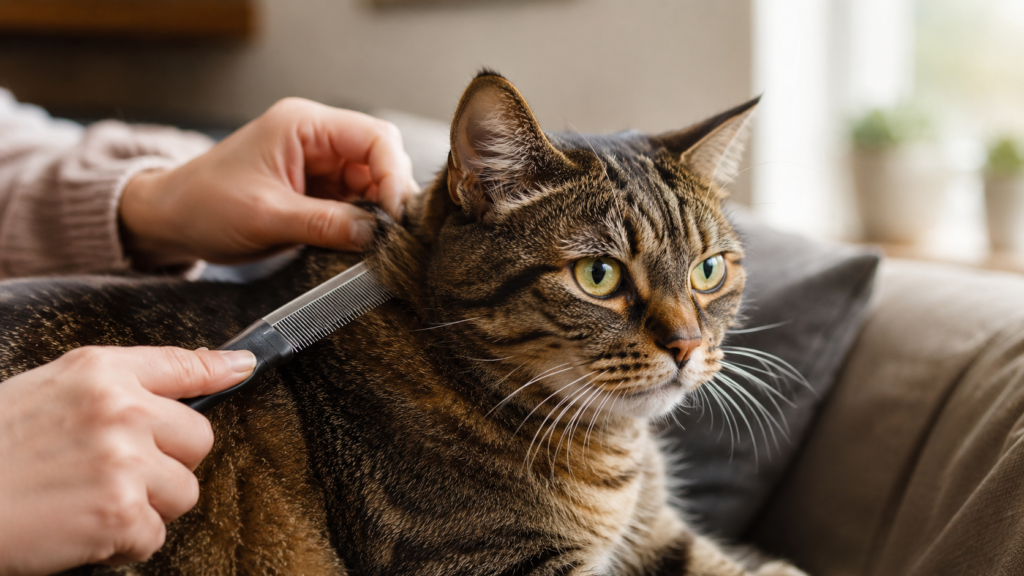
Look closely around the neck, base of the tail, lower back, belly, and areas where the fur parts easily. A flea comb can help because it reaches closer to the skin than your fingers can. Comb slowly, then check the comb for moving fleas or dark specks.
Itching is another clue, but it is not proof by itself. Cats can scratch or overgroom for many reasons, including skin irritation, allergies, mites, pain, stress, or other medical issues. Fleas are common enough that they are worth checking early, but a cat with ongoing skin problems should not be diagnosed at home.
Why Fleas Keep Coming Back
Fleas keep coming back because the adult fleas you see are only part of the problem. Fleas have a life cycle that includes eggs, larvae, pupae, and adults. Adult fleas feed on the cat and lay eggs, but those eggs can fall off into the home.
That means your cat’s bed, your sofa, the carpet, floor edges, and favorite resting spots can hold immature flea stages. Later, new adult fleas can emerge and jump back onto your cat. This can make it look like the treatment did not work, even when the bigger issue is that the home environment still has developing fleas.
The pupa stage is especially annoying because it is protected inside a cocoon. New fleas may emerge when they sense warmth, movement, or a nearby host. That is why owners sometimes see fresh fleas after cleaning or after a cat has already been treated.
For me, the safer way to think about flea removal is this: the product on the cat helps deal with fleas feeding on the cat, while cleaning and follow-up help reduce the hidden flea population in the home.
Use a Cat-Safe Flea Treatment
The most important rule is simple: use flea treatment made for cats, not dogs. Cats are not small dogs. Their bodies handle certain chemicals differently, and products that are fine for dogs can be toxic to cats.
Dog flea products containing permethrin are a well-known danger for cats. Exposure can happen if a dog product is applied directly to a cat, but it can also happen when a cat licks, rubs against, or sleeps close to a recently treated dog. Signs of serious exposure can include wobbliness, tremors, seizures, and other urgent symptoms.
A good cat flea product should match your cat’s species, age, weight, and health condition. Read the label carefully. If the label does not clearly say it is for cats, do not use it on your cat.
There are several types of flea control products, including topical products, oral or systemic products, collars, sprays, and products that affect flea development. They do not all work the same way. Some kill fleas after contact or feeding. Some affect eggs or larvae. Some spread through the coat. Some work through the bloodstream after the flea bites.
That difference matters because not every product stops every flea from biting immediately. If your cat has flea allergy dermatitis, even a few bites can trigger intense itching. This is one reason a veterinarian’s guidance is useful, especially when the cat has skin damage, sores, or a history of strong reactions.
Do Not Stack Flea Products
If you still see fleas after treatment, do not automatically apply more medicine. I understand the impulse. Seeing fleas after you have already done something is irritating and worrying. But using products too often, combining products, or guessing doses can put your cat at risk.
Some products take time to spread or work. Some fleas may also be newly emerging from the environment rather than surviving on the cat the whole time. That is why flea control often takes more than one day, especially when the home is already infested.
If you used the wrong product, applied it incorrectly, missed a dose, treated only one pet, or did not clean the environment, fleas can continue. If you used the product correctly and still see heavy fleas, ongoing flea dirt, worsening skin signs, or your cat seems unwell, that is where I would stop guessing and call a vet.
Clean the Home at the Same Time
Cleaning the home is not optional if you want to get rid of fleas properly. It is part of the treatment because many flea eggs and immature stages are not sitting neatly on your cat waiting to be killed.
Wash your cat’s bedding, blankets, and washable soft items. Vacuum carpets, rugs, floors, baseboards, sofa cushions, and the areas where your cat sleeps. Pay attention to quiet corners and furniture edges, because flea eggs and larvae can collect in hidden spots.
After vacuuming, empty the vacuum canister or discard the bag in a way that prevents fleas from continuing to develop inside it. Repeated cleaning matters more than one dramatic cleanup day.
For a mild problem, careful cleaning plus proper pet treatment may be enough. For a heavier infestation, you may need more follow-up and possibly professional pest control. If any household insecticide is used, follow the label exactly and keep cats away until the area is safe. Never apply household insecticide directly to your cat.
Treat Every Pet in the Home
If one cat has fleas, assume the household needs attention. Dogs, other cats, and even pets that seem fine may be part of the flea cycle.
This does not mean using the same product on every animal. It means each pet needs the right product for its species, age, weight, and health. A dog may need a dog product. A cat needs a cat product. A kitten may need a different approach from an adult cat.
In a multi-cat home, one itchy cat may be the obvious one, while another cat may show fewer signs. That does not mean the second cat is irrelevant. Fleas can move through the household, and untreated pets can keep the infestation going.
If you have both cats and dogs, be extra careful with dog flea products. Separate pets after topical treatment if the label or veterinarian advises it, especially while the product is still wet. Cats grooming product off another pet can create a safety problem.
Flea Combs and Baths Are Helpful, But Limited
A flea comb can help remove adult fleas and flea dirt. It is also useful when you are trying to confirm whether fleas are present. For kittens that are too young for many flea products, combing may be part of a safer short-term approach while you contact a veterinarian.
Bathing can physically remove some fleas, but it does not solve the environmental infestation. It also does not protect your cat from new fleas jumping on later. Some cats are very stressed by bathing, so I would not make a bath the default answer unless there is a clear reason and it can be done safely.
Be cautious with flea shampoos, sprays, and dips. Some may be appropriate when used exactly as labeled, but they are also easy to misuse. Do not use them on irritated, scratched, or broken skin unless your veterinarian tells you to. Do not combine them with other flea products unless a veterinarian specifically says to do so.
For many cats, a cat-safe veterinary flea product plus environmental cleaning is more practical and safer than trying to wash the problem away.
Be Very Careful With Kittens
Kittens need special caution because fleas can harm them quickly, but many flea products are not safe for very young or very small cats. The label matters. Age and weight matter.
A very young kitten with a heavy flea burden can become anemic, which means the body does not have enough healthy red blood cells. Fleas feed on blood, and small kittens have less reserve than adult cats. Pale gums, weakness, lethargy, poor appetite, weight loss, or a kitten that seems cold or unwell should be taken seriously.
For kittens that are too young for standard flea products, a veterinarian may recommend mechanical removal such as flea combing and careful cleaning while choosing the safest next step. Do not reach for adult cat products or dog products because the kitten looks miserable. That can make a bad situation worse.
I would be more cautious with kittens than with healthy adult cats. If the kitten is tiny, weak, heavily infested, or has pale gums, this is a veterinary situation, not just a home grooming task.
Indoor Cats Can Still Get Fleas
Indoor cats can get fleas. They may have lower exposure than outdoor cats, but they are not sealed off from the world.
Fleas can come in on dogs, people, visiting animals, used furniture, shared building spaces, or through open doors and windows. In warm indoor environments, fleas can continue their life cycle even when the weather outside is not ideal.
This is why an indoor-only cat with fleas is not a mystery or a sign that the home is dirty. It usually means a flea found a way in, then the life cycle had a chance to continue.
Outdoor cats and cats living with dogs usually have higher reinfestation risk. They may need more consistent prevention because they have more chances to pick up fleas from yards, wildlife areas, stray animals, or untreated pets.
When Fleas Cause Skin Problems
Some cats only scratch a little. Others develop much stronger reactions. Flea allergy dermatitis is an allergic reaction to flea saliva, and it can cause intense itching, overgrooming, scabs, hair loss, and skin sores.
What makes this tricky is that the number of fleas you see may not match how bad your cat feels. A flea-allergic cat can react strongly to a small number of bites. You might find one flea, a little flea dirt, or no visible fleas at all, yet the cat may still have major itching and skin damage.
Common problem areas can include the head and neck, back, tail base, belly, and groin area. Cats may scratch, bite, lick, or pull at their fur. If the skin becomes open, crusty, wet, infected-looking, or painful, home flea control alone is not enough.
A veterinarian can check whether fleas are the main issue, whether secondary infection is present, and whether your cat needs medical treatment for the skin reaction.
When to Call a Vet
Call a veterinarian if your cat is a kitten with fleas, has pale gums, seems weak or lethargic, is not eating, has open sores, has heavy hair loss, or keeps scratching until the skin bleeds. These are not signs I would sit on for long.
You should also contact a vet, emergency vet, or poison control service right away if your cat may have been exposed to dog flea treatment, especially a product containing permethrin. Wobbliness, tremors, seizures, drooling, repeated vomiting, diarrhea, poor appetite, collapse, or unusual behavior after flea product use should be treated as urgent.
If your cat has a seizure history, neurologic condition, serious illness, pregnancy, nursing status, or past sensitivity to flea products, ask a vet before choosing a product. Some flea treatments are considered safe and effective when used correctly, but individual cats still need the right match.
This is not about panicking over every scratch. It is about knowing when the situation has moved beyond routine flea control.
Common Mistakes That Make Fleas Harder to Remove
One common mistake is treating only the cat and ignoring the home. If eggs and immature fleas are still in bedding, carpets, and furniture, new fleas can keep appearing.
Another mistake is treating only one pet. In a household with multiple animals, untreated pets can keep the cycle going, even if they are not scratching as much.
A more dangerous mistake is using dog flea medicine on cats. This is one of the clearest “do not improvise” points in flea care. The same goes for doubling up products, applying them too often, or using multiple treatments without veterinary guidance.
Natural remedies are another area where owners can get misled. Essential oils are often marketed as gentle, but concentrated essential oils can be risky for cats. Cats groom themselves and can ingest substances placed on their fur. They also process some compounds differently from dogs and people. I would not use essential oils for fleas on a cat unless a veterinarian specifically directed it.
Diet tricks, garlic, supplements, and similar flea-repelling claims should also be treated carefully. The research support in the provided material points toward parasite control, environmental cleaning, and veterinary care when needed, not food-based flea treatment.
Why Flea Prevention May Need to Continue
Getting rid of an active flea problem can take time because of the flea life cycle. Even after adult fleas are killed, immature fleas in the environment may continue to emerge for a while.
That is why flea prevention often needs to continue beyond the first day you notice improvement. In some homes or climates, year-round prevention may be recommended. In other situations, a veterinarian may suggest a more risk-based plan depending on your cat’s lifestyle, local flea pressure, and household setup.
There is also a growing discussion about responsible use of parasiticides and their environmental impact. That does not mean ignoring fleas or avoiding treatment when your cat has an infestation. It means choosing products thoughtfully, using them correctly, and asking a veterinarian what level of prevention makes sense for your cat instead of applying products casually or unnecessarily.
The practical balance is clear enough: treat active fleas promptly and safely, but do not use flea products carelessly.
Final Takeaway
To get rid of fleas on cats, treat the cat, treat the household, and treat every pet appropriately. A flea comb or bath may remove some adult fleas, but it will not break the life cycle by itself.
Use only cat-safe flea products, follow the label, and avoid dog products, essential oils, early reapplication, and product stacking. Kittens, sick cats, senior cats, pregnant or nursing cats, and cats with skin wounds or neurologic history need extra caution.
If your cat is weak, pale-gummed, heavily infested, reacting badly to a product, or may have been exposed to dog flea treatment, contact a veterinarian or emergency vet. Fleas are common, but safe treatment still matters.
References
- CAPC Fleas Guidelines — Supports the need to treat the pet, the environment, and reinfestation risk together.
- CDC Flea Life Cycle — Supports the explanation of flea eggs, larvae, pupae, adults, and why fleas can persist in the home.
- CDC Getting Rid of Fleas — Supports household cleaning, pet treatment, follow-up, and the difficulty of moderate to severe infestations.
- FDA Safe Use of Flea and Tick Products — Supports label safety, species-specific use, age and weight cautions, adverse reaction signs, and veterinary guidance.
- ASPCA Flea Product Safety Warning — Supports the warning about permethrin and dangerous cat exposure to some dog flea products.
- MSD Veterinary Manual: Flea Allergy Dermatitis — Supports flea allergy dermatitis signs and the need for pet and environmental control.
- MSD Veterinary Manual: Essential Oil Toxicity — Supports caution against using essential oils on cats for flea control.
- National Kitten Coalition: Flea Anemia — Supports the kitten-specific warning about flea anemia and red-flag signs.