White flakes in your cat’s coat can be confusing. Sometimes they look like harmless dry skin. Other times, they are the first visible sign that your cat is itchy, not grooming well, dealing with parasites, or feeling unwell in a way that is easy to miss.
The safest way to think about cat dandruff is this: mild flakes on an otherwise normal cat may improve with better coat care and small changes at home, but persistent flakes should not be treated as a cosmetic problem only. Your cat’s skin and coat can tell you a lot about grooming ability, comfort, nutrition, parasites, allergies, and general health.
For me, the useful question is not just “How do I remove the flakes?” It is “Why are the flakes there?” Brushing away dandruff may make the coat look cleaner today, but if your cat is itchy, greasy, scabby, losing hair, acting differently, or no longer grooming properly, the flakes are only part of the story.
What Is Cat Dandruff?
Cat dandruff is visible flaking from the skin. You may see small white or pale flakes on your cat’s fur, especially along the back, rump, tail base, or bedding.
This is different from normal cat dander. Dander is made of tiny skin particles that all cats shed, and it is usually too small to notice clearly. Dandruff is larger and easier to see, which is why owners often spot it on dark coats, blankets, sofas, or while petting their cat.
A few flakes do not automatically mean something serious is happening. Dry indoor air, loose undercoat, or a missed grooming spot can make flakes more visible. But dandruff can also show up with skin inflammation, fleas, mites, allergies, ringworm, poor grooming, pain, obesity, nutritional problems, or other health issues.
That is why the goal is not to attack the dandruff with harsh products. The better goal is to remove loose flakes gently while looking for clues that tell you whether this is simple coat maintenance or something your vet should check.
The Safe First Steps to Reduce Cat Dandruff at Home
If your cat has mild dandruff but seems comfortable, eats normally, grooms normally, and has no sores, scabs, hair loss, odor, or heavy itching, you can start with gentle supportive care.
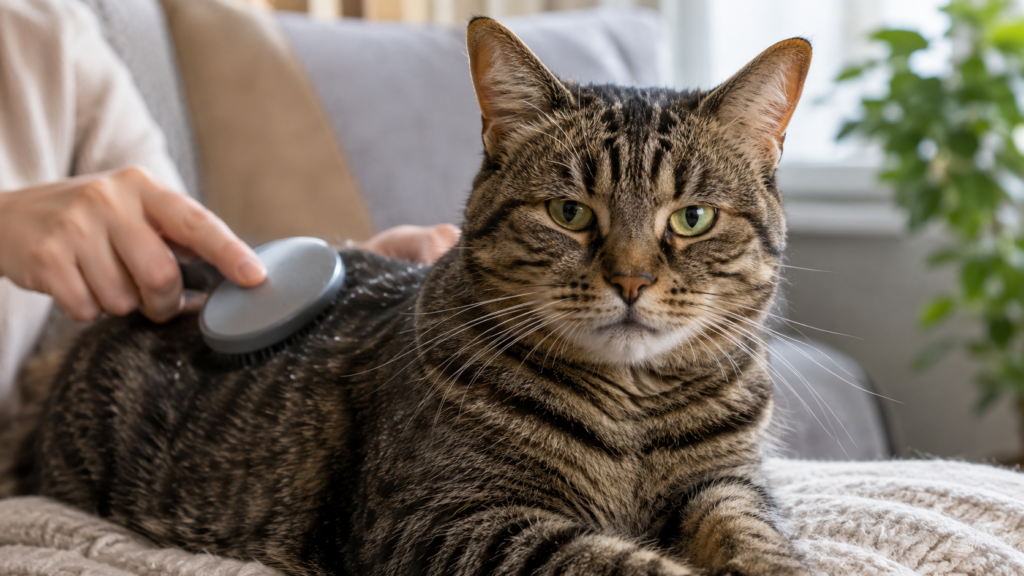
Brush your cat gently to remove loose flakes and help spread natural skin oils through the coat. Short, calm sessions are usually better than one long session, especially if your cat is not used to being brushed. Use a brush or comb that suits your cat’s coat type, and be careful around mats, sensitive skin, and the lower back.
Clean the places where flakes collect. Wash bedding, vacuum favorite resting spots, and check blankets or cat trees for heavy shedding, flea dirt, or signs that the coat is getting greasier or flakier over time.
Think about the air in your home. Dry indoor air, especially during colder months or in homes with central heating, can make skin flakes more noticeable. Improving indoor humidity may help some cats, but it should not be treated as a cure if the dandruff is persistent or comes with other signs.
Avoid frequent bathing unless your veterinarian recommends it. Many cats do not need regular baths, and too many baths can make the skin drier or more irritated. Hot water, human shampoo, harsh soaps, and leftover residue on the coat can all make things worse.
I would also avoid the common “natural remedy” route here. Essential oils, human dandruff shampoo, vinegar rinses, baking soda, and random oils are not safe assumptions for cats. Cats groom residue from their fur, so anything you put on the coat can become something they swallow.
When Cat Dandruff Is More Than Dry Skin
Cat dandruff becomes more concerning when it is persistent, getting worse, or paired with other changes. I would be more cautious if the flakes are greasy, smelly, crusty, itchy, or concentrated around irritated skin.
Watch for scratching, overgrooming, chewing at the skin, bald patches, scabs, redness, crusts, ear debris, or skin that looks sore. These signs can point toward fleas, mites, allergy, infection, ringworm, or another skin problem that needs proper diagnosis.
Also watch your cat’s general behavior. A cat with dandruff and weight loss, increased thirst, increased urination, vomiting, diarrhea, poor appetite, lethargy, hiding, reduced jumping, or a sudden change in grooming should not be treated as a simple dry-skin case.
A useful rule is this: if dandruff is the only sign and your cat seems completely normal, you can try gentle coat care first. If dandruff is one sign among several, stop guessing and call your veterinarian.
Why Your Cat May Have Dandruff
There is no single cause of cat dandruff. The flakes are a visible result, not a diagnosis.
One common reason is poor grooming. Cats usually keep their coats clean by licking, nibbling, and removing loose hair. If a cat cannot reach part of the body, dead skin and loose fur can build up. This often shows along the lower back, rump, or tail base because those areas are harder to reach.
Pain and stiffness can make grooming difficult. Senior cats, arthritic cats, overweight cats, injured cats, or cats with dental pain may groom less thoroughly. In that case, dandruff may appear alongside mats, a dull coat, or a greasy patch on the back.
Dry air can contribute to mild flaking, especially indoors. This is usually more believable when the flakes are fine, the skin is not red or itchy, and the problem seems seasonal.
Skin oil imbalance can also matter. Some cats develop scaling with oily skin, dry skin, or a mix of both. Veterinary sources often discuss this under seborrhea, which means abnormal scaling and oil production. In cats, this is usually secondary to another issue rather than a primary skin problem.
Parasites are another major possibility. Fleas, mites, and flea allergy can all make the skin flaky, itchy, crusty, or irritated. Cats can groom away live fleas before you see them, so not seeing fleas does not fully rule them out.
Allergies can cause skin reactions too. In cats, allergic skin disease may appear as itching, crusty bumps, hair loss from overgrooming, head and neck irritation, or certain inflammatory skin lesions. The pattern can help a vet investigate, but it does not prove the exact cause by itself.
Nutrition can affect skin and coat, but this should be handled carefully. A poor, incomplete, or imbalanced diet can contribute to coat and skin problems. Essential fatty acids are involved in skin health, but adding oils or supplements without veterinary guidance can cause problems and may not fix the real cause.
Check Where the Flakes Are
The location of the dandruff can give you useful clues.
If flakes are mostly along the back, rump, or tail base, think about grooming access. Can your cat turn comfortably? Does your cat still jump onto furniture? Does your cat avoid being touched near the hips or lower back? Is your cat overweight or older?
If flakes are paired with itching around the neck, back, or tail head, fleas or flea allergy become more important to consider. You may also notice scabs, hair thinning, or a cat that suddenly grooms in short, intense bursts.
If flakes come with circular hair loss, broken hairs, crusting, or skin changes, ringworm needs to be considered. Ringworm is not a worm. It is a fungal infection, and it can spread between cats and humans, so it is not something to self-treat based on appearance.
If the flakes look like they move, or if several pets or people in the home are itchy, ask your vet about mites. “Walking dandruff” is a real nickname for a mite problem called cheyletiellosis, and it can look like ordinary dandruff at first.
Be Careful With Walking Dandruff
Walking dandruff is one of the most important lookalikes because it sounds harmless but is not just dry skin. It is linked to Cheyletiella mites, which can cause scaling, itching, hair loss, and skin irritation.
This can spread among animals in close contact, and people may sometimes develop itchy skin reactions too. It is more suspicious if the dandruff appears after contact with a new pet, shelter environment, boarding situation, groomer, or another animal with skin signs.
Do not try to solve this with brushing or shampoo alone. If flakes seem to move, your cat is itchy, other pets are affected, or humans in the home have unexplained itchy spots, your veterinarian should check for parasites.
Do Fleas Cause Cat Dandruff?
Fleas can contribute to dandruff, especially when they trigger itching, inflammation, scabs, or flea allergy dermatitis.
A cat with fleas may scratch, lick, chew, or overgroom. You may see small scabs, hair thinning, or irritation near the back, neck, or tail base. Some cats are very good at grooming out fleas, so you may not find live fleas even when flea-related skin disease is part of the problem.
Look for flea dirt too. Flea dirt looks like small dark specks in the coat. If you are seeing dandruff plus dark specks, itching, scabs, or irritated skin, it is safer to treat this as a possible parasite issue and contact your vet for cat-safe flea control advice.
This is one area where product choice matters. Never assume a dog flea product is safe for cats. Cats are more sensitive to some ingredients, and flea control should be matched to the cat, household, and local parasite risks.
Should You Bathe a Cat With Dandruff?
Most cats with mild dandruff do not need a bath as the first step. Brushing is usually safer and less stressful.
Bathing can help in some skin conditions, but only when the product and reason are right. Medicated shampoos may be used for certain skin problems, but that decision belongs with a veterinarian, especially if the skin is oily, smelly, infected-looking, itchy, or inflamed.
Human dandruff shampoo is not a safe shortcut. Cat skin is not the same as human scalp skin, and cats lick their coats after grooming. A product that seems mild to a person can irritate a cat’s skin or become risky when swallowed during grooming.
If your vet does recommend bathing, follow the exact product and frequency they give. More bathing is not automatically better. With dandruff, overdoing it can strip the coat, dry the skin, and make the flakes worse.
What About Diet and Supplements?
Diet can affect skin and coat, but dandruff does not automatically mean your cat needs fish oil, coconut oil, or a new food.
Cats need a complete and balanced diet with appropriate protein, fat, essential fatty acids, vitamins, and minerals. If a cat is eating an incomplete diet, a poor-quality diet, too many extras, or not eating enough, the coat can become dull, dry, flaky, or brittle.
Fatty acids can support skin health in some situations, and veterinary sources note that omega-3 and omega-6 fatty acids may help reduce skin inflammation or support skin oils when used appropriately. But supplements are not guaranteed to fix dandruff, and too much can cause problems.
For me, the safer advice is simple: make sure your cat is eating a complete cat food appropriate for their life stage, then ask your veterinarian before adding supplements. This is especially important for kittens, senior cats, overweight cats, cats with chronic illness, or cats already on a special diet.
Why Senior or Overweight Cats Often Need Extra Attention
Dandruff in an older cat is worth looking at more carefully. Senior cats may groom less because of joint pain, stiffness, dental pain, reduced mobility, or illness. A scruffy coat can be one of the small changes owners notice before the bigger pattern becomes obvious.
Overweight cats may also struggle to reach the lower back and tail base. The flakes may collect exactly where the cat cannot groom well. Brushing can help remove buildup, but it does not solve the reason your cat cannot reach that area.
Do not crash-diet an overweight cat to fix dandruff. Weight loss should be planned with a veterinarian, because cats need safe, steady nutrition. What you can do at home is make grooming help gentler, keep sessions short, and notice whether your cat seems stiff, sore, or reluctant to move.
I would not ignore dandruff that appears suddenly in a senior cat, especially if the coat also looks greasy, matted, dull, or unkempt. That is a good moment to schedule a checkup rather than assuming it is just age.
Red Flags That Mean You Should Contact a Vet
Call your veterinarian if your cat’s dandruff is persistent, worsening, or paired with any skin or behavior changes.
The main warning signs include heavy itching, overgrooming, hair loss, scabs, redness, crusts, sores, greasy skin, bad odor, ear problems, painful skin, mats close to the skin, or flakes that seem to move.
You should also contact a vet if your cat has dandruff with weight loss, appetite changes, increased thirst, increased urination, vomiting, diarrhea, lethargy, hiding, reduced jumping, sudden aggression, or a clear change in grooming habits.
If people or other pets in the home are itchy too, do not treat the cat’s flakes as ordinary dry skin. Parasites or ringworm may need to be ruled out.
A vet may need to check for fleas, mites, ringworm, allergy, infection, pain, nutrition problems, or underlying illness. Skin problems often look similar from the outside, so diagnosis may require a physical exam and basic skin testing.
Common Mistakes That Can Make Cat Dandruff Worse
The first mistake is scrubbing the flakes away too aggressively. Irritated cat skin can become more painful if you brush hard, pull mats, or keep grooming after your cat is clearly uncomfortable.
The second mistake is using human products. Human shampoo, dandruff shampoo, essential oils, vinegar, baking soda, and scented skin products are not safe assumptions for cats. Cats lick their coats, so topical products can become oral exposure.
The third mistake is assuming all dandruff is dryness. A flaky cat may have fleas, mites, allergy, ringworm, infection, pain, poor grooming, diet issues, or systemic illness. Dry skin is only one possibility.
The fourth mistake is waiting too long when there are other signs. If your cat is itchy, scabby, losing hair, greasy, smelly, or acting differently, home care should not delay a vet visit.
A Practical Way to Monitor Mild Cat Dandruff
If your cat seems normal and the dandruff is mild, monitor it for a short period while improving gentle coat care.
Brush lightly and note where flakes appear. Check whether the skin underneath looks normal or irritated. Watch whether your cat scratches, licks, chews, hides, avoids touch, or reacts when you brush certain areas.
Look at the household pattern too. Are other pets itchy? Did a new pet recently arrive? Has your cat been boarded or groomed? Is flea prevention current? Has the home become very dry from heating or weather?
Also notice grooming ability. A cat that cannot reach the lower back, struggles to turn, hesitates before jumping, or develops mats may need more than grooming help.
If the dandruff improves with gentle brushing and your cat remains comfortable, you may only need better routine coat care. If it stays the same, returns quickly, spreads, or appears with other signs, the safer next step is veterinary advice.
Final Thoughts
Getting rid of cat dandruff starts with gentle care, not harsh treatment. Brush the coat, keep bedding clean, avoid drying or unsafe products, and look closely at where the flakes are and what else is happening with your cat.
Mild flakes on a comfortable, otherwise normal cat may improve with better grooming support and a less dry environment. But dandruff with itching, scabs, hair loss, oiliness, odor, pain, behavior change, poor grooming, or signs that other pets or people are affected should be checked by a veterinarian.
The flakes are the visible part. The real answer is finding out whether your cat’s skin is simply dry or whether your cat is telling you something else through their coat.
References
- Cats Protection: Can Cats Get Dandruff?
- Texas A&M School of Veterinary Medicine: Don’t Brush Off Feline Dandruff
- VCA Animal Hospitals: Seborrhea in Cats
- Cornell Feline Health Center: Fleas
- Cornell Feline Health Center: Ringworm
- AAHA: 2023 Management of Allergic Skin Diseases in Dogs and Cats Guidelines
- MSD Veterinary Manual: Toxicoses From Essential Oils in Animals