It’s a question most cat owners have asked at some point, usually while watching their cat stare blankly at the wall instead of acknowledging them. You feed this animal, clean its litter box, and worry about it when it sneezes. Does any of that register? Does your cat actually care about you, or are you just a convenient food source with a warm lap?
The honest answer is: probably yes, your cat does have some form of bond with you. But cat affection doesn’t look like dog affection, and it doesn’t look like human affection either. If you’re measuring your cat’s feelings by how enthusiastically it greets you at the door, you’re likely underestimating the relationship.
What follows is a practical look at what cat attachment actually means, which behaviors are worth paying attention to, and when a change in your cat’s behavior might warrant a vet visit rather than an emotional spiral.
Cats Can Form Real Bonds With People
There’s solid research behind the idea that cats attach to their owners in a meaningful way. A 2019 study published in Current Biology used a secure base test, similar to one used with human infants and dogs, to assess how cats relate to their caregivers. The results showed that roughly 65% of both kittens and adult cats were classified as securely attached. Securely attached cats were less stressed after a brief separation and, when reunited with their owner, balanced attention between the person and the room rather than clinging or avoiding entirely.
That’s a meaningful finding. It suggests that for most cats, a familiar human functions as a source of security, not just a food dispenser. The cat uses the owner as a kind of home base.
A more recent 2025 study complicated this picture somewhat, finding that cats in a modified version of the same test didn’t show the same owner-specific reactions that dogs typically do. The cats were calm and friendly toward both owners and strangers. I’d read that as a challenge to the idea that cats are emotionally dependent on owners the way many dogs are, not as proof that cats feel nothing. There’s a difference between dependency and affection, and cats seem to lean toward the latter without much of the former.
What “Love” Actually Looks Like in a Cat
The most useful way to think about cat affection is behavioral. Does your cat voluntarily choose to be near you? Does it interact with you in a relaxed way? Does it recover around you after something startling? Does it include you in its routines?
A 2021 study based on nearly 4,000 owner responses identified several distinct relationship types between cats and their owners, including friendship, co-dependent, casual relationship, remote association, and open relationship bond. The takeaway is that there’s no single template for a loving cat. Some cats are physically demonstrative; others are bonded but quiet about it.
Proximity and Voluntary Presence
One of the clearest signs of attachment is where your cat chooses to be. A cat that sits nearby, follows loosely from room to room, or settles in the same space as you when it could easily go elsewhere is showing social preference. This matters because cats are not obligated to be near you. They’re not pack animals. When they choose your company, that choice means something.
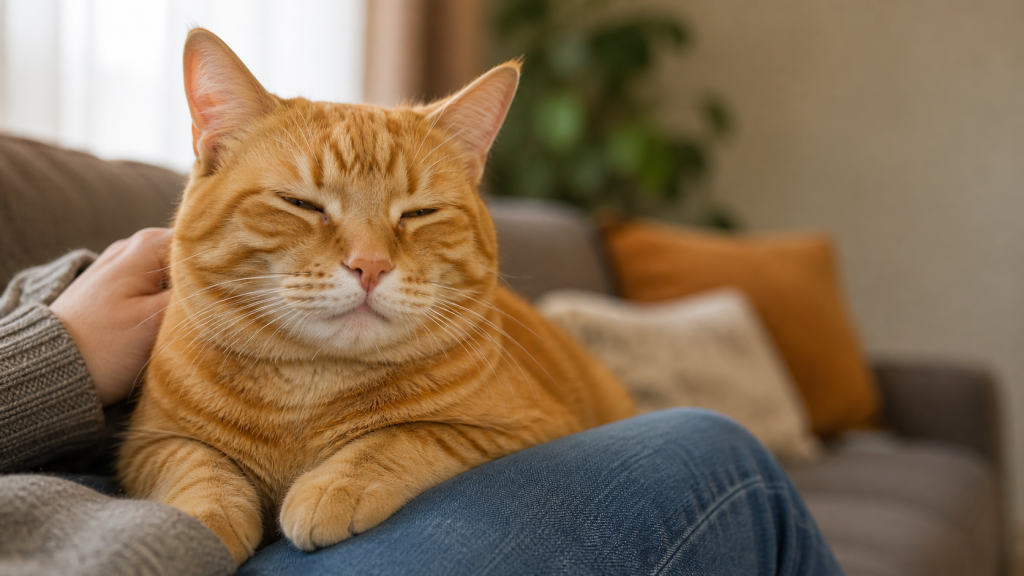
Some cats want lap time. Others prefer what I’d call parallel companionship, lying across the room while keeping an eye on you. Both can reflect genuine attachment. The key word is voluntary. A cat that stays near you when it has the option to leave is telling you something.
Scent Rubbing and Head Bunting
When your cat rubs its face or body against you, it’s doing more than being cute. Cats have scent glands around their cheeks, chin, mouth, and ears. Rubbing deposits scent and is part of how cats mark their social and environmental world as familiar and safe. When your cat includes you in that process, it’s essentially filing you under “trusted and familiar.”
That’s a better explanation than simply saying headbutts mean love. The mechanism is scent exchange and social familiarity. Your cat is incorporating you into its sense of home.
Slow Blinking
Slow blinking gets a lot of attention online, sometimes overstated as a literal “I love you” in cat language. The actual research is more modest but still interesting. A 2020 study found that cats produced more half-blinks and eye narrowing after owners slow-blinked at them, and cats were more likely to approach an unfamiliar person who had slow-blinked compared to someone with a neutral expression.
So slow blinking does appear to be a positive communication signal, one that indicates relaxation, trust, and openness to interaction. It’s most meaningful when paired with loose posture and voluntary proximity. On its own, it’s a good sign. As part of a pattern, it’s a better one.
Body Language as a Whole
Individual signals are easy to misread. A cat rolling onto its back may be showing trust, but it’s not necessarily asking for a belly rub. Purring usually suggests comfort, but cats also purr when stressed, in pain, or at the vet. Meowing is communication, not always affection.
The more reliable approach is to read the whole picture. Relaxed eyes, an upright tail, soft whiskers, forward ears, and loose posture together suggest a cat that’s comfortable and open. Tense posture, wide pupils, flattened ears, and a lashing tail suggest the opposite, regardless of whether the cat is also purring or meowing.
Kneading, sleeping nearby, and greeting you after an absence are all worth noting as part of a pattern. Sleep is a vulnerable state for cats, so repeated voluntary sleep proximity suggests real comfort and trust. I’d look at these behaviors as a cluster over time, not as individual proof of anything.
“My Cat Only Loves Me for Food”
This is one of the most common worries, and the research doesn’t really support it. In a preference assessment study with both pet and shelter cats, social interaction with humans was the most preferred stimulus category for the majority of cats, ranking above food, with clear individual variation.
Food is a powerful motivator, and cats do often approach owners around feeding time. But if your cat also seeks you out between meals, rests nearby, rubs against you, or relaxes during interaction, the relationship isn’t simply transactional. Food can strengthen routine and predictability, which cats value. It doesn’t explain everything else.
Why Your Cat Might Seem Distant
A cat that seems aloof isn’t necessarily unattached. There are several reasons a bonded cat might not show obvious affection.
Personality and Early Socialization
Affection varies by individual temperament, early socialization, past handling experiences, and household stress. A cat adopted as an adult, a former stray, or a cat that wasn’t handled much as a kitten may need more time and more choice before showing affiliative behavior. That’s not indifference. It’s caution, and it can shift with consistent, respectful interaction.
Your Interaction Style
How you interact with your cat affects how much affection it shows. A 2021 study tested simple interaction guidelines based on giving cats choice and control, paying attention to body language, and limiting touch mainly to preferred areas like the head and cheeks. When people followed these guidelines, cats showed more positive and affiliative behaviors. Control interactions, where people didn’t follow the guidelines, produced more aggression and conflict.
The practical implication is straightforward: let the cat approach you rather than reaching over it. Offer a hand or finger near the cat and let it decide whether to engage. Pet briefly around the head and cheeks if the cat leans in, then pause and see whether it re-engages. If it walks away, that’s fine. Respecting that boundary makes you more predictable and safer in the cat’s eyes, which tends to increase affection over time, not decrease it.
Stress and Environment
A cat in a stressful environment may spend more energy managing that stress than interacting socially. Cats do well with hiding spaces, vertical areas, predictable routines, clean litter, and control over their interactions. When those conditions aren’t met, a cat may seem distant even if it’s bonded to you.
In multi-cat homes, this gets more complicated. Another cat may be blocking access, controlling space, or creating low-level tension that’s invisible to you but very real to your cat. If your cat seems less affectionate than expected, it’s worth assessing the social environment before concluding the cat is simply uninterested in you.
A cat may also seem less loving after a move, a new baby, a new pet, construction noise, a schedule change, or a recent vet visit. The issue is often perceived safety, not a change in how the cat feels about you.
When Reduced Affection Is a Health Issue
This is the part I’d take seriously. Pain can look like lost affection. A cat that used to enjoy being touched but now avoids contact, hisses when you reach for it, or flinches at certain areas may be in physical discomfort. Cats with joint pain, for example, may resent contact around affected areas and respond with aggression that looks like a personality change.
Senior cats deserve particular attention here. Older cats may develop dental disease, arthritis, kidney disease, hyperthyroidism, or cognitive changes that alter their social behavior without changing their underlying bond with you. A senior cat that stops cuddling may still be attached but physically uncomfortable, less mobile, or less able to access favorite resting spots.
It’s also worth knowing that cats tend to hide signs of illness or weakness. A cat that seems fine may be managing discomfort quietly. This is one reason sudden or persistent changes in social behavior are worth taking seriously.
Contact a veterinarian if your cat’s reduced affection is sudden or persistent and is paired with any of the following:
- Hiding more than usual
- Changes in appetite or weight
- Vomiting, diarrhea, or litter box changes
- Increased drinking or urination
- Reluctance to jump or changes in mobility
- Altered grooming, bad breath, or difficulty eating
- New aggression, unusual vocalization, or disorientation
- Sensitivity when touched in a specific area
These aren’t relationship problems. They’re potential health signals, and they need a vet, not a behavior article.
Practical Ways to Strengthen the Bond
You can’t force a cat to be affectionate, but you can create conditions where affection becomes more likely. The research points toward a few consistent principles.
Be predictable. Cats respond well to consistent routines, familiar voices, and interactions that don’t suddenly escalate into restraint or forced handling. Avoid staring directly at your cat, which can read as a threat. Instead, use soft eyes and slow blinks when your cat is relaxed.
Play matters more than many owners realize. Daily play with a wand-type toy that mimics prey movement gives your cat an outlet for predatory behavior and creates positive associations with you as the source of that activity. It also reduces stress, which makes social behavior more likely.
Stop petting before your cat gets irritated. Petting-induced biting isn’t betrayal. It’s often overstimulation, or a cat’s way of ending contact it no longer wants. Warning signs include tail lashing, skin twitching, ears moving backward, and pupils widening. If you see those, stop. A cat that bites during petting may still be genuinely bonded to you. Affection is better measured by whether the cat voluntarily returns, not by how long it tolerates handling.
Protect your cat’s hiding spots and resting areas. A cat that has safe, undisturbed places to retreat will generally be calmer and more socially available than one that feels it has nowhere to go.
Reading Your Own Cat
The most useful standard isn’t another cat on social media or a generic list of “signs your cat loves you.” It’s your cat’s own baseline. What does your cat normally do? How does it normally behave around you compared to strangers? Does it seek you out outside of mealtimes? Does it recover around you after something startling?
A 2019 survey study of over 3,000 cat owners found associations between owner personality and reported cat behavior, with more consistent and observant caregiving linked to less anxious and avoidant behavior in cats. That’s correlational, not a direct cause-and-effect finding, but it supports the practical point that how you show up in the relationship shapes what you get back.
Compare your cat’s behavior against its own history, not against an idealized version of what a loving cat is supposed to look like.
Conclusion
Most cats can form meaningful bonds with their owners. The research supports that. But cat affection is usually subtle, individual, and context-dependent. A cat that doesn’t cuddle may still be bonded. A cat that purrs isn’t automatically happy. A cat that bites during petting may be overstimulated rather than hostile. And a cat that suddenly withdraws may need a vet check before anything else.
The signs worth paying attention to are patterns over time: voluntary proximity, relaxed body language, scent rubbing, slow blinking, normal eating and grooming, and a cat that chooses your company when it doesn’t have to. Those add up to something real, even if it doesn’t look like what you expected.
If your cat’s behavior has changed noticeably and you can’t explain it by a recent stressor or environmental change, a vet visit is the right first step. Behavior changes in cats are often the first visible sign of something physical, and that’s worth ruling out before drawing any other conclusions.
References
- Current Biology, 2019 Attachment Study (ScienceDirect) — supports the secure base attachment findings in cats.
- Pongrácz et al., 2025 (ScienceDirect) — supports the nuanced view that cats may not show owner-specific dependency-style attachment.
- Slow Blinking Study, Scientific Reports 2020 (Nature) — supports slow blinking as a positive cat-human communication signal.
- Frontiers in Veterinary Science, 2021 — supports the role of choice and control in improving cat-human interaction outcomes.
- Cat Preference Assessment Study (ScienceDirect) — supports the finding that social interaction ranked above food for most cats.
- Cats Protection: Cat Body Language — supports body language interpretation including scent rubbing, purring context, and belly-up posture.
- Cornell Feline Health Center: Aggression — supports petting-induced aggression and pain-related behavior changes.
- PLOS One, 2019 Owner Personality Survey — supports the association between owner behavior and reported cat behavior styles.