The text is already free of typos. Here it is unchanged:
This question usually comes from a real place. Maybe your cat walks away mid-cuddle. Maybe she ignores you when you call her name, even though you’re certain she heard you. Maybe you look at her sleeping across the room and wonder if any of what you do for her actually registers.
The honest answer is more interesting than a simple yes or no. Your cat probably does not understand love as a human concept. She doesn’t think in words, gratitude, or romantic affection. But research supports something arguably better: many cats recognize their specific person, form measurable social bonds, respond to familiar interaction patterns, and show trust through body language that you can learn to read.
The real question isn’t whether your cat understands the word love. It’s whether your care is visible to her in feline terms. And for most cats living with attentive owners, the answer is yes, though she’ll show it in ways that look nothing like what you might expect.
Your Cat Recognizes You More Than You Think
Cats are often accused of being indifferent to their owners, but voice recognition research tells a different story. A study published in Animal Cognition found that indoor companion cats could discriminate between speech directed at them and speech directed at adult humans, but only when the sentences were spoken by their owners. When a stranger used the same cat-directed tone, the cats didn’t react the same way.
This matters because owners often interpret a cat’s lack of obvious response as proof she doesn’t care. But the evidence suggests something more precise: your cat likely notices owner-specific cues and associates your voice with familiar interaction. She just isn’t obligated to respond like a dog or a child would.
A cat may recognize her owner’s voice and still not come when called. That’s not coldness. Cats haven’t been bred for obedience the way dogs have, and they may be weighing comfort, sleep, curiosity, or something else entirely. A muted response isn’t proof that your cat doesn’t know you or value your presence.
What Attachment Research Tells Us
A 2019 study from Oregon State University used a secure-base test (adapted from infant and dog attachment research) and found that about 64% of kittens and 66% of adult cats were categorized as securely attached to their caregivers. Securely attached cats showed reduced stress and balanced their attention between the caregiver and the environment after being reunited.
That’s a meaningful finding. It suggests many cats use their familiar person as a source of security, particularly when stressed. Your cat may not run to you with obvious joy every time you walk through the door, but she may relax, move more freely, or explore more confidently because you’re there.
But Cats Aren’t Tiny Dogs
A 2025 study tested therapy cats and companion cats in a modified version of the same attachment test and found no evidence of exclusive safe-haven reactions toward owners. Therapy cats behaved calmly and amicably toward both owners and strangers.
The takeaway isn’t that cats don’t bond with people. It’s that cat-human relationships may not always be dependency-based in the same way dog-human bonds often are. Your cat can form a genuine social relationship with you, seek your company, and prefer your presence without relying on you as her sole emotional regulator in every new situation. That’s not indifference. It’s feline independence, and it doesn’t cancel out the bond.
Signs Your Cat Feels Safe and Bonded With You
Cats don’t say “I love you” in any human-readable way, but they do communicate comfort, trust, and social preference through consistent body language. Here are some of the more reliable signals. Think of these as possible signs of a positive bond, not a rigid checklist:
- Slow blinking at you. A 2020 study found that cats produced more half-blinks and eye narrowing when owners slow-blinked at them, and cats were more likely to approach an unfamiliar person after a slow-blink exchange. This seems to work as positive emotional communication.
- Approaching with an upright tail. A tail held high, sometimes with a slight curve at the tip, is generally considered a friendly greeting.
- Rubbing her cheeks or head against you. This deposits scent and marks you as familiar and trusted. It’s sometimes called bunting.
- Choosing to be near you. Not on you, necessarily. Some cats show trust by quietly staying in the same room, sleeping nearby, or following your routine.
- Kneading. This traces back to kitten nursing behavior and may continue as a comfort behavior in adulthood.
- Relaxed posture in your presence. Loose body, soft eyes, relaxed whiskers, ears facing forward.
One cat may be affectionate through lap-sitting. Another may show trust by simply sleeping with her belly partially visible in the same room. Both are meaningful. The key is whether she’s voluntarily choosing proximity when she could easily leave.
A Note About Purring
Purring is often treated as definitive proof of happiness, but it needs context. Cats may also purr when stressed, anxious, or in pain. A purring cat curled loosely on your lap, kneading and slow blinking, is very different from a purring cat that’s hiding, eating less, or moving stiffly. Read clusters of signals rather than relying on one behavior alone.
The Belly Display Isn’t What You Think
When a cat rolls over and shows her belly, it can indicate trust or a relaxed greeting. But it’s often not an invitation to touch the belly. Many cats dislike belly contact, and reaching for it can damage trust and trigger scratching. I think this is one of the most common ways well-meaning owners accidentally undermine their relationship. Your cat is showing you something vulnerable. The loving response is to acknowledge it without grabbing.
How to Show Love in Cat-Readable Language
This is where the question flips. Instead of asking whether your cat understands your love, it’s more useful to ask whether your love is expressed in a form she can actually receive. Human affection can become stressful when it removes the cat’s control over the interaction.
Veterinary behavior guidelines consistently emphasize that cats benefit from regular, friendly, predictable interaction. But many cats prefer frequent, low-intensity contact that lets them initiate, moderate, and end the exchange. The most cat-readable version of love is consent-based, not intense.
Practical Ways to Communicate Safety and Care
- Slow blink softly. Look at your cat with relaxed eyes and blink slowly. This is one of the few evidence-backed ways to signal calm friendliness.
- Speak calmly. Your cat likely knows your voice. A gentle, familiar tone reinforces that association.
- Let her sniff before touching. Offer a hand. Wait. Let her decide.
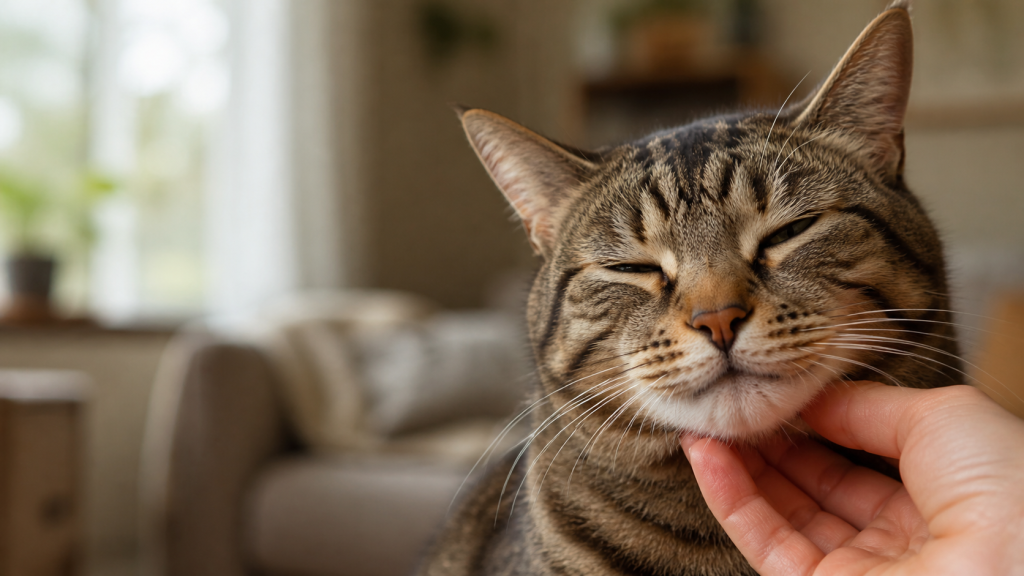
- Pet preferred areas. Cheeks, chin, and head are generally well-tolerated. Avoid the belly and the base of the tail unless you know your specific cat enjoys it.
- Stop before she gets overstimulated. Shorter, more frequent interactions are usually better than long sessions that end in a swat.
- Play with wand toys. Predatory play satisfies a deep need. It’s also relationship-building time.
- Keep routines predictable. Feeding times, play times, quiet times. Predictability is safety in cat terms.
- Provide safe resting and hiding places. A cat who can retreat when she needs to will trust you more, not less.
- Respect when she walks away. This is not rejection. It’s a cat exercising healthy control over her own space.
For me, the safer way to think about this is: love, from a cat’s perspective, is less about how much you pet her and more about whether she can opt in, relax, and leave freely.
What Not to Do When Trying to Show Love
Some of the most common affection mistakes come from treating cats like small humans or small dogs. Avoid staring directly (cats can perceive it as threatening), grabbing, hugging tightly, holding after she tries to leave, rubbing the belly by default, forcing face-to-face contact, waking her repeatedly for affection, or punishing hissing and swatting.
Hissing and swatting aren’t personal insults. They’re communication. A cat who can say “no” without losing access to care is a cat who can trust you. If you override those signals consistently, you’re not showing love. You’re showing unpredictability, which is one of the things cats find most stressful.
Why Some Cats Seem Less Affectionate
A cat’s social comfort with humans is shaped by genetics, parental sociability, and crucially, her experiences between about 2 and 9 weeks of age. Positive, frequent handling during that sensitive period makes a kitten more likely to tolerate contact and feel less fearful of people later in life.
If you adopted a previously stray, undersocialized, or trauma-exposed cat, she may never become a lap cat. That’s not a reflection of your care. Trust can improve with predictable, low-pressure interaction over time, but some cats will always prefer distance. A cat can know you’re safe and still choose space. That’s a valid form of feline trust.
Multi-Cat Homes Can Complicate Things
In homes with multiple cats, one cat may avoid an owner not because she lacks attachment, but because another pet blocks access to key resources: food, litter, resting places, safe pathways, or even the owner’s lap. This isn’t jealousy in the human sense. It’s resource pressure and social tension.
If one cat seems withdrawn, consider whether she has separate access to feeding stations, litter boxes, resting areas, vertical spaces, and one-on-one time with you away from other animals. Making love practical in a multi-cat home means making space equitable.
Indoor Versus Outdoor Cats May Show It Differently
Indoor-only cats may rely more visibly on their owner for play, stimulation, and social contact. Indoor-outdoor cats may divide their attention between you and territory patrol, hunting behavior, and outdoor exploration. Not following you around the house doesn’t mean your outdoor cat cares less. It may simply mean she has other outlets. The more useful measure is her baseline behavior over time, not a comparison to social-media cats or highly affiliative breeds.
When Distance Isn’t Normal
There’s an important difference between a cat who has always been independent and a cat whose behavior has recently changed. A naturally low-affection cat will still eat, play, groom, use the litter box, and approach on her own terms. She’s just quiet about it.
Concerning signs include:
- Sudden, persistent hiding
- Reduced appetite or significant changes in drinking
- Litter box avoidance or urinating outside the box
- New aggression when handled
- Lack of grooming, or excessive grooming in one area
- Lethargy or reluctance to move
- Pain responses when touched
- A major change in social behavior that doesn’t resolve
These aren’t signs that your cat “hates” you. They can indicate fear, overstimulation, pain, environmental stress, or illness. Cats often mask symptoms until behavioral shifts become noticeable. A sudden change in affection is not just a relationship problem. It can be a medical one.
I wouldn’t ignore this if the change came on quickly and persists for more than a day or two. Contact your veterinarian, especially if appetite, litter habits, or mobility are also affected.
The Real Answer to the Question
Your cat probably knows you as a familiar, important person. She can learn that your voice, smell, routines, touch style, and presence predict safety and good things. Whether that constitutes “knowing you love her” depends on how loosely you’re willing to define the word love.
What I think matters more than the label is this: your cat can tell the difference between a person who respects her boundaries and one who doesn’t. She can distinguish a predictable, calm environment from a chaotic one. She can learn that you are the person whose voice she recognizes, whose scent means safety, and whose hands know when to stop.
That may not look like love in a human sense. But in feline terms, it’s the whole package. And if she’s choosing to be near you, relaxing in your presence, greeting you with an upright tail, or slowly blinking across the room, she’s telling you something real. Just not in English.
References
- Oregon State University Newsroom — Supports findings on secure attachment in cats and kittens (2019 study).
- Scientific Reports (2020) — Slow-blink study showing cats respond to owner slow-blink sequences.
- Applied Animal Behaviour Science (2025) — Study on therapy cats and attachment patterns challenging dependency-based models.
- AAFP/ISFM Environmental Needs Guidelines — Feline environmental and interaction needs, including consent-based handling.
- AAFP/ISFM Cat Friendly Veterinary Interaction Guidelines (2022) — Touch preferences, socialization windows, and interaction principles.
- Cats Protection — Cat Body Language Guide — Signs of relaxation, trust, and stress in cats.
- Cornell Feline Health Center — Fear and aggression signals, behavioral red flags.
- Oakdale Veterinary Group — Behavior changes as potential indicators of medical issues.