The text is already free of typos. Here it is unchanged:
You’ve probably watched your cat encounter catnip and thought: “Are you… high right now?” The rolling, the rubbing, the sudden burst of energy or the glassy-eyed flop onto the floor. It genuinely looks like intoxication. And if you’ve ever felt a twinge of guilt about offering catnip, or wondered whether you’re basically handing your cat a recreational drug, you’re not alone in asking.
The short answer is that catnip can produce a temporary euphoric-looking response in many cats. Calling it “high” isn’t unreasonable as everyday language, but it’s also not the same thing as human drug intoxication. The behavior is brief, self-limiting, and generally safe. Most cats manage it perfectly well on their own.
What I want to do here is explain the actual mechanism, describe what normal responses look like (they vary more than you’d think), cover why some cats couldn’t care less, and lay out the practical limits, including the signs that mean something has actually gone wrong.
What Catnip Actually Does Inside Your Cat
The active compound in catnip (Nepeta cataria) is nepetalactone, an oil found in the plant’s leaves and stems. Here’s the part many articles get wrong: the reaction is mainly scent-triggered, not food-triggered. Your cat doesn’t need to eat catnip to respond. They need to smell it.
When a cat sniffs catnip, nepetalactone reaches the vomeronasal organ, a specialized scent-processing structure that carries chemical signals from the nose and mouth to the brain. This triggers what appears to be a natural pleasure response. Research suggests that nepetalactone may cause the body to release endorphins (the cat’s own internal feel-good chemicals), and studies have shown that blocking opioid receptors with a drug called naloxone can suppress the typical catnip response.
For me, the safer way to think about it is this: catnip seems to activate an internally regulated pleasure system, not flood the brain with an external drug. The cat’s own body is producing and managing the response. That’s meaningfully different from what happens when a person takes a narcotic, even though the visible behavior might look similar from the outside.
Smelling vs. Eating Aren’t the Same
This distinction matters practically. When your cat chews dried catnip leaves, that chewing releases more aroma, which intensifies the scent-driven response. But simply swallowing catnip plant material isn’t the primary mechanism that produces the “high” behavior. Many owners assume eating is what does it, but it’s really the smell.
This is why catnip sprays can work even though the cat never ingests anything. You can scent a toy, a scratcher, or a cat tree and get the same behavioral response without your cat consuming any plant material at all. That’s a useful option for cats prone to stomach upset.
What Normal Catnip Behavior Looks Like
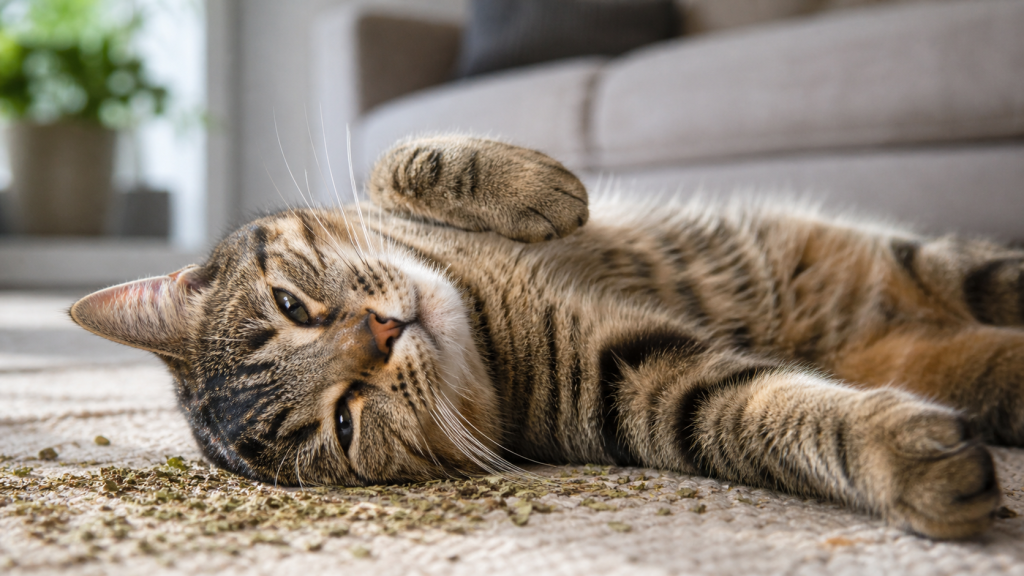
There’s no single “typical” catnip reaction. This is one of the things that confuses owners, because you might expect rolling and zoomies, and instead your cat just gets quiet and spacey. Both can be normal.
Common responses include:
- Face rubbing and head pressing against the catnip source
- Rolling on the back or side
- Vocalizing (meowing, chirping, or yowling)
- Sudden playfulness or hyperactivity
- Drooling
- A relaxed, sedated-looking pause
- Running and jumping (the “zoomies”)
- A quiet sphinx-like posture
Some cats become silly and bouncy. Others mellow out completely. A few get overstimulated and may swat or act slightly aggressive. The point is that if your cat doesn’t roll around like the viral videos suggest, they might still be responding. A calm rub, a deliberate sniff, or a brief pause can all be part of the picture.
How Long Does It Last?
The effect usually starts within seconds of sniffing and lasts somewhere around 5 to 15 minutes. After that, most cats lose interest and walk away.
What follows is a refractory period, a temporary reset window where the cat won’t respond to catnip again even if they smell it. This usually lasts somewhere between 30 minutes and 2 hours. Sources vary slightly on the exact timing, but the key practical point is that the experience has a natural endpoint. Your cat isn’t going to be “high” indefinitely, and offering more catnip during the refractory window won’t restart anything.
If your cat’s behavior doesn’t resolve within that expected window, or if something seems off beyond just mild silliness, that’s when it’s worth paying closer attention.
Why Some Cats Don’t React at All
If your cat sniffs catnip and couldn’t be less interested, there’s nothing wrong with them. Estimates vary, but roughly 40 to 50 percent of cats may show no obvious behavioral reaction to catnip. The sensitivity appears to be inherited, traced back to research from the early 1960s on the genetics of the catnip response.
A cat that ignores catnip isn’t being stubborn, broken, or defective. It’s simply not wired to respond. No training, coaxing, or stronger product will change the underlying biology.
Age Plays a Role Too
Young kittens typically don’t respond to catnip. Most sources suggest the response doesn’t reliably develop until somewhere between 3 and 6 months of age, and some cats may not show clear reactions until closer to a year old. Research has found that kittens under 3 months didn’t display the characteristic rolling behavior after catnip exposure, while adults over 6 months rolled significantly more than juveniles.
So if you bought catnip toys for a young kitten and they completely ignore them, that’s almost certainly developmental timing, not a bad product. Try again in a few months.
Is It Actually Safe?
For most cats in ordinary use, yes. Catnip is generally considered safe by veterinary sources. But “safe” deserves a little nuance, because if you search online you’ll find the ASPCA’s plant database lists catnip as toxic to cats, with nepetalactone identified as the toxic principle and vomiting and diarrhea listed as possible clinical signs.
That sounds alarming until you understand what “toxic” means in a poison-control database. It means the plant can cause clinical signs, not that normal exposure is life-threatening. The practical translation: a small amount of catnip, especially just sniffing it, is not expected to harm a healthy cat. But if a cat eats a large amount of the actual plant material, it can cause an upset stomach.
Cats are not expected to fatally overdose from ordinary catnip exposure. But unlimited use isn’t consequence-free either. Large quantities can cause vomiting and diarrhea, and concentrated catnip oils are more potent than dried leaves, so they deserve extra caution.
Red Flags Worth Watching For
Normal catnip weirdness (brief rolling, rubbing, drooling, running, mellowing out) is not an emergency. But certain signs suggest either too much ingestion, something else going on, or a reaction that’s gone beyond normal:
- Repeated vomiting
- Diarrhea
- Wobbly walking or loss of coordination
- Disorientation that doesn’t resolve
- Dilated pupils
- Behavior that persists well beyond 15 to 20 minutes
- Dizziness or trouble balancing
If any of these signs don’t fade after the expected short window, I’d stop guessing and contact a veterinarian. It’s possible your cat ate too much plant material, got into something else entirely, or has a sensitivity that needs professional evaluation.
Is Catnip Addictive?
No, not in the way we understand addiction in humans. Catnip does not appear to cause dependence or withdrawal. The endorphin release is internally regulated by the cat’s own body, and repeated exposure doesn’t create the escalating craving cycle that defines substance addiction.
That said, cats can develop a mild tolerance with very frequent use, meaning the response might become less dramatic over time. This isn’t addiction. It’s more like diminishing novelty. If your cat seems less interested than they used to be, taking a break for a week or two and then reintroducing catnip often resets the response.
The “Feline Marijuana” Comparison
This is one of those analogies that’s catchy but scientifically loose. Veterinary behavior experts have noted that catnip can superficially look like a narcotic response, but there’s no evidence it operates the same way as cannabis, marijuana, or cocaine in people. Cats are not small humans, and mapping human drug experiences onto feline biology can mislead owners into either overconcern or carelessness.
The cleanest way I’d frame it: catnip can make cats act high, but what’s happening inside is a brief, self-regulated pleasure response, not chemical intoxication in the human sense. You don’t need to feel guilty about offering it.
Practical Tips for Using Catnip Well
Start Small and Observe
A pinch of dried catnip or a low-exposure toy is enough for a first introduction. Watch how your individual cat responds before offering more. Some cats get playful. Some get relaxed. A few get agitated or slightly aggressive. If your cat consistently becomes stressed or combative after catnip, skip it. Not every cat enjoys the experience.
Different Forms, Different Considerations
Dried catnip, fresh leaves, sprays, and concentrated oils are not interchangeable from a safety standpoint. Sprays let you scent objects without offering ingestible plant material. Fresh catnip tends to be more potent than dried. Dried catnip loses potency over time unless stored in an airtight container. Highly concentrated catnip essential oils deserve extra caution because of their potency.
If your cat tends to eat everything they can get their mouth on, spray-based products on toys or scratchers may be a better fit than loose dried herbs scattered on the floor.
Watch the Toy, Not Just the Herb
This one gets overlooked. Catnip can increase rough play, chewing, and toy destruction. The catnip itself might be relatively safe, but the ripped toy seam, loose stuffing, swallowed bell, chewed feather, or ingested string becomes the real hazard. Supervise strong responders, especially with softer toys that can be torn apart.
Multi-Cat Households Need Extra Thought
In a home with multiple cats, giving catnip in one shared space can create competition, resource guarding, swatting, or redirected aggression, especially if one cat becomes stimulated while another becomes irritable. I’d suggest introducing catnip to each cat separately first so you know their individual responses. Use multiple toys or scent spots, and remove catnip if one cat starts bullying another.
More Isn’t Better
Once enough nepetalactone triggers the scent response, piling on more catnip doesn’t proportionally increase the effect. The body’s endorphin release is regulated. Dumping a whole container on the floor is more likely to waste product, create a mess, or cause stomach upset if eaten than to produce a stronger experience. A small amount refreshed occasionally is more practical than frequent heavy doses.
Why the Behavior May Have Evolved
There’s a fascinating research angle worth mentioning briefly. A 2021 study found that when cats rub against catnip and similar plants, the compounds transfer to their fur, particularly around the face and head, and those compounds actually repel certain mosquitoes. A follow-up study found that cats damaging plant leaves increases the release of these insect-repellent chemicals.
This suggests the rolling and rubbing behavior may not just be about pleasure. It might have an evolved function as a natural insect deterrent. That said, this is a biological explanation of behavior, not a household pest-control recommendation. Catnip toys are not a substitute for veterinary parasite prevention.
Catnip as Enrichment, Not a Fix
Catnip works best as one enrichment tool among many. It can make toys, scratchers, and play sessions more interesting for responsive cats. But it shouldn’t replace daily interactive play, climbing spaces, food puzzles, scratching posts, or predictable time with you.
I’d also be cautious about framing catnip as a treatment for anxiety, pain, or behavioral problems. Some sources mention potential calming benefits, but that’s different from a clinical treatment plan. If your cat has persistent stress signs like hiding, overgrooming, aggression, house soiling, or appetite changes, those deserve veterinary attention, not just a sprinkle of dried herbs.
Why Your Cat Might React Differently on Different Days
The same cat may respond strongly one day and barely notice catnip the next. This doesn’t necessarily mean the product is bad or your cat is sick. Several factors can change the experience: the catnip may have lost potency (especially if it’s been stored open), the cat might still be in a refractory period from earlier exposure, the setting might be unfamiliar or stressful, or the form might not be releasing enough aroma.
Keeping dried catnip in an airtight container helps preserve potency. And if your cat seems consistently uninterested, alternatives like silver vine or Tatarian honeysuckle sometimes get a reaction from cats that don’t respond to catnip.
When to Call a Vet
For most cats, catnip is a brief, entertaining, harmless experience. But contact your veterinarian or an animal poison-control service if your cat shows:
- Vomiting that happens more than once or persists
- Diarrhea after catnip exposure
- Wobbly or uncoordinated movement
- Disorientation or confusion that doesn’t clear within 15 to 20 minutes
- Any symptoms that seem disproportionate to a brief scent response
These signs could mean the cat ate too much, got into something else, or is having an unusual reaction. It’s always better to check than to assume everything is fine when something looks genuinely wrong.
The Bottom Line
Catnip creates a real, temporary, scent-driven behavioral response in many cats. It’s fair to call it euphoric-looking. It’s reasonable to call it a “high” in casual conversation. But it’s not equivalent to human drug intoxication, it’s not addictive, and for most cats, it’s a safe bit of enrichment that resolves on its own in minutes.
Use it in moderation, observe your cat’s individual response, store it properly, and stop offering it if your cat becomes aggressive, distressed, or unwell. Normal catnip behavior should be brief and self-resolving. If it’s not, that’s when a vet conversation makes sense.
References
- PetMD — Does Catnip Make Cats High? — mechanism, endorphin research, safety, and red flags
- PetMD — What Is Catnip? — vomeronasal organ, duration, product forms, and practical guidance
- VCA Hospitals — Cat Behavior and Play — enrichment, toy safety, and multi-cat considerations
- ASPCA Poison Control — Catnip — clinical signs listing, toxicity classification
- AAFP/ISFM Environmental Needs Guidelines — environmental enrichment standards for cats
- EurekAlert — Catnip and Mosquito Repellent Research — evolutionary function of catnip rubbing behavior