
The text is already correct with no typos. Here it is unchanged:
If you’ve ever watched your cat go from zooming around the house to flopped out on the floor after a catnip session, you’ve probably wondered: does catnip actually calm cats down? The short answer is that it can, but not in the straightforward way most people hope for.
This question matters because most owners aren’t asking out of curiosity alone. They’re usually dealing with something specific: a cat that’s anxious during storms, hyperactive at night, stressed about a vet visit, or just generally hard to settle. And they want to know if catnip is a safe, natural way to help.
The honest answer is conditional. Catnip may make some cats more playful first and more relaxed afterward. But it can also make some cats more wired, and it doesn’t work at all for others. That “it depends” isn’t a cop-out. It’s actually the most useful thing to understand before you reach for the catnip tin.
How Catnip Works in a Cat’s Brain
The active compound in catnip is nepetalactone, a volatile chemical found in the plant’s leaves and stems. When a cat sniffs it, nepetalactone enters the nasal tissue and triggers sensory pathways connected to emotional and behavioral centers in the brain, including areas like the amygdala and hypothalamus.
Several veterinary sources describe the response as “pheromone-like,” meaning it seems to tap into the same pathways that process social and emotional chemical signals. That said, we can’t know exactly what a cat subjectively experiences. We can only observe what they do.
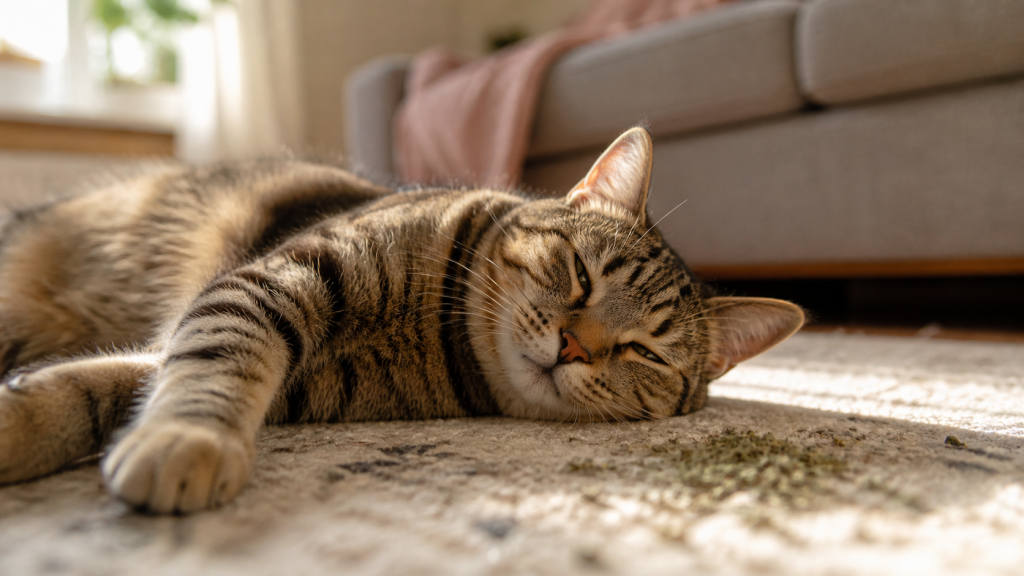
What most cats do is this: they sniff, rub their face on the source, roll around, vocalize, lick or chew the plant, and show short bursts of playful or euphoric behavior. After that initial excitement, many cats settle into a quieter, more relaxed state. Some zone out. Some lie in a loose, comfortable posture. Some just stop moving around as much.
This two-phase pattern is why the answer to “does catnip calm cats” is yes and no at the same time. The calming part often comes after the stimulating part. And for some cats, the stimulating part is all you get.
The Calming Effect Is Real, But Short and Unpredictable
The noticeable effects of catnip typically last about 10 minutes, with most sources putting it in the 5 to 15 minute range. After that, the cat enters a temporary refractory period where it won’t respond to more catnip for roughly 30 to 60 minutes.
This timing matters a lot. Catnip is not an all-day anxiety tool. It’s not a long-lasting sedative. If you’re hoping to keep your cat calm for a two-hour car ride or an entire afternoon of construction noise, catnip alone won’t do that.
What makes this trickier is that individual responses vary widely. The ASPCA notes that catnip makes some cats sedated and others stimulated. You won’t know which category your cat falls into until you try, and that unpredictability is a problem if you’re counting on catnip to manage a real behavior issue. An already overaroused cat could become more reactive, not less.
Not All Cats Respond to Catnip
Different studies give different numbers, but roughly 50 to 80 percent of cats show a noticeable response to catnip. The MSD Veterinary Manual puts it at approximately 50 to 60 percent. A 2017 study of 100 domestic cats found 68 percent responded. Some owner-facing sources cite 70 to 80 percent.
If your cat sniffs catnip and walks away unimpressed, that’s completely normal. It doesn’t mean the product is stale or your cat is unusual. The response appears to be genetically influenced, and kittens under about six months old typically show no reaction because they haven’t reached the relevant stage of brain maturation.
Passive Responses You Might Be Missing
Here’s something I find genuinely interesting: a study published in Behavioral Processes argued that the traditional way we judge catnip response (looking for rolling, rubbing, and active play) may miss a large group of cats who respond passively. In that study, about 80 percent of cats showed passive responses like a sphinx-like posture, reduced vocalization, and decreased motor activity, while only about 20 percent showed the classic active rolling behavior.
This means your cat might actually be responding to catnip by getting quieter, and you might be interpreting that as “nothing happened.” It also means a cat that seems calmer after catnip might actually be affected, showing a genuine passive response.
I wouldn’t stretch this into “all cats are secretly calmed by catnip,” because one study with specific conditions doesn’t prove that. But it’s worth noticing if your cat becomes still and quiet after catnip rather than rolling around wildly.
Sniffing vs. Eating Aren’t the Same
The classic catnip response is driven by smell, not digestion. When your cat sniffs catnip, that’s what triggers the behavioral change through those nasal-brain pathways.
Some cats do eat catnip, especially fresh leaves. Eating small amounts is generally considered safe, and some sources suggest that ingesting catnip tends to produce a more mellowing effect compared to sniffing. But the evidence for using eaten catnip as a reliable calming tool isn’t strong enough to recommend it as a strategy.
I’d frame it this way: the best-supported use of catnip is as controlled olfactory enrichment (letting your cat smell it), not as a dietary supplement or treat. If your cat nibbles some, that’s usually fine. But “feed catnip to calm your cat” isn’t advice I’d feel comfortable giving.
When Catnip Is Actually Useful
Catnip works best as an enrichment tool rather than a treatment for anything. Here’s where it genuinely helps:
- Making scratching posts more attractive. Rubbing dried catnip on a new scratcher can encourage a cat to use it instead of your furniture.
- Increasing interest in toys. A catnip-stuffed toy or a sprinkle of dried catnip can make a boring toy exciting again.
- Helping a cat engage with a new space. A bit of catnip on new bedding or a carrier can make unfamiliar things smell interesting rather than threatening.
- Providing mental stimulation. For indoor cats especially, catnip offers a brief sensory experience that breaks up monotony.
The key mindset shift is this: catnip doesn’t stop bad behavior. It redirects interest toward something acceptable. A cat that scratches furniture needs appropriate scratching options in multiple locations. Catnip just makes those options more appealing.
Catnip for Hyper Cats Isn’t That Simple
If your cat runs around at 3 a.m., bites during play, or has seemingly endless energy, catnip might help only if the underlying problem is boredom or a lack of appropriate outlets.
A hyper cat usually needs structured interactive play that mimics hunting sequences, feeding enrichment, vertical space for climbing, scratching surfaces, hiding spots, and predictable daily routines. Professional feline behavior guidelines recommend play that lets cats express parts of the predatory sequence (stalk, chase, pounce, catch), rotating toys to prevent boredom, and never using hands or feet as play targets.
Catnip can make a play session more engaging, but it doesn’t replace the play session itself. And if you give catnip to a cat that’s already overstimulated, you might just amplify the chaos for 10 minutes before the cat crashes.
Catnip for Anxious or Fearful Cats
This is where I’d be more cautious. If your cat is already showing fear signs (hiding, hissing, crouching, dilated pupils, rapid breathing, or avoiding people), adding catnip to the situation is unpredictable. Some cats might relax. Others might become more hyperactive or reactive.
A fearful cat needs perceived safety first: hiding spots, climbing surfaces, separate resources, predictable interactions, and reduced stressors. Forcing catnip, toys, or social contact on a scared cat doesn’t help and can make things worse.
If you want to offer catnip to an anxious cat, offer it as a choice. Leave a small amount in an area the cat already feels comfortable, and let the cat approach on its own terms. Don’t put it in the carrier right before a vet visit unless you already know how your specific cat responds.
Multi-Cat Households Need Extra Thought
In homes with multiple cats, a single catnip toy can become a high-value resource that one cat guards or that triggers competition. This is especially true if resources are already limited or if there’s existing tension between cats.
The safer approach is to provide separate catnip toys or scratchers in different locations, so no cat needs to compete for access. Watch for signs of tension: staring, blocking pathways, swatting, chasing, or one cat consistently monopolizing the catnip item while others avoid the area.
Don’t assume a single catnip mouse tossed into the living room is harmless enrichment for every household dynamic.
What’s Normal and What’s Concerning
Catnip is widely used and generally considered low-risk in small, controlled amounts. It’s not addictive, and it’s not related to marijuana or other recreational drugs despite the internet jokes. It causes a short-lived, smell-triggered behavioral response, not intoxication in the human sense.
That said, “natural” doesn’t mean unlimited or consequence-free.
Normal Catnip Behavior
Rolling, rubbing the face or body on the source, sniffing intensely, licking or chewing the plant, short vocalizations, brief playful bursts, drooling (in some cats), relaxed lying down, or a quiet sphinx-like posture. These are all within the typical range.
Signs That Something Is Wrong
Persistent vomiting or diarrhea, severe lethargy, wobbly or unsteady walking, breathing difficulty, seizures, repeated drooling with visible distress, or collapse. These are not normal catnip effects and should not be dismissed as “just the catnip working.”
Too much catnip can cause vomiting, diarrhea, dizziness, or trouble walking. If your cat eats a large amount and develops digestive upset, remove the catnip and monitor closely. If symptoms are severe or don’t resolve, contact your veterinarian.
Avoid Concentrated Catnip Oils
There’s an important distinction between dried catnip (or a catnip-stuffed toy) and concentrated catnip essential oils. Cats are especially sensitive to essential oils partly because of enzyme deficiencies that affect how they metabolize certain compounds, and because grooming increases both oral and skin exposure.
Highly concentrated catnip oils are more potent and carry more risk than dried plant material. Don’t apply concentrated oils directly to your cat, and don’t use catnip essential oil diffusers as a “calming aromatherapy” strategy. Stick to dried catnip, fresh leaves, or commercially made catnip toys.
When to Skip the Catnip and Call a Vet
Catnip is enrichment, not treatment. If your cat is showing signs of chronic anxiety, recurring aggression, house soiling, pain-related behavior changes, sudden appetite loss, or any of the emergency signs listed above, catnip isn’t the answer.
Specifically, contact a veterinarian if your cat:
- Hides more than usual or avoids interaction
- Has stopped eating or changed litter box habits
- Shows sudden aggression or major behavior changes
- Has vomiting, diarrhea, unsteady movement, seizures, or breathing difficulty (whether or not catnip was involved)
These situations need professional assessment, not more enrichment experiments at home.
What to Try If Your Cat Doesn’t Respond to Catnip
If catnip does nothing for your cat, alternatives exist. A 2017 study testing 100 cats found that silver vine produced a response in 79 percent of cats (the highest of any plant tested), compared to 68 percent for catnip, 53 percent for Tatarian honeysuckle, and 47 percent for valerian root. Among cats that didn’t respond to catnip specifically, almost 75 percent still responded to silver vine.
These alternatives can be stimulating or calming depending on the individual cat, just like catnip. None of them are guaranteed sedatives. But if you’re looking for enrichment options and catnip isn’t working, silver vine is probably the next thing worth trying.
Practical Tips for Using Catnip Well
- Start with a small amount and observe your cat’s individual response before relying on it for any purpose.
- Store dried catnip in an airtight container to preserve potency.
- Fresh catnip may be stronger than dried, so use less.
- Offer it as a choice. Let your cat approach rather than pushing it in their face.
- Remove it if your cat becomes aggressive, overstimulated, or seems distressed.
- Don’t use it as your sole strategy for managing boredom, hyperactivity, or anxiety.
- Replace catnip toys when they lose their scent and become stale.
- Keep concentrated oils away from your cat entirely.
The Bottom Line
Catnip can calm some cats, but calling it a “calming aid” oversimplifies what’s actually happening. Most cats get excited first, and some settle into relaxation afterward. The effect is short (about 10 minutes), individual, and not something you can count on for managing real stress or anxiety.
For me, the safer way to think about catnip is as a choice-based enrichment tool. It’s something you offer, observe, and adjust based on your specific cat’s response. It’s one small piece of a larger picture that includes play, safe spaces, routine, appropriate resources, and veterinary care when something isn’t right.
If your cat enjoys catnip and relaxes afterward, that’s a nice bonus. If it doesn’t work or makes things worse, that’s also normal, and it’s worth exploring other approaches instead of increasing the dose.
References
- Cats Protection: Why Do Cats Go Crazy for Catnip — supports information on effects duration, age factors, safety, and scratching post use.
- Small Door Veterinary: Catnip — supports information on the excitement-to-relaxation pattern, safety, storage, and the distinction from marijuana.
- PetMD: What Is Catnip — supports timing estimates, overconsumption risks, storage, and avoidance of concentrated oils.
- MSD Veterinary Manual: Behavior of Cats — supports response rate data, essential oil sensitivity, and environmental enrichment guidance.
- Behavioral Processes (2017): Catnip Response Study — supports passive vs. active response findings and age-related factors.
- BMC Veterinary Research (2017): Plant Alternatives Study — supports response rate comparisons between catnip, silver vine, Tatarian honeysuckle, and valerian root.
- Cornell Feline Health Center: Poisons — supports red-flag poisoning signs requiring emergency care.
- CatVets: Setting Up for Success — supports environmental safety guidance for fearful and anxious cats.