
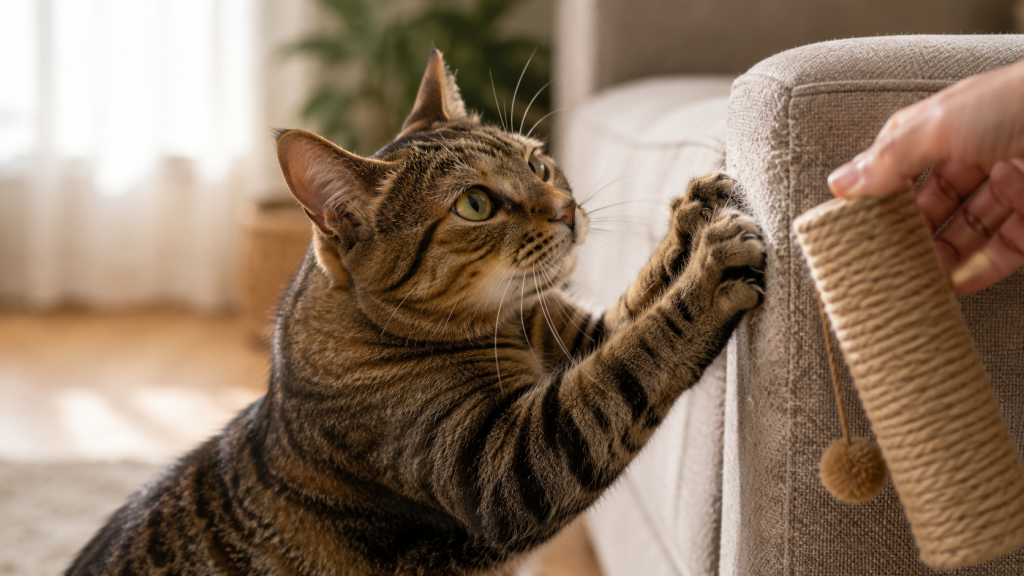
When a cat scratches the sofa, bites your hand, yowls at 4 a.m., or jumps on the counter right after you said no, it is easy to feel like you need firmer discipline. I understand that impulse. You are not trying to be harsh. You just want the behavior to stop.
The safer answer is this: disciplining a cat should mean changing behavior, not punishing the cat. Cats can learn from consequences, but punishment from people is often too late, too confusing, or too scary to teach the lesson we meant to teach.
For me, the most useful way to think about cat discipline is simple: stop the unwanted behavior from paying off, give the cat a better option, reward that option quickly, and fix the setup that made the problem easy in the first place.
The Short Answer Is Redirect, Reward, and Prevent
To discipline a cat safely, interrupt only when needed, redirect immediately, reward the behavior you want, and change the environment so the old behavior stops working. That is behavior modification in plain language.
A cat scratching furniture, climbing counters, biting during play, or meowing for food is usually not being spiteful. The behavior is doing something for the cat. It may provide attention, food, play, height, scent marking, stress relief, or escape from something uncomfortable.
Your job is not to convince the cat that the behavior is morally wrong. Your job is to make the right behavior easier and more rewarding. That might mean a scratching post near the sofa, a perch near the kitchen, scheduled play before bedtime, a quiet moment before feeding, or a cleaner, safer litter box setup.
Timing matters. Rewards work best when they happen almost immediately, ideally within a few seconds, so the cat can connect the reward to the behavior. If your cat scratches the post and gets a treat much later in another room, the lesson may be lost.
Why Punishment Usually Backfires With Cats
Punishment can stop what you see in the moment, but it often teaches the wrong lesson. A cat sprayed for jumping on the counter may learn not to jump up when you are watching. The food, height, curiosity, or attention that made the counter interesting may still be there.
The bigger risk is fear. Yelling, hitting, tapping, chasing, or spraying can make a cat anxious around you, afraid of hands, or more defensive. In some cats, punishment can increase aggression. In others, it simply makes the cat hide the behavior.
There is also a timing problem. For punishment to be clear, it has to happen right as the behavior happens. Real life rarely works that way. You find the scratched chair ten minutes later, or you yell after the cat has already jumped down. By then, your cat may only connect your anger with your presence.
I would avoid any method that relies on fear, pain, or startling the cat. Even if it seems to work once, the cost to trust is not worth it.
First, Ask What the Behavior Is Doing for the Cat
The fastest way to make progress is to identify the payoff. Cats repeat behavior that works. If biting gets play, meowing gets breakfast, counter-surfing finds food, or scratching leaves scent on a central piece of furniture, the behavior has a reason.
Look at two things: what happens before the behavior, and what happens after. Before might be boredom, food left out, no scratcher nearby, a closed bedroom door, a tense multi-cat hallway, or an outdoor cat visible through a window. After might be attention, food, access, play, or relief from stress.
Once you see the pattern, discipline becomes much less emotional. You remove the payoff, block rehearsal when possible, and reward a replacement behavior the cat can actually do.
A Practical Four-Step Plan
1. Prevent the behavior when you cannot supervise
Prevention is not giving up. It is how you stop the cat from practicing the habit. If food is left on the counter, the counter keeps paying. If the sofa is the only satisfying scratching surface, the sofa keeps winning.
Use simple management: put food away, close a door, cover a tempting surface, block access temporarily, clean scent-marked areas properly, or move resources so the cat does not feel trapped. Prevention is especially useful while you are teaching the replacement behavior.
2. Remove the reward
If meowing brings food, wait for quiet before feeding. If pawing at a door gets you to rush over, your attention may be part of the reward. If rough biting turns into a wrestling match, the cat may read that as play.
This part can feel hard because behavior may briefly get more intense when the old reward disappears. Stay consistent, but do not ignore genuine needs, pain, fear, hunger, or medical changes. I would never treat a sudden behavior change as stubbornness.
3. Redirect to a better behavior
Redirection means giving the cat an acceptable outlet right away. A cat chewing your hand during play can be redirected to a wand toy or kicker toy. A cat scratching the sofa can be guided toward a scratcher placed next to that sofa. A cat climbing counters may need an allowed high perch nearby.
Redirection works best when the alternative meets the same need. A tiny, wobbly post will not replace a sturdy sofa arm for a cat that loves vertical scratching. A toy tossed once may not satisfy a young cat with a big play drive.
4. Reward fast
Reward the behavior you want within a few seconds. Use something your cat actually values, such as a favorite treat, play, gentle attention, or access to something appropriate. The reward has to matter to that individual cat.
A clicker can help mark the exact moment, but it is not required. The important part is precision. Mark the good behavior, then reward it. Do not wait until the cat has wandered away and done three other things.
How to Discipline a Cat for Scratching Furniture
You do not discipline scratching out of a cat. You redirect it. Scratching is normal feline behavior. Cats scratch to mark, stretch, maintain claws, and leave scent from glands in their paws.
Start by observing what your cat already likes. Does your cat scratch vertical sofa arms, horizontal rugs, rough fabric, cardboard, carpet, or wood? Match the scratcher to the preference instead of buying what looks best to you.
Place the scratcher near the forbidden target at first. If the sofa is the favorite spot, a scratcher across the room is asking too much. Make the sofa less rewarding while the new post becomes rewarding. You can protect the furniture, limit access when unsupervised, and reward the cat immediately for using the post.
Do not scold after the fact. Your cat will not connect your anger with the earlier scratch marks. Reward the right surface, make the wrong surface less satisfying, and be patient while the habit shifts.
How to Handle Biting and Rough Play
For play biting, stop using hands and feet as toys, redirect to appropriate toys, and withdraw attention when teeth or claws hit skin. Rough play is common in kittens and young cats, but it becomes a problem when people become the target.
Young cats often need to chase, pounce, grab, and wrestle. Give them toys that allow those behaviors without using your body. Wand toys, chase games, and toys they can kick are safer outlets than fingers.
When play gets too rough, go still, end the game calmly, and restart later with a toy. Everyone in the home needs the same rule. If one person wrestles with hands and another person tries to ban biting, the cat gets mixed signals.
Do not tap, flick, hit, or yell. Those reactions can make hands scary, or they can make the interaction more exciting. Neither helps the cat learn gentle play.
How to Stop Counter-Surfing
Counter-surfing improves when the counter stops paying and the cat gets a better place to climb. Cats may jump up because of food smells, height, water, curiosity, or your reaction.
Remove food, secure trash, clean surfaces, and block access when you cannot supervise. If the counter is the only interesting high place in the room, offer an acceptable perch nearby. Reward the cat for using that instead.
Mild environmental management can help, but I would be careful with anything meant to scare the cat. The goal is not to make the kitchen feel dangerous. The goal is to make the wrong choice boring and the right choice worthwhile.
How to Respond to Excessive Meowing
First, check the reason. A cat may meow because of hunger, boredom, anxiety, pain, confusion, or a learned attention pattern. Sudden or unusual vocalizing deserves more caution than a predictable dinner routine.
If needs and health concerns have been addressed, attention can reinforce meowing. Feeding, yelling, talking, or rushing over may all keep the pattern going. The better plan is to reward quiet moments before the noise starts or after the cat has settled.
This is easiest when you teach the routine outside the crisis moment. For example, reward quiet sitting before meals, not frantic meowing at the food bin. If you wait until the cat screams, then pause for one second of silence and feed every time, you may still be rewarding the whole demand sequence.
Litter Box Problems Are Not Discipline Problems
Do not punish a cat for peeing or pooping outside the litter box. House soiling can involve medical problems, litter box aversion, surface preference, location problems, stress, mobility issues, or cognitive changes in older cats.
This is where I would stop guessing sooner rather than later. If urination or defecation is painful, urgent, or difficult, the cat may start avoiding the box because the box has become associated with discomfort.
Call a veterinarian if your cat repeatedly enters the box and produces only small amounts of urine, cries, strains, seems tender around the abdomen, or suddenly changes litter box habits. A blockage or serious urinary problem can be urgent.
For the environment, use enough boxes, usually one per cat plus one extra. Put them in accessible places where the cat cannot be trapped. Scoop daily, try unscented litter if scent may be an issue, clean accidents with an enzymatic cleaner, and consider low-sided boxes for older cats, very young cats, or cats with physical limitations.
Do not rub a cat’s nose in urine or feces. Do not drag the cat to the box, scold, or confine the cat for long periods without addressing the cause. That adds stress without solving the problem.
Aggression Needs Safety, Not Stronger Discipline
Aggression is not the place to escalate punishment. Sudden aggression, aggression during touch, escalating bites, or a cat that seems painful or unusually reactive should be discussed with a veterinarian. Medical issues can contribute to aggressive behavior.
Watch body language. Flattened ears, dilated pupils, raised hair, an arched back, a tucked tail, crouching, tail lashing, or whiskers pressed down can mean the cat is fearful, aroused, or ready to defend itself. Do not reach in to comfort, grab, punish, or prove dominance.
Petting-induced aggression can feel personal, but it often means the cat is overstimulated or wants the contact to stop. Shorten petting sessions, watch for early signals, and stop before the cat has to bite. Reward calm tolerance rather than restraining the cat.
Redirected aggression is especially risky. A cat may see another cat outside, hear a frightening noise, or become highly aroused, then lash out at whoever is nearby. That is a safety issue, not disobedience. Give space, reduce triggers when you can, and do not handle the cat with bare hands during a fight or high-arousal moment.
Cat bites and scratches can become infected. Clean wounds thoroughly and consult a physician if you are bitten or scratched seriously.
When Multi-Cat Homes Create Resource Stress
In multi-cat homes, unwanted behavior may come from tension rather than defiance. Cats do not automatically want feline roommates, and non-bonded cats sharing limited space can feel stressed.
The tricky part is that conflict is not always obvious. One cat may block a hallway, stare from a doorway, guard the litter box area, or quietly control access to food and resting spots. You may only see the result: spraying, hiding, chasing, litter box avoidance, or sudden fights.
Spread resources out. Offer food, water, litter boxes, scratching areas, resting places, safe hiding spots, and play opportunities in more than one location. In some homes, visual barriers help because cats can move without feeling watched or trapped.
If outdoor cats trigger your indoor cats through windows, block that view where needed. Removing the trigger may do more than any discipline ever could.
What Not to Do When Disciplining a Cat
Some common methods feel satisfying to humans because they create an immediate reaction. That does not mean they teach well.
- Do not hit, tap, flick, chase, or pin your cat.
- Do not yell as a main training method.
- Do not rub your cat’s nose in accidents.
- Do not punish after you find damage later.
- Do not use hands or feet as toys, then expect no biting.
- Do not grab fighting or highly aroused cats with bare hands.
- Do not treat sudden aggression or litter box changes as attitude.
If you need to interrupt for safety, use the calmest option available, then redirect. After that, fix the setup. The best discipline plan is usually quiet and boring from the outside, but very clear to the cat.
When to Contact a Veterinarian
Contact a veterinarian when the behavior is sudden, intense, painful-looking, or connected to eating, drinking, urination, defecation, mobility, touch sensitivity, confusion, or aggression. Behavior can be the first thing owners notice when a cat is uncomfortable.
I would be especially cautious with litter box changes, repeated straining, small amounts of urine, crying in the box, sudden aggression, aggression when touched, or an older cat who suddenly cannot manage a box or perch they used before.
A veterinary behaviorist or qualified behavior professional may also be needed for serious aggression, repeated fighting, severe fear, or problems that do not improve with safe environmental changes. Stronger punishment is not the next step.
What to Remember
The best way to discipline a cat is to stop thinking in terms of punishment and start thinking in terms of learning. Prevent the unwanted behavior, remove the payoff, reward the behavior you want, and give your cat outlets for normal feline needs.
Scratching, climbing, pouncing, hiding, marking, and setting limits around touch are normal cat behaviors. Your task is to make them work inside a human home.
If the behavior is sudden, aggressive, painful-looking, or related to the litter box, pause the training plan and call a veterinarian. A cat cannot be trained out of a medical problem.
References
- AAFP Positive Reinforcement Guide — timing, rewards, positive reinforcement, meowing example.
- AVSAB Position Statement on Punishment — risks of punishment, timing problems, behavior modification principles.
- Merck Veterinary Manual: Behavior Problems of Cats — punishment concerns, environmental management, deterrent cautions.
- AAFP/ISFM Environmental Needs Guidelines — normal feline needs, enrichment, resources, environment-related behavior.
- Cornell Feline Health Center: Destructive Behavior — scratching as normal marking and claw behavior.
- ASPCA: Litter Box Problems — medical red flags, litter box setup, what not to do.
- ASPCA: Aggression in Cats — aggression types, body language, safety cautions.
- 2024 AAFP Intercat Tension Guidelines — multi-cat tension, resource distribution, indoor household stress.