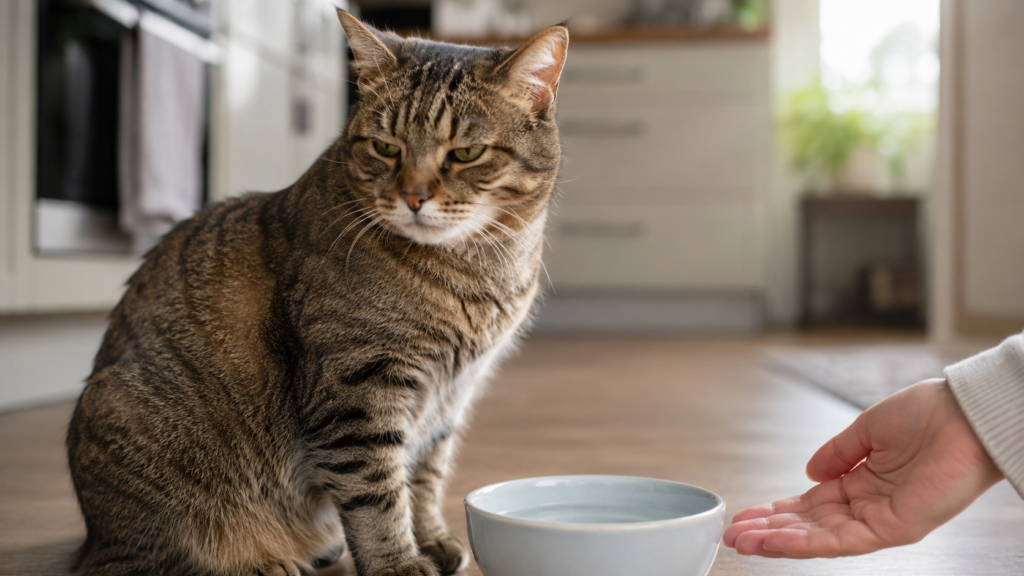
If your cat has not touched their water bowl all day, it is hard not to worry. Cats are quiet about discomfort, and drinking habits can be difficult to judge, especially if your cat eats wet food or shares water bowls with other pets.
The safest answer is this: a cat should not go without water, and you should not wait several days to see what happens. Some sources mention that cats may survive only a few days without water, but dehydration can start much earlier. If your cat has not drunk anything for more than 24 hours, or if they are also vomiting, having diarrhea, refusing food, hiding, weak, or acting unlike themselves, it is safer to contact a veterinarian.
I would not treat this as a survival countdown. A better question is: “Is my cat getting enough fluid today, and are there signs that something is wrong?”
How Long Can a Cat Safely Go Without Water?
A healthy adult cat should have access to fresh water every day. If a cat truly has no water intake at all, that can become concerning within 24 hours, even though survival may take longer in some cases.
This is where a lot of generic advice becomes risky. You may see claims that cats can survive two, three, or four days without water. That may describe a possible survival window in some cases, but it does not mean the cat is safe, comfortable, or only mildly affected during that time.
Cats can become dehydrated before the situation looks dramatic. By the time you see tacky gums, sunken eyes, weakness, or skin that does not spring back normally, the cat may already need veterinary help.
So for a real cat owner at home, I’d use this practical rule: if your cat has not drunk for about a day, or you are not sure they are getting fluid from food, call your vet for advice. If there are signs of illness, do not wait for the 24-hour mark.
Not Drinking From the Bowl Is Not Always the Same as No Water Intake
This is the detail that makes the question more complicated. Some cats barely seem to drink because they get much of their moisture from wet food.
Canned or wet cat food contains far more water than dry food. Dry food contains very little moisture, so a cat eating mostly kibble usually needs to drink more from a bowl. A cat eating mostly wet food may drink less visibly because food is doing part of the hydration work.
That means “my cat never drinks” can mean two very different things. A wet-food cat that is eating normally, peeing normally, and acting bright may simply not need many long water-bowl visits. A dry-food cat that has stopped drinking, or a sick cat that is not eating wet food either, is a different situation.
The question is not only, “Did I see my cat drink?” It is also, “Is my cat eating, peeing, behaving normally, and getting moisture somewhere?”
How Much Water Does a Cat Usually Need?
There is no perfect number for every cat, but a common practical estimate is about 4 ounces of water per 5 pounds of body weight per day. A 10-pound cat may need around 8 ounces daily from food and drinking combined.
Other veterinary nutrition references give water needs in a similar range by body weight, but the number still depends on diet, temperature, health, and activity. A cat eating dry food in hot weather may need more free water than a cat eating wet food indoors in a cool room.
This is why I would be careful with rigid water targets. They can help you understand the scale, but they do not replace watching your cat’s normal pattern.
If your cat usually drinks from the bowl several times a day and suddenly stops, that change matters. If your cat usually makes medium-sized urine clumps and suddenly produces tiny clumps, no clumps, or much larger clumps, that also matters.
Signs Your Cat May Be Dehydrated
Possible signs of dehydration include dry or tacky gums, sunken-looking eyes, low energy, weakness, poor appetite, and skin that does not quickly return to place when gently lifted over the shoulders.
The skin test is commonly mentioned, but it is not perfect. Older cats may naturally have looser skin, and very young kittens can be harder to assess this way. A normal-looking skin test also does not prove your cat is fine.
I would look at the whole picture instead of one sign. Is your cat eating? Are they keeping food and water down? Are they using the litter box normally? Are they alert? Do their gums feel moist rather than sticky? Are they acting like their usual self?
If the answer to several of those questions is no, it is time to stop guessing.
When Not Drinking Becomes an Urgent Problem
A cat that is not drinking needs veterinary advice sooner if there are other symptoms. Vomiting and diarrhea are especially important because the cat is losing fluid while also not replacing it.
Contact a veterinarian promptly if your cat is not drinking and also has repeated vomiting, diarrhea, lethargy, weakness, collapse, pale or tacky gums, sunken eyes, refusal to eat, or major behavior changes.
You should also be more cautious if your cat is a kitten, a senior, has kidney disease, diabetes, hyperthyroidism, heart disease, or is on medication that affects fluid balance.
If your cat is straining to urinate, crying in the litter box, visiting the box repeatedly, or producing little or no urine, treat that as an emergency. That is not just a water issue. A urinary blockage can become life-threatening quickly, especially in male cats.
Why Cats May Stop Drinking
A cat may stop drinking because they feel sick, weak, nauseated, stressed, painful, or unable to access water comfortably. Sometimes the water setup is the problem. Sometimes the drinking change is a sign of illness.
Common practical causes include a dirty bowl, stale water, a bowl placed too close to the litter box, competition in a multi-cat home, or a bowl shape the cat dislikes. Some cats avoid deep or narrow bowls if their whiskers touch the sides too much.
But I would not assume the bowl is the only issue if the change is sudden. Medical problems can affect thirst, appetite, urination, and hydration. Kidney disease, diabetes, hyperthyroidism, vomiting, diarrhea, dental pain, and general illness can all change how much a cat drinks or how much fluid they lose.
Dental pain is easy to miss. A cat with mouth pain may drool, chew oddly, drop food, avoid hard food, turn their head while eating, or become irritable. If drinking or eating seems uncomfortable, that deserves a vet’s attention.
Why Some Cats Drink More, Not Less
A cat drinking much more than usual can also be a warning sign. This may seem like the opposite of the keyword, but it matters because owners often notice water changes in either direction.
If the bowl is suddenly empty every day, or the litter box has much larger urine clumps, the cat may be losing more water through urine and drinking to compensate. Conditions such as diabetes, kidney disease, and hyperthyroidism can cause increased thirst and urination.
Do not restrict water to “test” this. If your cat is drinking more than usual, let them drink and book a veterinary check. The pattern itself is useful information.
Kittens, Senior Cats, and Sick Cats Have Less Room for Waiting
Kittens are more vulnerable than healthy adult cats. They have smaller reserves and can weaken faster if they are not eating or drinking properly. Very young kittens who are still nursing need frequent milk intake, not just water, and suspected dehydration in kittens should be taken seriously.
Senior cats also deserve extra caution. Many cats develop age-related health changes from around 7 to 10 years old, and by 12 many have some physical changes. Older cats are more likely to have kidney disease, dental disease, arthritis, thyroid disease, diabetes, or other problems that can affect water intake and hydration.
Sick cats need a shorter safety window too. A cat with chronic kidney disease, for example, may need careful hydration support because dehydration can worsen how they feel and add strain to the body. If a cat with known kidney disease stops drinking, stops eating, vomits, or becomes lethargic, I would not watch and wait.
Indoor, Outdoor, and Multi-Cat Water Problems
Indoor cats are usually easier to monitor because you can see the bowl, the food, and the litter box. Still, even indoors, water intake can be hard to measure if several pets share bowls.
In a multi-cat home, one cat may block another from a water station without obvious fighting. A nervous cat may avoid a bowl in a busy hallway, near a litter box, or close to where another cat rests. This can look like pickiness when it is really an access problem.
Outdoor cats are harder. They may drink from puddles, ponds, neighbors’ bowls, or other sources you never see. That does not mean outdoor drinking is ideal or safe, but it does mean the home bowl may not tell the whole story.
If you are worried about one specific cat, separate observation helps. Watch their food intake, check their litter box output if possible, and offer water in a quiet place where other pets cannot interfere.
Safe Ways to Encourage a Cat to Drink More
If your cat is otherwise normal, eating, peeing, and acting well, you can make hydration easier at home.
Offer fresh water every day and wash bowls regularly. Place water away from the litter box and away from loud, busy areas. Try more than one water station, especially in a larger home or multi-cat household.
Some cats prefer wide, shallow bowls. Some prefer ceramic, glass, or stainless steel. Some like water filled closer to the top so they do not have to push their face deep into the bowl.
Wet food can also increase total moisture intake. If your cat eats dry food, some owners add water gradually to kibble, but do not let your cat go without food just because they reject moistened kibble. Cats can be stubborn about texture, and food refusal creates a different health concern.
A cat fountain may help some cats, especially those attracted to moving water. But fountains are not magic. Research on whether fountains significantly increase water intake is mixed, so think of a fountain as one tool, not a cure for dehydration or illness.
What Not to Do If Your Cat Will Not Drink
Do not force water into your cat’s mouth if they are weak, vomiting, resisting, or acting sick. This can create stress and may make the situation worse. If a cat cannot or will not drink, that is a reason to call a veterinarian, not a reason to push harder at home.
Do not wait several days because an article says cats can survive that long. Survival is not the same as safety.
Do not assume dehydration is the only issue. A cat that stops drinking may have nausea, pain, dental disease, fever, urinary trouble, kidney disease, diabetes, hyperthyroidism, stress, or another problem that needs proper care.
Do not remove water if your cat is drinking more than usual. Increased thirst can be a sign of illness, but the cat still needs access to water.
A Practical Way to Judge the Situation Today
If your cat has not drunk from the bowl but is eating wet food, acting normal, and using the litter box normally, monitor closely and make water easier to access. Check whether they are getting moisture from food before assuming they have had no fluid.
If your cat eats mostly dry food and has not drunk for a day, I would contact a vet for guidance, especially if this is unusual for them.
If your cat is not drinking and also not eating, vomiting, having diarrhea, hiding, weak, drooling, acting painful, or producing abnormal urine, treat it as a veterinary concern.
If your cat is a kitten, senior, chronically ill, overheated, or has known kidney or urinary problems, be more cautious. These cats have less room for delay.
Final Thoughts
A cat should not go without water. The practical danger point is not “how many days until a cat cannot survive,” but how quickly dehydration or illness could become serious for the cat in front of you.
If your cat simply drinks less because they eat wet food and otherwise seem normal, that may not be alarming. If they truly are not taking in fluid, or if their behavior, appetite, vomiting, diarrhea, gums, eyes, energy, or litter box habits look wrong, contact a veterinarian.
For me, the safer way to think about it is simple: low visible drinking can be normal, but a sudden change plus illness signs is not something to wait out.
References
- Cats Protection: How long can cats go without food? — supports the 24-hour concern threshold for cats not drinking and higher-risk signs such as vomiting, diarrhea, and lethargy.
- MSD Veterinary Manual: Nutritional Requirements of Small Animals — supports general water requirement ranges and moisture differences between dry and canned pet foods.
- Cornell Feline Health Center: Hydration — supports dehydration signs, causes of reduced intake, disease-related water loss, and access issues in multi-cat homes.
- VCA: Tips to Encourage Cats to Drink More Water — supports practical hydration estimates and safe ways to encourage drinking.
- VCA: Emergencies in Cats — supports urgency around vomiting, diarrhea, weakness, and not forcing food or water during illness.
- Cornell Feline Health Center: Feline Lower Urinary Tract Disease — supports the warning that urinary blockage is a medical emergency.
- Cornell Feline Health Center: Chronic Kidney Disease — supports hydration concerns in cats with kidney disease.
- British Journal of Nutrition: Effect of dietary water intake on urinary output in cats — supports the relationship between high-moisture diets, total fluid intake, urine volume, and urine dilution.