
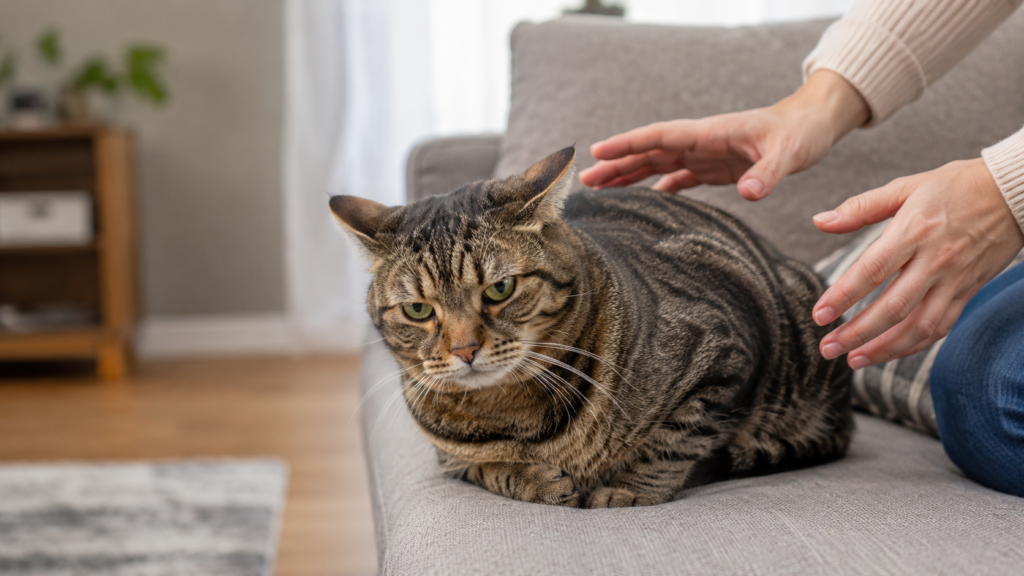
A cat in pain does not always cry, limp, or make the problem obvious. That is what makes this question so stressful. You may only notice that your cat is quieter than usual, hiding under the bed, skipping a favorite windowsill, eating strangely, or acting “off” in a way you cannot quite explain.
The safer way to think about feline pain is not, “Does my cat show one perfect pain sign?” It is, “Has my cat’s normal behavior changed?” Cats often show pain through small shifts in movement, appetite, grooming, litter box habits, posture, sleep, and social behavior. One mild change does not always mean an emergency, but a new pattern, a worsening change, or several signs together deserves attention.
I’d be especially cautious if the change affects eating, urination, breathing, walking, jumping, grooming, or how your cat reacts to being touched. Those are not just personality details. They are daily functions, and when they change, pain or illness may be part of the reason.
Signs Your Cat May Be in Pain
A cat may be in pain if they are hiding more, eating less, moving less, sleeping in unusual places, grooming poorly, over-licking one area, avoiding jumps or stairs, limping, sitting hunched, growling when touched, using the litter box differently, or acting unusually withdrawn or irritable.
The tricky part is that none of these signs proves pain by itself. A cat can hide because of fear, stress, illness, or pain. A cat can eat less because of nausea, dental pain, fever, or many other problems. What matters most is the change from your cat’s normal baseline.
A normally social cat who suddenly avoids people is more concerning than a shy cat who has always liked quiet corners. A senior cat who slowly stops jumping onto the bed may be showing chronic discomfort. A young cat who suddenly crouches, cries in the litter box, and produces little or no urine needs urgent veterinary care.
Pain signs are often easier to notice when you look at function. Ask yourself: Is my cat eating normally? Moving normally? Grooming normally? Resting comfortably? Using the litter box normally? Interacting normally? If several answers have changed, I would stop guessing and call a vet.
Why Cats Hide Pain So Well
Cats are good at hiding pain because obvious weakness can make an animal more vulnerable. Even in a safe home, that instinct can still shape how a cat behaves when something hurts.
This is why a painful cat may become still instead of dramatic. They may curl up in a quiet room, avoid being handled, stop jumping, or sleep more. To an owner, that can look like calm behavior, aging, or moodiness. In reality, it can be a cat trying not to move because movement hurts.
This is also why your observations at home matter. A veterinarian may not see your cat jump, eat, climb, play, groom, or use the litter box during an appointment. You see those patterns every day. Short videos of your cat walking, hesitating before a jump, climbing stairs, eating, or trying to use the litter box can help your vet understand what has changed.
The most useful clue is often not one dramatic symptom. It is the difference between “my cat has always done this” and “my cat started doing this recently.”
Changes in Movement Are Often a Big Clue
Pain often shows up in the way a cat moves, especially when joints, muscles, paws, the back, the hips, or injuries are involved. Many owners look for limping first, but cats with pain do not always limp clearly.
A cat with discomfort may avoid jumping onto furniture, hesitate before jumping down, take a lower route to a favorite spot, move stiffly after resting, stop using stairs, or play less. They may still walk, eat, and act fairly normal, which can make the problem easy to dismiss.
This is especially common with chronic joint pain. A cat may no longer leap straight to the counter. Instead, they may use a chair as a step. They may stop sleeping on a high shelf and choose the floor. They may pause before jumping, then decide not to do it. These small decisions can be more revealing than a limp.
For indoor cats, vertical space is part of daily life. If your cat suddenly stops using the cat tree, windowsill, bed, sofa arm, or favorite high perch, that change deserves attention. It may not mean pain for certain, but it is worth tracking closely.
Pain Can Change How a Cat Rests
A comfortable cat usually looks loose and settled. A cat in pain may look tense, tucked, hunched, or guarded. They may sit with their body compact, keep their head low, or lie in a position that seems less relaxed than usual.
Some cats repeatedly get up and lie down again because they cannot get comfortable. Others choose unusual sleeping places, such as a closet, under furniture, behind appliances, or a quiet corner they rarely used before.
Hiding is not automatically a medical emergency, especially if your cat is reacting to a visitor, noise, or stressful event. But hiding becomes more concerning when it is new, persistent, paired with appetite changes, or paired with movement problems, litter box changes, breathing changes, or sensitivity to touch.
For me, the question is not just “Is the cat hiding?” It is “Why is this cat hiding now, and what else changed at the same time?”
Facial Expression Can Help, but It Is Not a Perfect Test
A cat’s face can show pain, especially acute pain. Signs can include narrowed eyes, a tense muzzle, a changed whisker position, a lower head position, and ears held differently than usual.
There is a tool called the Feline Grimace Scale that uses facial features to help assess acute pain. It can be useful because it gives owners and veterinary teams a more structured way to look at a cat’s face instead of relying on vague impressions.
Still, facial expression should not be treated as a home diagnosis. A stressed or frightened cat may also look tense. A cat with chronic pain may not show a dramatic grimace all the time. Lighting, posture, sleepiness, and fear can all affect what you think you are seeing.
Use the face as one piece of the puzzle. If your cat’s expression looks tense and they are also hiding, eating less, moving differently, or reacting badly to touch, that combination is more meaningful than facial expression alone.
Appetite Changes Can Point to Pain or Illness
A painful cat may eat less, eat more slowly, drop food, avoid hard food, chew on one side, drool, walk up to food and then leave, or suddenly prefer softer food. Mouth pain is one possible reason, but appetite changes can also happen with many illnesses.
Dental pain is easy to miss. Cats with painful teeth or gums may still eat enough to seem “fine,” but they may chew awkwardly, turn their head while eating, drool, have bad breath, become irritable, or avoid certain textures. Tooth resorption and periodontal disease can be painful, and owners cannot reliably judge the full problem just by looking at the mouth.
Reduced appetite also matters because cats can become medically worse if they go without enough food. This is especially concerning in overweight cats, which are at higher risk of serious liver problems if they stop eating for several days.
I would not treat “still eating a little” as proof that a cat is okay. A cat who wants food but seems uncomfortable eating, or a cat whose appetite clearly drops, should be taken seriously.
Grooming Changes Can Mean More Than Messy Fur
Pain can make a cat groom less. If bending, twisting, or reaching hurts, your cat may stop grooming the back, hips, belly, or legs properly. You might notice mats, dandruff, greasy fur, or a coat that looks rougher than usual.
Pain can also make a cat lick one area too much. A cat may repeatedly lick a sore paw, painful joint, wound, or irritated area. Over-licking can lead to hair loss or skin irritation, but the licking itself does not tell you the exact cause.
This is where generic advice often gets too simple. Poor grooming does not automatically mean arthritis. Over-grooming does not automatically mean anxiety. Both can have several causes, including pain, stress, skin disease, parasites, or other medical issues.
What matters is the pattern. A cat who stops grooming at the same time they avoid jumping, sleep more, or dislike being touched may be showing discomfort. A cat who suddenly licks one spot intensely may need a check for injury, pain, or skin trouble.
A Painful Cat May Become Irritable, Quiet, or Withdrawn
Pain can change a cat’s mood. A normally friendly cat may avoid petting, hide from people, stop sleeping near you, or become less interested in play. Another cat may hiss, growl, swat, or bite when approached or picked up.
This does not mean the cat is being mean. Defensive behavior can be a way of protecting a painful area. If being lifted, brushed, stroked, or touched suddenly causes a strong reaction, that is useful information for your vet.
Do not keep testing the painful spot to “make sure.” Repeatedly pressing, stretching, or picking up a cat who may be hurt can make the pain worse and can also get you bitten or scratched. Observe the pattern, note where the reaction happens, and contact a veterinarian.
In multi-cat homes, pain can also look like social tension. A painful cat may avoid shared spaces, guard a resting place, become snappy with another pet, or stop competing for food, litter boxes, or favorite sleeping spots. That can be mistaken for a behavior problem when the first question should be medical.
Litter Box Changes Can Be a Pain Warning
Litter box changes are one of the most important pain clues because urinary problems can become urgent. A cat who strains, cries in the box, visits the box repeatedly, passes only small amounts of urine, has blood in the urine, urinates outside the box, or licks the genital area may be in pain.
This is not something to dismiss as spite or bad behavior. Cats do not urinate outside the box to punish you. Pain, stress, bladder inflammation, urinary tract problems, and other medical issues can all change litter box behavior.
A cat who cannot urinate needs emergency veterinary care. This is especially critical in male cats, because a urinary blockage can become life-threatening. Repeated trips to the litter box with little or no urine, crying while trying to urinate, weakness, vomiting, or collapse are not “monitor at home” signs.
The confusing part is that straining to pee can look like constipation to an owner. If you are not sure whether your cat is passing urine, it is safer to treat the situation as urgent and call a vet or emergency clinic.
Pain Does Not Always Sound Like Crying
Some cats vocalize when they are in pain. They may meow more, growl, hiss, yowl, or cry when touched, lifted, eating, moving, or using the litter box.
Other cats become unusually quiet. A silent cat can still be in serious pain. This is why waiting for crying can be risky.
Purring can also confuse owners. Cats often purr when comfortable, but purring does not always mean everything is fine. A cat who is purring while hunched, hiding, refusing food, breathing strangely, or guarding a body part may still need help.
The better question is not “Is my cat making a pain sound?” It is “Has my cat’s voice changed, and what is happening around that change?” A yowl during litter box use is different from a normal greeting meow. A growl when touched is different from ordinary chatting.
Acute Pain vs Chronic Pain
Acute pain comes on suddenly. It may happen after a fall, fight, wound, surgery, dental problem, urinary problem, burn, or sudden illness. A cat with acute pain may hide, guard a body part, limp, resist touch, eat less, vocalize when moved, sit hunched, or seem unable to settle.
Chronic pain develops over time. It may be easier to miss because the changes are gradual. A cat may stop jumping as high, sleep more, play less, groom less, or avoid stairs. Owners often describe this as “slowing down,” especially in older cats.
Aging itself is not a diagnosis. Senior cats may sleep more than younger cats, but a clear loss of normal function should not be brushed off as age alone. If your older cat no longer jumps, climbs, grooms, or uses the litter box comfortably, pain should be on the list of possibilities.
I tend to look at chronic pain through lost habits. What did the cat used to do easily that they now avoid? That question often reveals more than staring at the cat and waiting for an obvious limp.
What Is Normal, and What Is Concerning?
Some behavior changes have simple explanations. A cat may hide during fireworks, sleep more after a stressful vet visit, or avoid a room where a loud noise happened. A single skipped jump may not mean much if the surface was slippery or the cat was startled.
The concern rises when the change is new, repeated, unexplained, worsening, or paired with other signs. A cat who hides once during a thunderstorm is different from a cat who hides every day and eats less. A cat who misses one jump is different from a cat who stops jumping altogether.
Watch for clusters. Appetite change plus hiding is more concerning than hiding alone. Litter box straining plus crying is more concerning than a single accident. Poor grooming plus stiffness plus avoiding stairs points more strongly toward discomfort than one messy patch of fur.
If your cat’s normal daily pattern changes and you cannot explain why, a vet visit is the safer choice. You do not need to know the diagnosis before asking for help.
When to Contact a Veterinarian Quickly
Contact a veterinarian promptly if your cat has a new behavior change that affects eating, movement, urination, defecation, grooming, sleep, social behavior, or touch tolerance. This is especially true if the change lasts, worsens, or appears with more than one sign.
Seek urgent or emergency care if your cat has trouble breathing, open-mouth breathing, collapse, seizures, severe injury, uncontrolled bleeding, suspected poisoning, repeated vomiting or diarrhea, abnormal gum color, eye injury, severe pain, or inability to urinate.
A cat who repeatedly enters the litter box but produces little or no urine should be treated as urgent. A cat who refuses food, becomes very lethargic, or hides and seems weak also needs prompt help.
I would rather call a vet and be told it can wait than assume pain is “just stress” and miss something serious. Cats are too good at hiding problems for owners to rely on obvious drama.
What You Can Safely Do at Home While You Arrange Help
The safest thing you can do at home is observe carefully and reduce stress. Do not force your cat to move, jump, stretch, or let you inspect a painful area. Keep them in a quiet, comfortable space where food, water, bedding, and a litter box are easy to reach.
Take short videos if you can do it without bothering your cat. Useful clips include walking, jumping, using stairs, entering the litter box, eating, grooming, or reacting to touch. Also write down when the change started, what triggers it, whether it is getting worse, and whether your cat is eating, drinking, peeing, and pooping.
For a cat who may have mobility pain, small environmental changes can help while you wait for veterinary advice. A low-sided litter box, soft bedding, ramps, steps, and easier access to favorite resting places may reduce strain. These changes do not diagnose or treat the cause, but they can make daily movement less difficult.
Do not give human pain medicine. Acetaminophen can be fatal to cats, and other pain relievers can also be dangerous without veterinary direction. Do not use leftover pet medication, essential oils, supplements, or home remedies to manage pain unless your veterinarian specifically recommends them for your cat.
What Owners Often Misunderstand About Cat Pain
The biggest mistake is waiting for a cat to cry. Many cats do not cry when they hurt. They hide, move less, eat differently, or stop doing normal things.
Another mistake is assuming litter box problems are behavioral first. Painful urination, urinary blockage, constipation, arthritis, or other medical issues can all change litter box habits. Medical causes should be considered before blaming the cat.
Owners also often label chronic pain as aging. An older cat who no longer jumps, grooms well, plays, or uses stairs may not simply be “lazy.” They may be adapting to discomfort.
One more mistake is trying to prove pain at home by touching or pressing the sore area. That can hurt the cat and make them more defensive. Careful observation is more useful than repeated testing.
A Practical Way to Check Your Cat’s Pain Clues
When something feels off, compare your cat with their normal daily life. Look at movement, appetite, grooming, litter box habits, posture, sleep, voice, and social behavior.
A cat who is still eating, walking, and purring can still be in pain. A cat who hides may be stressed, sick, or painful. A cat who suddenly bites when picked up may be protecting a sore area. The signs are not always specific, so the pattern matters.
If the change is mild and brief, you can monitor closely while staying ready to call your vet. If the change affects basic functions, keeps happening, gets worse, or appears with red flags, do not wait for a clearer sign.
Pain in cats is often quiet. The most useful thing you can do is notice the quiet changes early.
References
- AAFP, How Do I Know if My Cat Is in Pain?
- VCA Animal Hospitals, How Do I Know if My Cat Is in Pain?
- International Cat Care, Cat Carer Guide: Acute Pain
- FDA, Osteoarthritis in Cats: More Common Than You Think
- Cornell Feline Health Center, Feline Dental Disease
- Cornell Feline Health Center, Feline Lower Urinary Tract Disease
- FDA, Get the Facts About Pain Relievers for Pets
- AAHA, Help, Is This a Pet Emergency?