
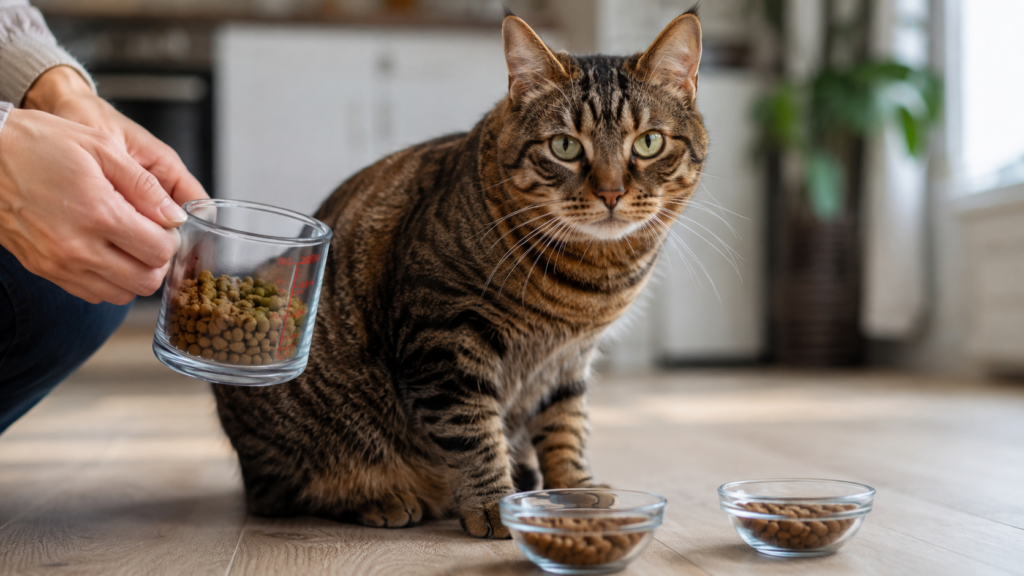
Feeding a cat sounds simple until you are standing in the kitchen wondering whether two meals is enough, whether the dry bowl should stay out all day, or whether your cat is truly hungry every time they stare at you near the food cabinet.
The practical answer is this: most healthy adult cats do well with two measured meals a day. Some cats do better with three or four smaller measured meals, especially if they eat too fast, beg between meals, or do not handle large meals well. Once-a-day feeding may work for some healthy adult cats, but it is not the best fit for every household or every cat.
For me, the safer way to think about it is not “How many times should food appear?” but “Can my cat eat enough, stay at a healthy weight, and show a normal appetite pattern I can actually monitor?” That last part matters. A feeding schedule is not only about convenience. It can help you notice when your cat suddenly eats less, eats more, vomits, loses weight, or starts acting differently around food.
The best feeding frequency for most adult cats
Most healthy adult cats can be fed once or twice a day, but twice a day is usually the most practical default.
Two meals, often morning and evening, are simple to manage and easier to track than constant grazing. You can see whether your cat finished breakfast, left dinner untouched, or suddenly started acting unusually hungry. That pattern is harder to spot when food is always sitting in the bowl.
Some cats are fine with two meals. Others do better when the same daily food amount is split into three or four smaller meals. This can help if your cat tends to gulp food, seems uncomfortable with large meals, begs intensely between meals, or does better with a small meal later in the evening.
The important word is “same.” More meals should not mean more total food. If your cat eats four times a day, those meals should usually come from the same measured daily amount, divided into smaller portions.
A simple feeding schedule by life stage
Kittens usually need to eat more often than adult cats. They are growing, they have smaller stomachs, and they need more food relative to their body size. Many kittens need three or more meals a day, especially when they are young.
A practical pattern is three meals a day for kittens until around six months, then two meals a day from about six months to one year. After one year, many cats can move to an adult schedule of once or twice daily, though two measured meals are often easier for owners to manage.
Senior cats do not automatically need a special feeding frequency just because they are older. Some older cats stay on the same schedule for years. What matters more is whether they are maintaining weight, eating comfortably, drinking normally, and acting like themselves.
I’d be more cautious with a senior cat that suddenly eats less, loses weight, drops food, avoids dry food, drinks much more, or seems hungry all the time. Those are not problems to solve only by changing the number of meals.
Is it okay to feed a cat once a day?
Once-a-day feeding can be acceptable for some healthy adult cats, but I would not treat it as the easiest recommendation for most owners.
There is research suggesting that some healthy indoor cats may show stronger satiety signals after one larger daily meal compared with several smaller meals. Satiety means the body’s feeling of fullness. That does not prove every cat should eat once a day, and it does not erase the practical downsides.
One large daily meal can be less forgiving. If your cat vomits when their stomach is empty, eats too quickly, needs medication with food, has diabetes, has kidney disease, or is already difficult to monitor, once-a-day feeding may not be the safest fit.
There is also the owner side. With two meals, you get two clear chances to notice appetite changes. With one meal, a missed meal may mean your cat has gone a long time without food before you realize something is wrong.
Why many cats prefer smaller meals
Cats are often described as natural small-meal eaters, and there is a reason for that. Their natural feeding pattern is closer to hunting and eating small amounts throughout the day, not standing at one bowl for one large meal.
That does not mean you need to feed your cat ten times a day by hand. It also does not mean a constantly filled dry bowl is automatically natural. A bowl that refills all day is not the same as hunting, searching, or working for food.
A better compromise is to split your cat’s measured daily food into smaller feeding opportunities. This might mean breakfast, dinner, and a small bedtime portion. It might mean two wet food meals plus a measured amount of dry food in a puzzle feeder. It might mean an automatic feeder if your schedule keeps you away during the day.
The goal is not to make feeding complicated. The goal is to give your cat a routine that fits their body, their behavior, and your ability to keep portions under control.
Free-feeding is not the same as measured feeding
Free-feeding means leaving food available for your cat to eat whenever they want. This usually happens with dry food because it can sit out longer than wet food.
Some cats can handle this if the daily portion is measured and the bowl is not constantly topped up. Many cats cannot. The problem is that free-feeding makes it easy for a cat to eat more calories than they need, especially with calorie-dense dry food.
This is where many owners get caught. The bowl looks small, so it feels harmless. But if the food is always available, it becomes difficult to know how much your cat actually ate. In a multi-cat home, it becomes even harder because one cat may eat more while another gets less.
If you free-feed dry food, I would still measure the full daily amount. Put out only that amount for the day and check what is left. If the bowl is empty by noon and your cat is gaining weight, the feeding system probably is not working.
Wet food, dry food, and meal timing
Wet food works better as a scheduled meal because it should not sit out all day. It has a high moisture content, which can be useful for cats that need more water in their diet, but leftovers need proper handling. Uneaten wet food should be refrigerated or thrown away according to food safety guidance, and bowls should be cleaned after use.
Dry food is easier to use for timed feeders, puzzle feeders, or small portions placed around the home. That convenience can be helpful, but it also makes overfeeding easier if the amount is not measured.
Mixed feeding can work well when it is planned. For example, your cat might have wet food at breakfast and dinner, with a small measured dry portion in a puzzle feeder during the day. The mistake is feeding a full wet food amount and then also leaving an unlimited dry bowl available.
The format matters less than the total intake, appetite pattern, and whether the schedule helps you notice changes.
Feeding frequency in a multi-cat home
In a multi-cat home, the best feeding schedule is the one that lets each cat eat their own food without pressure.
Cats may eat near each other because they have no other choice, not because they are comfortable. One cat may rush, guard the bowl, or steal food. Another may quietly avoid eating until the room is calm. From the owner’s view, it can look like everyone ate normally, even when one cat is overeating and another is missing meals.
Scheduled meals can make this easier to manage because you can watch who eats what. Some homes need separate rooms, different feeding stations, raised feeding spots, or microchip feeders. The right setup depends on the cats.
I would not judge a multi-cat feeding routine only by the clock. I’d look at whether each cat can approach food calmly, eat at a normal pace, and leave without being chased, blocked, or crowded.
Indoor cats may need feeding enrichment, not just more food
Indoor cats can become very focused on food because food is one of the few predictable events in the day. That does not always mean they are underfed.
A bored indoor cat may beg because the routine is rewarding. A cat may also learn that meowing near the kitchen gets attention. In that situation, adding more food can quietly turn into weight gain.
Feeding enrichment can help without increasing calories. Puzzle feeders, slow feeders, hidden dry-food portions, and timed feeders can make meals last longer and give the cat something to do. For some cats, a short play session before a meal also fits their natural pattern better than simply filling the bowl.
This should still be gentle. A puzzle feeder should not be so difficult that the cat gives up or becomes frustrated. For older cats, anxious cats, or cats with mobility issues, the food still needs to be easy to reach.
What if your cat acts hungry all the time?
A cat that begs between meals may be hungry, but begging does not always mean the cat needs more food.
Some cats beg because they are used to getting snacks. Some beg because their meals are too far apart for their comfort. Some are bored. Some compete with other cats. Some may have a medical issue affecting appetite, weight, thirst, or digestion.
Start with the basics. Is your cat’s daily food measured? Is your cat gaining, losing, or maintaining weight? Are treats counted as part of the day’s intake? Does your cat eat calmly, or do they gulp and then beg again? Is another cat interfering?
If your cat is at a healthy weight but seems restless between meals, splitting the same daily amount into smaller portions may help. If your cat is losing weight while eating more, drinking more, vomiting, or acting unlike themselves, that is not a training problem or a schedule problem. That is a reason to call your veterinarian.
When feeding less can be risky
If your cat is overweight, it may be tempting to simply cut food sharply or skip meals. I would not do that.
Cats, especially overweight cats, can be at risk if they stop eating or lose weight too quickly. A serious liver condition called hepatic lipidosis can occur when a cat goes without enough food, and overweight cats are at higher risk.
Weight loss for cats should be gradual and planned with a veterinarian. Meal frequency can be part of that plan, but the plan should focus on safe calories, body condition, food type, and steady monitoring.
This is one of those areas where “just feed less” sounds simple but can be unsafe. A measured routine is good. Sudden restriction is different.
When to contact a veterinarian about eating changes
Contact a veterinarian if your cat suddenly refuses food, eats much less than usual, or has a major appetite change that does not fit their normal pattern.
A cat skipping food for more than a day should not be brushed off. It is also more concerning if the cat is overweight, very young, elderly, diabetic, already ill, vomiting repeatedly, weak, hiding, losing weight, drooling, or drinking and urinating much more than usual.
Vomiting matters too. Some cats vomit yellow fluid when their stomach has been empty for a long time, and a different feeding schedule may help some of them. But repeated vomiting, vomiting with weakness, appetite loss, weight loss, or clear discomfort needs veterinary attention. Do not assume it is only empty-stomach vomiting.
For me, the line is simple: if the feeding pattern changes suddenly, or if your cat seems unwell along with the appetite change, I would stop adjusting the schedule and call a vet.
Medical conditions can change the schedule
Some cats need a feeding schedule that matches their medical care. Diabetes is one example. Many diabetic cats are fed around insulin times, but feeding frequency and timing should be guided by the veterinarian managing that cat.
Kidney disease, dental disease, urinary issues, digestive problems, obesity, prescription diets, and medication schedules can also affect how often a cat should eat. A cat with mouth pain may struggle with dry food. A cat with kidney disease may need a specific diet. A cat on wet food may need smaller scheduled servings because wet food cannot sit out all day.
This is why a general article can give a range, but not a personal rule for every cat. A healthy adult cat and a medically managed cat are not the same feeding question.
How to choose a routine that works
A good feeding routine should be measured, repeatable, and easy to observe.
For many adult cats, that means two meals a day. If your cat struggles with that, split the same daily amount into three or four smaller portions. If your cat grazes, measure the full day’s food instead of filling the bowl whenever it looks low.
Watch the pattern after you change anything. Your cat should be eating consistently, maintaining an appropriate body condition, using the litter box normally, and acting like themselves around food. A little excitement at mealtime is normal. Constant distress, food guarding, sudden appetite changes, or weight changes need a closer look.
Treats count too. If treats, lickable snacks, and table scraps are added on top of regular meals, the actual daily intake can creep up quickly. A small treat routine can be fine, but it should not quietly become an extra meal.
So, how many times a day should your cat eat?
Most healthy adult cats should eat two measured meals a day, or the same daily amount split into three or four smaller meals if that suits them better.
Kittens usually need more frequent meals. Senior cats may stay on an adult schedule unless their health, appetite, weight, or comfort changes. Cats with medical conditions need individual advice from a veterinarian, especially if food timing connects to medication or disease management.
I would use feeding frequency as a tool, not a strict identity. The best routine is the one that keeps your cat nourished, keeps portions controlled, reduces stress around food, and makes appetite changes easy to notice.
If your cat suddenly stops eating, eats much less, eats dramatically more, vomits repeatedly, loses weight, or seems unwell, do not try to fix it only by moving meals around. That is the point where a vet’s guidance matters more than any general feeding schedule.
References
- Cornell Feline Health Center, How Often Should You Feed Your Cat? — Supports adult, kitten, senior, wet food, dry food, and health-condition feeding considerations.
- VCA Animal Hospitals, Feeding Times and Frequency for Cats — Supports practical meal timing, scheduled feeding, appetite monitoring, and feeding frequency options.
- AAFP/FelineVMA Consensus Statement, Feline Feeding Programs — Supports natural feeding behavior, small meals, puzzle feeding, indoor-cat enrichment, and multi-cat feeding station guidance.
- PLOS One, Once-Daily Feeding Study in Indoor Cats — Supports nuance around once-daily versus multiple daily meals in healthy adult cats.
- Cornell Feline Health Center, Obesity — Supports obesity risk, free-feeding concerns, and caution against sudden starvation diets.
- Merck Veterinary Manual, Proper Nutrition for Cats — Supports owner guidance on cat nutrition, feeding routines, and appetite concerns.
- Cornell Feline Health Center, Feline Diabetes — Supports the need for individualized feeding timing in diabetic cats.
- FDA, Safe Handling Tips for Pet Foods and Treats — Supports safe handling and storage of leftover canned or pouched pet food.