Measuring dry cat food should feel simple, but it gets confusing quickly. One bag says one thing, another bag says something different, and your cat may act hungry even after eating what looks like a reasonable amount.
The most useful answer is this: feed by calories first, then convert those calories into the dry food your cat actually eats. A “cup” of dry food is not the same across all brands or recipes because kibble can vary a lot in calorie density.
For a healthy adult cat, the right amount also depends on body size, body condition, age, activity level, whether your cat is neutered, and whether dry food is the whole diet or only part of it. I’d be cautious with any advice that says every cat needs the same fixed amount, like “half a cup a day,” without looking at the food label or the cat in front of you.
The quick answer is to start with calories, not cups
The basic formula is simple:
Your cat’s daily calorie need ÷ calories per cup of dry food = cups of dry food per day
For example, if your cat needs about 250 calories per day and the dry food has 400 calories per cup, the math looks like this:
250 ÷ 400 = 0.625 cup per day
That is a little over half a cup per day. If you feed two meals, each meal would be about 0.31 cup.
But if another dry food has 500 calories per cup, the same cat would need only:
250 ÷ 500 = 0.5 cup per day
That difference matters. Two cats could both be eating “half a cup,” but one may be getting too little, too much, or just enough depending on the food.
For many healthy adult cats around 4 to 5 kg (about 9 to 11 lb), daily calorie needs often fall somewhere around the mid-200 calorie range. A smaller, quiet indoor cat may need less. A bigger, more active cat may need more. Kittens, pregnant cats, nursing cats, and cats with medical conditions should not be fed from a generic adult chart.
Why dry food amounts vary so much
Dry food is calorie-dense because it contains much less moisture than wet food. Dry pet food is usually around 10 to 12% moisture, while canned food is often around 75 to 78% moisture. That means dry food packs more calories into a smaller-looking portion.
This is where many owners get caught. A small scoop of kibble may not look like much in the bowl, especially compared with a serving of wet food. But calorie-wise, that small scoop can be significant.
Different dry foods also have different calorie levels. One formula may have 320 calories per cup. Another may have 450 or 500 calories per cup. Some weight-management foods are designed to be lower in calories per cup, while some rich or energy-dense foods may be much higher.
That is why the feeding guide on the bag is only a starting point. It is based on an average cat, not necessarily your cat. If your cat is neutered, indoors, older, less active, or already gaining weight, the label amount may be more than they need.
How to find the right dry food amount for your cat
Start by checking the calorie statement on the food label. Look for something like “kcal/cup” or “calories per cup.” Pet food labels may also list calories per kilogram, but the cup number is usually easier for daily feeding.
Next, estimate your cat’s daily calorie need. For a healthy adult cat, veterinary calorie charts can give a starting range based on body weight. A cat around 8.8 lb may need roughly 225 to 250 calories per day. A cat around 9.9 lb may need roughly 240 to 270 calories per day. A cat around 11 lb may need roughly 250 to 290 calories per day.
Those numbers are not a promise. They are a starting place.
Once you have a calorie target, divide it by the dry food’s calories per cup. Then decide how to split that amount through the day.
Here is a simple example using dry food at 400 calories per cup:
| Estimated daily calories | Dry food calories | Approximate dry food per day |
|---|---|---|
| 200 calories | 400 kcal/cup | 1/2 cup |
| 250 calories | 400 kcal/cup | 5/8 cup |
| 300 calories | 400 kcal/cup | 3/4 cup |
If your cat also eats wet food, treats, toppers, or table scraps, do not use the full dry-food amount. Those calories count too.
Measure the food more carefully than you think you need to
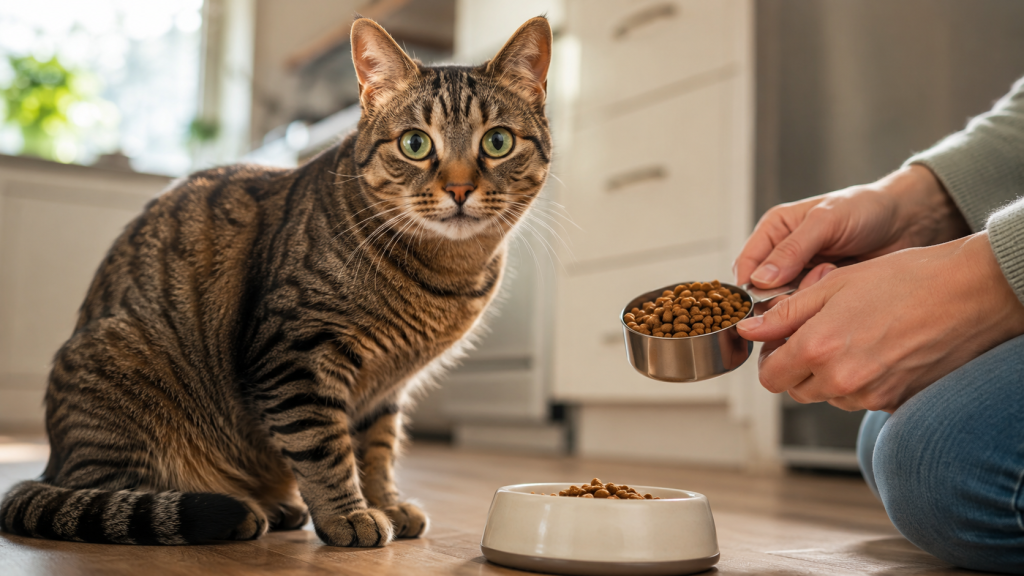
Cups are convenient, but they are not very precise. A rounded scoop, a heaping scoop, and a loosely filled scoop can all look close enough in the moment, but the difference adds up over weeks.
For me, the safer way to think about dry food is this: use cups to understand the portion, but use grams when accuracy matters.
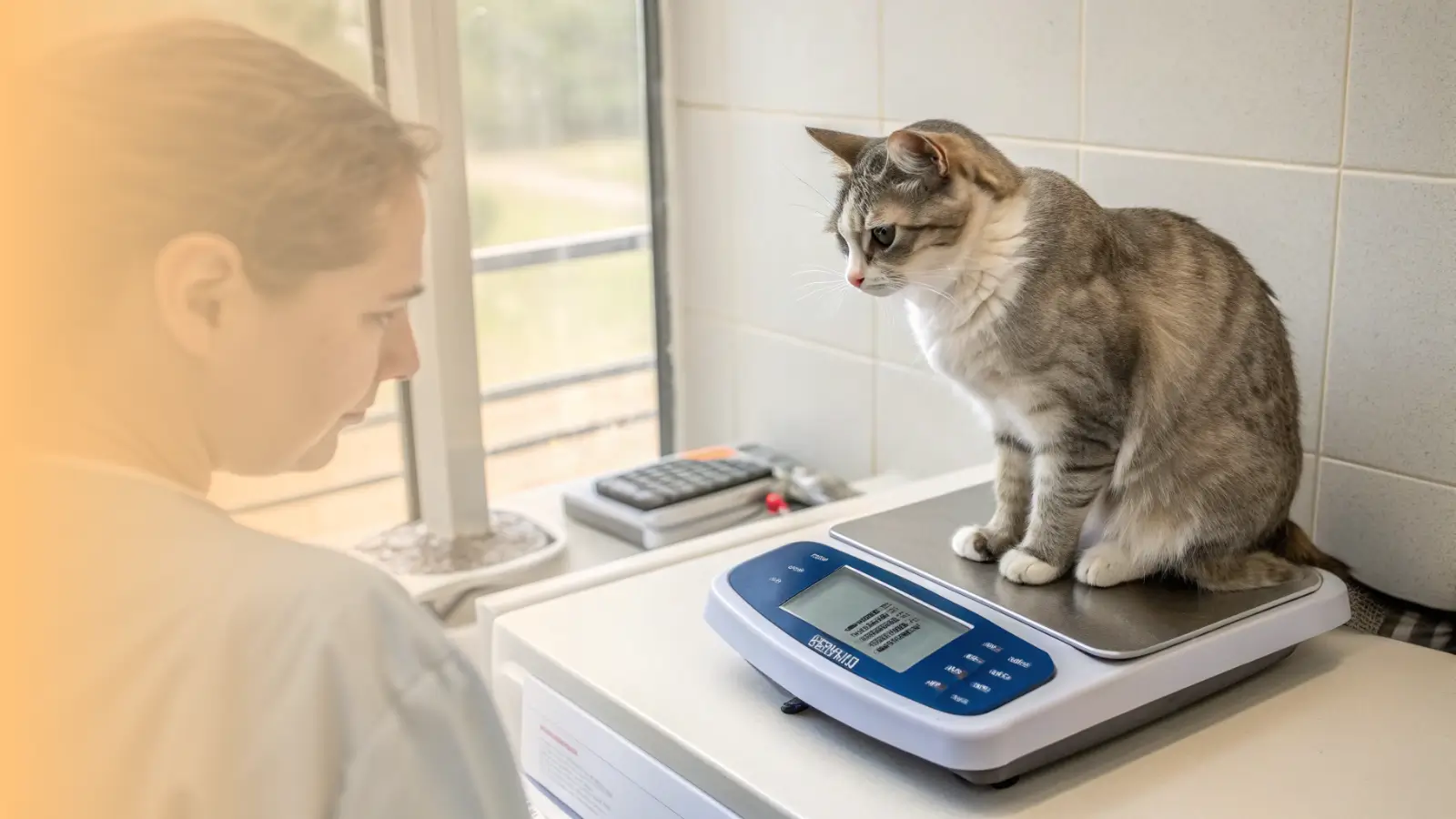
A kitchen scale is especially useful if your cat is overweight, small, on a strict calorie target, or in a multi-cat home where small mistakes are easy to miss. If the food bag or manufacturer provides both calories per cup and weight per cup, you can convert the daily portion into grams and measure it the same way each day.
This does not need to become obsessive. But if a cat keeps gaining weight even though you are “feeding the recommended amount,” measuring by weight is one of the first things I’d tighten up.
Should cats eat once, twice, or several times a day?
Most cats do better with more than one feeding opportunity per day. Feeding frequency and total food amount are separate issues.
You can feed the same daily dry-food portion in two meals, three meals, or several smaller meals. The important part is that all of those meals come from the same measured daily amount.
Some cats enjoy nibbling through the day, and some owners use dry food because it is easier to leave out than wet food. That can work for certain cats, but “available all day” should not mean “refilled all day.” If the bowl is always topped up, you may have no real idea how much your cat is eating.
A measured daily portion can be placed in a bowl, split into meals, or used partly in puzzle feeders. What matters is that the total amount is controlled.
Free-feeding dry food
Free-feeding means leaving dry food available so your cat can eat whenever they want. Some cats self-regulate fairly well. Others do not.
Free-feeding can backfire when a cat is bored, sedentary, neutered, or highly food-motivated. It can also hide changes in appetite because you may not notice whether your cat is eating less than usual until the bowl pattern changes a lot.
In a single-cat home, measured free-feeding may be reasonable if your cat maintains an ideal body condition and does not overeat. In that setup, you still measure the full daily amount once, then let your cat eat from that portion.
In a multi-cat home, free-feeding is trickier. One cat may eat more than their share while another eats less. If one cat is gaining weight and another seems thinner, shared dry food bowls are often part of the confusion. Separate feeding areas, supervised meals, timed feeders, or microchip feeders can make each cat’s actual intake easier to manage.
What if your cat acts hungry?
A cat acting hungry does not always mean they need more dry food. That is one of the hardest parts of feeding.
Some cats beg because they like the food, because they have learned that asking works, or because food has become part of their routine for attention. Some cats also seem hungrier when meals are reduced too suddenly or when their daily food is delivered in one or two small-looking portions.
Before adding more food, look at the bigger picture. Is your cat maintaining a healthy weight? Can you feel their ribs with light pressure? Do they have a visible waist from above? Has their weight changed recently?
If your cat is losing weight, suddenly ravenous, eating less, vomiting repeatedly, drinking more, or behaving differently, that is not a simple portion-size problem. This is where I’d stop guessing and call a veterinarian.
Treats, toppers, and wet food count too
Treats should be part of the daily calorie budget, not extra food floating outside the plan. A common guideline is to keep treats at no more than 10% of daily calories.
For a cat eating 250 calories per day, that means treats should stay around 25 calories or less. The main food should make up the rest.
This matters with dry food because owners often use kibble as a treat, add a few extra pieces after meals, fill puzzle toys, or give “just a small handful” without counting it. Those small extras can turn a good feeding plan into slow overfeeding.
Mixed feeding needs the same math. If your cat eats wet and dry food, decide how many calories will come from wet food first, then use dry food to fill the remaining calorie target.
For example, if your cat’s daily target is 250 calories and their wet food provides 150 calories, the dry food should provide about 100 calories. If the dry food has 400 calories per cup, that is 100 ÷ 400, or 1/4 cup of dry food per day.
Kittens need a different feeding approach
Kittens should not be fed like adult cats. They are growing, so they need more energy and the right nutrient balance for growth.
A kitten should eat food labeled complete and balanced for growth or for all life stages. Adult maintenance food is not the right default for a growing kitten unless your veterinarian specifically recommends it.
Kittens also usually need more frequent meals than adult cats. Their exact dry food amount depends on age, weight, growth rate, and whether they are eating wet food too. The feeding guide on kitten food can be useful as a starting point, but growth and body condition should be monitored.
If a kitten is not eating well, losing weight, or failing to grow as expected, do not solve that by guessing a larger dry-food portion. Kittens can become fragile quickly when they are not getting enough food.
Adult indoor cats often need less than owners expect
Many indoor adult cats need fewer calories than the feeding guide suggests. This is especially true for neutered cats with quiet routines.
Neutering can lower energy needs, and indoor life often means less movement. A cat may still enjoy food, ask for food, and finish every meal, even if their body does not need more calories.
This is why I’d rather adjust by body condition than by appetite alone. If an indoor cat is slowly gaining weight, the dry-food amount may be a bit too high, even if the serving looks normal.
A small reduction can make sense for a healthy overweight-prone cat, but large cuts should be handled carefully. If your cat is already obese, has a medical condition, or needs a proper weight-loss plan, involve a veterinarian.
Senior cats need monitoring, not assumptions
Senior cats can be tricky because age does not point in only one direction. Some older cats gain weight because they move less. Others lose weight or muscle even if they are still eating.
That means “feed less because your cat is old” is too simple. A senior cat’s portion should be based on weight trends, body condition, muscle condition, appetite, and health status.
Watch for changes that do not fit your cat’s normal pattern. Weight loss, increased hunger, poor appetite, repeated vomiting, increased thirst, or visible muscle loss should not be treated as ordinary aging.
For older cats, I’d be more cautious with any sudden feeding change. If their body is changing, it is safer to ask a vet what calorie target and food type make sense.
When dry food portions become a vet question
Dry food amount is usually a home-management question for healthy adult cats. It becomes a veterinary question when appetite, weight, or health changes.
Contact a veterinarian if your cat stops eating properly, eats much less than usual, loses weight quickly, or seems unwell. Cats that go with little or no food for several days are at risk of a serious liver condition called hepatic lipidosis, especially if they were overweight before.
You should also get veterinary advice before putting an obese cat on a strict diet. Cutting regular food too sharply can reduce calories, but it can also reduce essential nutrients. Some cats need a veterinary weight-loss plan or a therapeutic diet designed for calorie control.
Medical conditions can also change the feeding decision. Cats with diabetes, kidney disease, urinary issues, bladder stones, chronic vomiting, diarrhea, dental pain, hyperthyroidism, or other health problems may need a different food type, calorie target, or feeding routine.
Common dry food feeding mistakes
One common mistake is using the feeding chart as a fixed rule. It is a starting point. Your cat’s body condition tells you whether that starting point is working.
Another mistake is measuring with a random scoop. A coffee mug, plastic cup, or heaping scoop can quietly add more food than intended. Use a proper measuring cup or, better, a gram scale.
A third mistake is forgetting the extras. Treats, toppers, wet food, food puzzles, and “just a few kibbles” all count.
In multi-cat homes, the biggest mistake is assuming each cat eats an equal share. They often do not. If one cat is heavier and one cat is thinner, shared dry food access deserves a closer look.
How to adjust the amount safely
After choosing a starting amount, monitor your cat rather than changing food every few days. Weight and body condition change gradually.
A practical approach is to feed the measured amount consistently, then track your cat’s weight and body shape over time. You should be able to feel the ribs with light pressure, but they should not be sharply visible on a healthy adult cat. From above, many cats at a healthy condition have some waist definition, though coat length and body shape can make this harder to judge.
If your cat is gaining weight, the daily calories may be too high. If your cat is losing weight without a clear reason, do not just add food and move on. Weight loss can be a health sign, especially in older cats.
Small adjustments are safer than dramatic cuts. If you are trying to help an overweight cat lose weight, a vet-guided plan is the better route.
The bottom line on how much dry food to feed a cat
The right amount of dry food is the amount that fits your cat’s calorie needs, your specific food’s calorie density, and your cat’s body condition. For many healthy adult cats, the final amount may land somewhere around half to three-quarters of a cup per day, but that is only an example range. The label, the calorie math, and your cat’s condition matter more than a generic cup amount.
Start with calories. Count treats and wet food. Measure the dry food carefully. Then adjust based on weight, body shape, and your veterinarian’s advice when health or weight concerns are involved.
If your cat suddenly eats much less, loses weight, seems unusually hungry, or has a medical condition, do not treat the dry-food portion as a guessing game. That is the point where a vet can give a safer target than any general feeding chart.
References
- WSAVA Calorie Needs for Healthy Adult Cats — Supports adult cat calorie ranges by body weight and the need to adjust for individual body condition.
- AAHA Calorie Calculator for Cats — Supports calorie estimation, life-stage factors, and differences between neutered, intact, inactive, growing, pregnant, and nursing cats.
- AAFCO: Understanding Pet Food Calories — Supports using kcal per cup or kcal per kilogram from the pet food label instead of relying on cup amounts alone.
- FDA: Complete and Balanced Pet Food — Supports complete-and-balanced labeling, life-stage differences, moisture differences between dry and canned food, and dry-matter nutrient comparison.
- Cornell Feline Health Center: How Often Should You Feed Your Cat? — Supports feeding frequency, free-feeding caveats, dry-food access, and water availability for dry-fed cats.
- Pet Nutrition Alliance Calorie Calculator — Supports calorie budgeting, treat limits, and the need for veterinary guidance with obesity or weight-loss plans.
- VCA: Fatty Liver Syndrome in Cats — Supports the warning about cats eating little or nothing for several days and the risk of hepatic lipidosis.
- Tufts Petfoodology: Should You Be Weighing Your Pet’s Food? — Supports weighing pet food for more accurate portion control.