
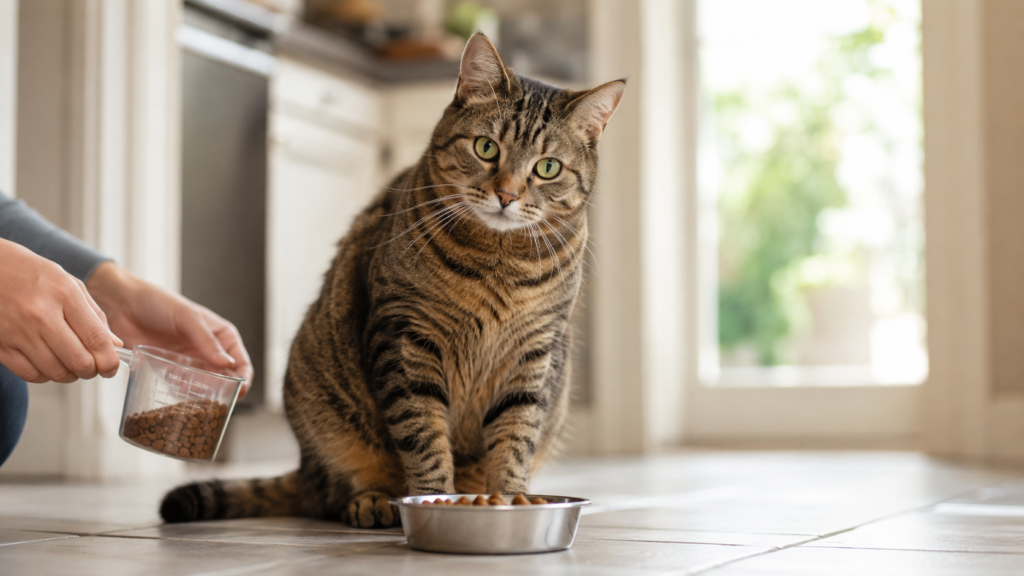
Most adult cats need about 200–300 calories a day, but that range is only a starting point. A small, lean indoor cat may need less. A large, active, intact cat may need more. A kitten, senior cat, overweight cat, or cat with a medical condition should not be fed by a simple average.
For a healthy adult cat at an ideal body condition, veterinary calorie charts often put a typical 9–11 lb cat at around 240–290 calories per day. That does not mean every 10 lb cat should eat the same amount. The right number depends on your cat’s ideal weight, body condition, neuter status, activity level, food type, treats, and weight trend.
For me, the safer way to think about cat calories is this: start with an estimate, measure the food, then watch the cat, not just the chart. If your cat is slowly gaining weight, the calories may be too high. If your cat is losing weight, acting hungry all the time, refusing food, or changing body shape quickly, that is not something to solve by guessing.
Calories are useful because they turn feeding from “a scoop looks about right” into something you can actually check. But they are not a diagnosis, and they are not a replacement for veterinary advice when a cat is underweight, overweight, sick, elderly, or suddenly eating differently.
The quick answer: how many calories does a cat need per day?
A healthy adult cat at an ideal body condition often needs roughly 20–30 calories per pound of body weight per day, but that shortcut is too rough for many cats. Veterinary calorie charts are more useful because they adjust for body size and life stage.
Here is a practical starting range for many healthy adult cats:
| Cat’s weight | Approximate daily calories for many healthy adult cats |
|---|---|
| 8–9 lb | About 225–250 calories |
| 9–10 lb | About 240–270 calories |
| 10–11 lb | About 250–290 calories |
| 12 lb | Often around 280–320 calories, depending on body condition and activity |
Treat these numbers as a starting estimate, not a rule. A neutered indoor cat that spends most of the day sleeping may need fewer calories than an intact or more active cat of the same weight. An overweight cat should usually be fed based on a veterinary weight-loss plan or ideal weight target, not simply their current weight.
The mistake I see in many feeding discussions is that they ask, “How much does the cat weigh?” and stop there. Weight matters, but body condition matters just as much. A muscular 12 lb cat and an overweight 12 lb cat do not have the same calorie needs.
Why there is no perfect calorie number for every cat
Cat calorie needs are usually estimated in two layers. The first is the cat’s basic energy need at rest. Veterinary nutrition resources call this the resting energy requirement, or RER. The second is the cat’s real-life daily need, often called the maintenance energy requirement, or MER.
That second number changes with the cat’s situation. A neutered adult cat generally needs fewer calories than an intact adult cat. A kitten needs more calories for growth. An obesity-prone cat often needs fewer calories than a lean, active cat. This is why two cats with the same weight can need noticeably different portions.
A 10 lb adult cat is a good example. A typical estimate may land around the mid-200 calorie range for a neutered adult cat. But an obesity-prone cat may need closer to the low 200s, while an intact adult cat may need closer to 300 calories. None of those numbers are wrong by themselves. They describe different cats.
This is also why the feeding guide on the bag or can is not always perfect for your cat. It may be a useful starting point, but it cannot know your cat’s body condition, metabolism, activity, treat intake, or whether several people in the house are all handing out extras.
Start with ideal weight, not always current weight
If your cat is already at a healthy body condition, current weight can be a reasonable starting point. If your cat is overweight or underweight, current weight can point you in the wrong direction.
This matters most with overweight cats. A 15 lb cat that should ideally weigh 11 lb should not automatically be fed like a lean 15 lb cat. Feeding based only on current weight can keep the cat stuck above a healthy size.
Body condition score is a better guide than weight alone. Veterinary resources often use a 9-point body condition scale. A score around 4–5 out of 9 is usually considered ideal. A cat above that range may be carrying too much body fat. A cat below that range may be too thin.
You do not need to turn this into a complicated exam at home, but you can look for simple clues. Can you feel the ribs without pressing hard? Is there a visible waist from above? Does the belly area look heavily padded, or does the cat look bony? These signs are not a formal diagnosis, but they can help you decide whether the calorie number deserves a closer look.
I would be especially cautious with an overweight cat that needs to lose weight. Cats should not be crash dieted. A safer plan usually involves a veterinarian, a target weight, accurate measuring, and regular monitoring.
How to use food labels to calculate your cat’s calories
Cat food calories are usually listed as kcal, which means kilocalories. On pet food labels, kcal is the same kind of “calorie” people usually mean when talking about food.
Look for the label section that says Calorie Content. It may list calories in a few ways, such as:
- kcal per cup
- kcal per can
- kcal per pouch
- kcal per kilogram
- kcal per treat
For daily feeding, the most useful number is usually kcal per cup, can, pouch, or treat, because that matches how you actually serve the food.
For example, if your cat’s daily target is 250 calories and the dry food has 400 calories per cup, one full cup would already be too much for the day. Your cat would need closer to ⅝ cup total, before treats or wet food are added.
With canned food, the math works the same way. If one can has 90 calories and your cat’s daily target is 250 calories, two cans would provide 180 calories. The remaining 70 calories could come from another measured portion of food, or from a carefully planned mix of foods.
The key is to count everything together. Dry food, wet food, toppers, dental treats, lickable treats, pill pockets, and table scraps all use part of the same daily calorie budget.
Wet food and dry food can be confusing
Wet food and dry food are not easy to compare by weight because they contain very different amounts of moisture. Canned food is usually much higher in water, while dry food is much more calorie-dense by volume.
This is why “one bowl” of dry food can contain far more calories than it looks like. A small-looking portion of kibble may carry a large share of the day’s calories. Wet food often looks larger on the plate because it contains more water, but the only fair way to compare foods is to check the calories per can, pouch, ounce, gram, or cup.
Do not assume wet food is automatically low-calorie, and do not assume dry food is automatically bad. The practical question is simpler: how many calories does this portion add to my cat’s day?
For cats that seem hungry after small dry portions, wet food can sometimes make meals look and feel more substantial because of its moisture content. But be careful with this point. Changing diet type is still a nutrition decision, especially for cats with medical conditions. If your cat is on a prescription diet or has kidney disease, diabetes, digestive issues, urinary problems, or another diagnosed condition, ask your vet before changing food.
Treats should usually stay under 10% of daily calories
Treats are easy to underestimate because cats are small. A treat that seems tiny to you can be a meaningful chunk of your cat’s daily calories.
A common veterinary nutrition guideline is that about 90% of a cat’s daily calories should come from complete and balanced food, with treats or extras limited to about 10% or less. For a 250-calorie cat, that means treats should usually stay under about 25 calories a day.
That is not much. A few crunchy treats, a lickable treat, or bits of human food can use that up quickly.
The part many owners miss is that treats should be subtracted from the food, not added on top. If your cat should eat 250 calories a day and gets 25 calories in treats, the regular food should provide about 225 calories, not the full 250 plus treats.
This matters even more in multi-person homes. One person may think they gave “just a few.” Another person may do the same later. By the end of the day, the cat has eaten an extra snack-sized meal without anyone meaning to overfeed.
Free feeding makes calorie control harder
Some cats like grazing, and many cats naturally prefer small meals across the day. That does not mean an always-full bowl works well for every cat.
The problem with free feeding is measurement. If a bowl is topped up whenever it looks low, you may not know how many calories your cat actually ate. In a multi-cat home, the problem is even bigger because one cat may eat more than their share while another eats less.
If you free-feed, the more accurate method is to measure or weigh the total food offered for the day, then check what remains. That gives you at least a rough idea of actual intake.
For many indoor cats, scheduled meals make calorie control easier. Meals also help you notice changes sooner. If a cat suddenly stops finishing breakfast, eats much faster than usual, or starts begging constantly, you can spot the pattern more clearly than you would with a bowl that is always available.
I would not frame meal feeding as the only acceptable method for every cat. Some households manage free feeding carefully. But if weight is creeping up, free feeding is one of the first places I would look.
Kittens need more calories than adult cats
Kittens should not be fed like small adult cats. They are growing, and growth uses a lot of energy.
Young kittens need kitten food or food labeled for growth, not just smaller portions of adult maintenance food. Veterinary life-stage guidance notes that kittens can begin weaning onto balanced kitten food at a few weeks of age, and calorie needs are much higher during early growth than later adolescence.
Kittens also have small stomachs, so several small meals are usually more practical than one or two large meals. Many kittens continue eating growth-formulated food until they are close to finished growing, often around 12 months, though individual timing can vary.
The main point is simple: kitten calorie advice should be separate from adult maintenance advice. A kitten that seems constantly hungry may simply be growing, but poor growth, weight loss, vomiting, diarrhea, or refusal to eat should not be dismissed as a feeding math problem.
Senior cats do not all need fewer calories
It is too simple to say that older cats always need fewer calories. Some senior cats gain weight as activity drops. Others lose weight and muscle as they age.
Veterinary sources note that calorie needs may decrease at first in mature adult years, then increase in some older cats, especially around the geriatric stage. Some older cats have more difficulty digesting and using nutrients. Research following cats over time has also found that cats may gain body condition up to around 10 years, then become more likely to lose weight and muscle as they get older.
This is where body condition and muscle condition both matter. Body condition is about fat. Muscle condition is about muscle. A senior cat can lose muscle even if they still have some belly fat, so the scale alone may not tell the full story.
If an older cat is getting thinner, losing muscle along the spine or hips, eating less, eating more but losing weight, or changing thirst and litter box habits, I would stop guessing and call a vet. Senior weight change often deserves a medical check.
How fast should an overweight cat lose weight?
An overweight cat should lose weight slowly and with monitoring. Veterinary nutrition resources commonly describe a safe feline weight-loss pace as about 0.5–1% of body weight per week.
That is slower than many owners expect. But slow matters for cats.
Cats, especially overweight cats, can be at risk if they stop eating or lose weight too quickly. One serious concern is hepatic lipidosis, a liver condition that can happen after anorexia or a major drop in food intake. In simple terms, when a cat is not taking in enough energy, the body mobilizes fat, and too much fat can build up in the liver.
This is why “just feed less” can be unsafe if it turns into severe restriction. It is also why a cat who refuses food should not be left to “get hungry enough.”
If your cat has a high body condition score, has a lot of weight to lose, or has any known medical issue, a veterinarian can help set a calorie target and choose a diet that still provides enough nutrients while reducing calories.
When calorie questions should become a vet question
Some feeding questions are normal. It is reasonable to wonder whether your cat should eat 220 or 260 calories, or how to split wet and dry food across meals.
Other signs should move the issue out of simple calorie math.
Contact a veterinarian if your cat suddenly will not eat, eats much less than usual, loses weight without trying, seems hungry all the time but gets thinner, vomits repeatedly, has diarrhea, drinks or urinates more than usual, becomes weak, hides more than usual, or has a sudden major behavior change.
A mature cat that does not eat for about 24 hours should be taken seriously. For very young kittens, even shorter periods without food can be dangerous.
Weight loss with a strong appetite is another sign that deserves attention. One possible medical cause is hyperthyroidism, which commonly causes weight loss with increased appetite, increased thirst, and increased urination in cats. That does not mean every hungry, thin cat has hyperthyroidism. It does mean extra food may not fix the real problem.
Common calorie mistakes cat owners make
The first mistake is using the feeding guide as a fixed rule. Feeding guides are starting points. Your cat’s body condition and weight trend tell you whether the amount is working.
The second mistake is measuring with a random scoop. A “scoop” can quietly become larger over time. If you feed dry food, use a proper measuring cup or, better, a kitchen scale if you want more accuracy.
The third mistake is forgetting treats. Treats, lickable snacks, pill pockets, table scraps, and food used for training all count.
The fourth mistake is feeding an overweight cat based only on current weight. If the current weight is not the healthy target, the calorie number can be too high.
The fifth mistake is cutting calories too sharply. Cats need steady nutrition, and rapid restriction can be risky. Weight loss should be planned, measured, and slow.
The sixth mistake is missing medical changes. A cat that suddenly eats less, eats more but loses weight, or changes body shape may need a vet, not a new calculator.
A simple way to estimate your cat’s daily calories
For a healthy adult cat, start with a veterinary calorie chart or calculator that considers body weight, body condition, and neuter status. Use the result as an estimate.
Then check your cat food label. Find the calories per cup, can, pouch, or gram. Decide how much of the daily calorie target will come from regular food, and keep treats under 10% of the total.
After that, watch your cat over time. Weigh your cat regularly if you can do it safely and calmly. Look at body shape. Feel for ribs. Notice whether your cat is leaving food, begging constantly, gaining weight, or losing weight.
For a healthy adult cat, a small adjustment may be reasonable if the trend is mild and gradual. For kittens, seniors, overweight cats, underweight cats, cats with chronic disease, or cats with sudden appetite or weight changes, it is safer to involve your veterinarian.
Calories should make feeding clearer, not more stressful. The goal is not to hit a perfect number forever. The goal is to feed a measured amount that keeps your cat lean, nourished, and stable.
Conclusion
Most healthy adult cats eat somewhere around 200–300 calories per day, with many average-sized cats falling near the middle of that range. But the right number depends on the cat in front of you: body condition, ideal weight, age, neuter status, activity, food calories, treats, and health status.
Use calorie charts and labels as tools, not as final answers. Measure the food, count treats, and watch your cat’s body condition and weight trend.
If your cat is overweight, underweight, suddenly not eating, losing weight despite eating, or changing appetite in a noticeable way, do not try to solve it with calorie math alone. That is where a veterinarian can help you avoid unsafe restriction and check for medical problems that are not visible from the food bowl.
References
- WSAVA Calorie Needs for Healthy Adult Cats — Supports adult cat calorie ranges and the idea that calorie needs vary by individual cat.
- MSD Veterinary Manual: Daily Maintenance Energy Requirements for Dogs and Cats — Supports RER and MER concepts, including different multipliers for neutered, intact, obesity-prone, and growing cats.
- Pet Nutrition Alliance Calorie Calculator — Supports using body condition, ideal weight, treat calories, and veterinary guidance for overweight cats.
- Cornell Feline Health Center: Obesity — Supports body condition scoring and obesity context in cats.
- AAFCO: Calories in Pet Food — Supports how pet food calories are labeled and why kcal per serving matters.
- FDA: Complete and Balanced Pet Food — Supports the importance of complete and balanced nutrition.
- VCA: Nutrition, Feeding Guidelines for Cats — Supports practical feeding guidance, grazing behavior, and measuring intake.
- Cornell Feline Health Center: Anorexia — Supports warning signs around appetite loss and when not eating becomes concerning.