Brushing a cat’s teeth sounds simple until you picture the actual cat.
Many owners want to do the right thing, but the practical worries are real. What if your cat hates it? What if you hurt their gums? What if they bite? And if your cat already has bad breath or brown buildup on the teeth, is brushing enough?
The short answer is this: brushing your cat’s teeth can help control plaque before it hardens into tartar, but it works best as gentle preventive care. It is not a substitute for a veterinary dental exam if your cat already has red gums, obvious pain, loose teeth, heavy tartar, bad breath, drooling, or changes in eating.
The safest way to brush cats’ teeth is to use cat-safe toothpaste, introduce it slowly, keep the mouth mostly closed, lift the lips gently, and brush the outside gumline with a soft brush or gauze. The goal is not a perfect human-style brushing session. The goal is regular, low-stress plaque removal that your cat can learn to tolerate.
Why Brushing Your Cat’s Teeth Matters
Cats can develop dental disease even when they seem normal at home. That is one reason dental care feels confusing for owners. A cat may still eat, play, and act mostly like themselves while their mouth is uncomfortable.
Dental disease is common in cats, especially as they get older. Veterinary sources report that many cats over four years old have some form of dental disease, including gingivitis, periodontitis, or tooth resorption. Gingivitis means inflamed gums. Periodontitis is deeper disease around the structures that support the tooth. Tooth resorption is a painful condition where the tooth structure breaks down.
Brushing mainly helps with plaque. Plaque is a soft bacterial film that collects on the teeth, especially near the gumline. If it sits there too long, it can harden into tartar. Once plaque has hardened, a toothbrush cannot remove it properly.
That is the main reason daily brushing is recommended. It is not because your cat’s mouth needs to smell minty. It is because brushing works best before buildup becomes hardened and before gum inflammation progresses.
I would think of brushing as maintenance, not repair. If the teeth look fairly clean and the gums look calm, brushing can help keep things that way. If your cat’s mouth already looks sore or dirty, brushing may still be part of future care, but the first step is usually a vet check.
Before You Start, Check Whether Brushing Is Safe
Do not start by forcing a toothbrush into your cat’s mouth. First, look for signs that brushing may be painful or that your cat needs veterinary attention.
Healthy-looking gums are usually light pink, not angry red or swollen. Teeth should not have heavy grey-brown buildup. Your cat’s breath should not smell strongly rotten or foul. Mild cat breath is one thing. A strong bad smell from the mouth is different.
Be more cautious if you notice red or bleeding gums, drooling, food dropping from the mouth, chewing on one side, pawing at the face, head tilting while eating, loose or broken teeth, facial swelling, abnormal discharge, or a sudden refusal to eat. Those are not brushing problems. Those are reasons to call your veterinarian.
This is where I would stop guessing. If a cat reacts sharply when you touch one side of the mouth, or if brushing suddenly becomes impossible after being tolerated before, pain should be considered. That does not mean you can diagnose the exact problem at home, but it does mean the mouth deserves proper veterinary assessment.
Brushing sore gums can make the cat more defensive and can teach them that mouth handling is scary. That makes future dental care harder. It is better to pause and get the mouth checked than to push through a painful session.
What You Need to Brush a Cat’s Teeth
You only need a few basic supplies: cat-safe toothpaste, a soft cat toothbrush or finger brush, and a reward your cat likes. Some cats may do better at first with gauze, a soft cloth, or dental wipes instead of a toothbrush.
Use toothpaste made for cats or veterinary use. Do not use human toothpaste. Human toothpaste is not meant to be swallowed by cats and may contain ingredients that can irritate the stomach or create other safety concerns. Baking soda is also not a good substitute because it can upset the stomach’s acid balance.
Cat toothpaste is usually flavored to make the process easier. The flavor matters more than owners expect. If your cat likes the toothpaste, the whole routine becomes less like restraint and more like training.
The toothbrush should be small and soft. A large brush makes the process clumsy and can bump the gums. In a multi-cat home, use a separate toothbrush for each cat and replace brushes regularly. It is basic hygiene, and it also keeps each cat’s routine consistent.
If your cat refuses the brush, do not treat that as failure. Some cats are more willing to accept a piece of gauze or a dental wipe on your finger. Mechanical wiping still helps disturb plaque, especially while you are training toward brushing.
How to Introduce Tooth Brushing Slowly
Start before the toothbrush ever touches the teeth. Let your cat smell and taste a tiny amount of cat toothpaste. You can put a little on your finger or on the brush and let them investigate it on their own.
The first goal is simple: your cat learns that the toothpaste predicts something safe, maybe even pleasant. Do this in a calm place, not when the house is noisy or your cat is already irritated.
Next, gently touch around the lips and cheeks. You are not trying to open the mouth yet. You are teaching your cat that brief mouth handling is not a threat. Keep the session short, then reward your cat.
Once your cat accepts that, lift the lip slightly and touch a small amount of toothpaste to a visible tooth, often one of the canine teeth near the front. Stop there if that is all your cat can handle. A two-second calm interaction is more useful than a 30-second fight.
Over time, introduce the brush or gauze. Let your cat lick toothpaste from it first. Then try one or two gentle touches along the outside of the teeth. Build slowly.
Some cats move through these steps in days. Some take weeks. Some never fully accept a brush but may tolerate wipes. That difference matters. A calm routine your cat will repeat is more valuable than an ideal routine that collapses after one stressful attempt.
How to Brush Your Cat’s Teeth
When your cat is ready, sit somewhere quiet and stable. Many cats do best when they are facing away from you, either on your lap or on a safe surface. This position can feel less confrontational than approaching straight from the front.
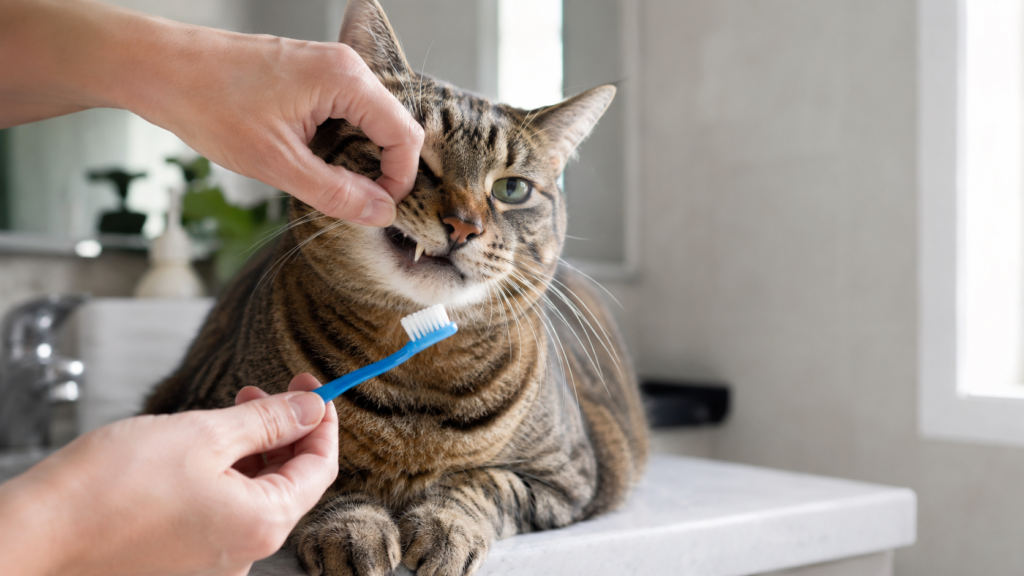
You do not need to pry your cat’s mouth open. Keep the mouth mostly closed and gently lift the lips. The teeth you are trying to reach first are the outside surfaces, especially the gumline.
Angle the toothbrush toward the gumline, around 45 degrees if you can manage it. Use small, gentle circular motions. Focus on the outer surfaces of the teeth, especially the cheek teeth and canine teeth. These areas tend to collect plaque and tartar more quickly.
Do not worry about brushing the inside surfaces at first. Veterinary guidance commonly emphasizes that the outside surfaces are the practical priority for most cats. Your cat’s tongue helps clean the inner surfaces, and trying to brush the inside can make the routine much harder than it needs to be.
Keep the session short. At the beginning, brushing one or two teeth may be enough. Later, you can work toward brushing each side for a short period. Some guidance suggests building toward about 30 seconds per side, while other practical resources describe a full-mouth routine taking a couple of minutes once the cat accepts it.
End with a reward, even if the session was tiny. The reward is not just a treat. It is part of the training. It tells your cat that cooperation has a predictable payoff.
How Often Should You Brush a Cat’s Teeth?
Daily brushing is the best target because plaque can harden into tartar within a few days. If daily brushing is not realistic yet, brushing several times a week is still more useful than doing nothing.
A practical minimum often suggested is around three times per week to help control plaque and tartar buildup. Daily or every-other-day brushing is better if your cat will allow it.
The important point is consistency. Brushing once intensely after weeks of no care is not the same as gentle, regular plaque removal. I would rather see an owner brush calmly for 20 seconds most days than wrestle the cat once a week for a perfect session.
If you miss a day, just restart. Do not turn brushing into a stressful all-or-nothing routine. Cats often respond better when the pattern is predictable and low pressure.
What If Your Cat Hates Tooth Brushing?
If your cat hates tooth brushing, step back to an easier stage. That may mean going back to toothpaste tasting, lip touching, or simply rewarding calm mouth handling.
Resistance can look like turning away, ducking the head, leaving, pushing with the paws, or clamping the mouth shut. Those are signs to slow down, not signs to hold the cat harder.
Do not force the brush into the mouth. Force may work once, but it often makes the next session worse. It can also increase the risk of scratches, bites, and a cat who hides when the toothbrush appears.
For anxious cats, older cats, or cats with a history of painful dental disease, tooth brushing may not be fully possible at home. That does not mean you are careless. It means the dental plan needs to fit the individual cat.
Ask your vet about safer alternatives if brushing is not working. Gauze, dental wipes, veterinary toothpaste, dental diets, water additives, gels, sprays, or treats may help support oral care, but they are not all equal. Products accepted by the Veterinary Oral Health Council are a better place to look than random dental treats with big claims.
What Brushing Can and Cannot Fix
Brushing can help reduce plaque before it hardens. It can support gum health when the mouth is not already painful. It can also help you notice changes earlier because you are looking at your cat’s mouth more often.
Brushing cannot remove hardened tartar properly. It cannot treat tooth resorption. It cannot fix loose teeth, broken teeth, deep gum disease, oral infection, or pain. It also cannot replace dental X-rays or a veterinary exam under anesthesia when those are needed.
This distinction matters because many owners start searching for tooth brushing only after they notice bad breath or brown buildup. At that point, brushing may be too late as the first step.
Professional dental cleaning is different from brushing. Veterinary dental care can include scaling above and below the gumline, polishing, oral examination, and dental radiographs when needed. Cleaning below the gumline is important because disease can hide where owners cannot see it.
Be careful with anesthesia-free dental cleanings. They may remove visible tartar above the gumline, but they do not allow the same level of examination, X-rays, or cleaning under the gums. They can make teeth look cleaner while leaving deeper disease untreated.
Common Mistakes to Avoid
One common mistake is starting too fast. If the first session involves restraint, mouth opening, and scrubbing, many cats will remember that. Start with taste and touch first.
Another mistake is using the wrong toothpaste. Human toothpaste is not safe for cats, and home substitutes like baking soda are not a good shortcut.
A third mistake is brushing over obvious pain. Red gums, bleeding, drooling, chewing changes, loose teeth, swelling, or strong bad breath should shift the plan from brushing better to calling the vet.
Some owners also overestimate dry food. Ordinary kibble should not be treated as a complete dental care plan. Some dental diets are designed for oral care and may have evidence or VOHC acceptance, but that is different from assuming all dry food cleans teeth.
Scraping tartar at home is another risk. It may seem like a simple cosmetic task, but dental disease often involves the gumline and areas below it. Sharp tools, rough handling, or scraping an awake cat’s teeth can hurt the mouth and make the cat fear future handling.
Kittens, Senior Cats, and Multi-Cat Homes
Kittens are often easier to train because mouth handling can become normal before they develop strong resistance. You can start with very gentle lip touching and toothpaste tasting, then build slowly as they mature.
Adult cats can still learn, but they may need more time. If your cat has never had mouth handling before, do not expect immediate cooperation. Treat it like teaching a new routine, not correcting bad behavior.
Senior cats need extra caution. Older cats are more likely to have dental disease or tooth resorption, and they may already have painful areas in the mouth. If an older cat has visible tartar, bad breath, eating changes, or gum redness, a veterinary check should come before a new brushing routine.
In a multi-cat home, brush cats separately. Use separate toothbrushes, separate rewards, and separate pacing. One cat may accept brushing quickly while another needs weeks of training. Trying to process every cat the same way usually creates stress.
Also pay attention to social pressure. If one cat guards treats or becomes tense around another cat, brushing sessions can become part of that tension. Quiet, individual sessions are usually safer.
When to Contact a Veterinarian
Contact your veterinarian if your cat has bad breath that seems strong or foul, red or bleeding gums, heavy tartar, loose or broken teeth, drooling, facial swelling, pawing at the mouth, food dropping, chewing on one side, reduced appetite, sudden texture preference changes, or any sign that touching the mouth hurts.
You should also ask your vet before starting if your cat is older and has never had dental care, or if you already suspect mouth pain. A normal appetite does not always mean the mouth is healthy. Cats can keep eating despite dental discomfort.
If your cat suddenly stops eating, seems severely painful, has swelling around the face or mouth, or shows a major sudden behavior change, treat that as more urgent. Home brushing is not the right tool in that moment.
For me, the safer rule is simple: brushing is for a mouth that can tolerate gentle handling. If the mouth looks painful, smells abnormal, bleeds, or changes how your cat eats, get veterinary help before trying to clean it yourself.
Final Thoughts
Brushing cats’ teeth works best when it is slow, gentle, and realistic. Use cat-safe toothpaste, focus on the outside gumline, keep the mouth mostly closed, reward cooperation, and build the routine in small steps.
Do not judge the routine by day one. A cat who only licks toothpaste today may accept lip lifting next week and a few brush strokes later. That is still progress.
But do not use brushing to avoid dental care when something looks wrong. If your cat has bad breath, red gums, heavy buildup, mouth pain, eating changes, or loose or broken teeth, a vet visit is the safer next step. Brushing is useful home care, but it is not a treatment for painful dental disease.
References
- Cornell Feline Health Center: Feline Dental Disease — Supports dental disease prevalence, plaque and tartar explanation, brushing technique, and warning signs.
- Cornell Feline Health Center: Tooth Resorption — Supports the discussion of tooth resorption as a common and painful feline dental condition.
- Merck Veterinary Manual: Dental Disorders of Cats — Supports daily brushing, plaque hardening into calculus, and home wiping as a possible aid.
- VCA Hospitals: Brushing Teeth in Cats — Supports practical brushing steps, toothpaste safety, frequency, technique, and multi-cat toothbrush hygiene.
- Blue Cross: Cat Dental Care — Supports owner-facing guidance on when brushing may be appropriate, signs of dental problems, and the limits of brushing tolerance.
- AAHA Dental Care Guidelines for Dogs and Cats — Supports the distinction between home brushing, professional dental cleaning, anesthesia, and cleaning below the gumline.
- Veterinary Oral Health Council Accepted Products — Supports cautious discussion of dental products that may help with plaque or tartar control.